How to Clean Wicker, Rattan & Fabric Patio Furniture
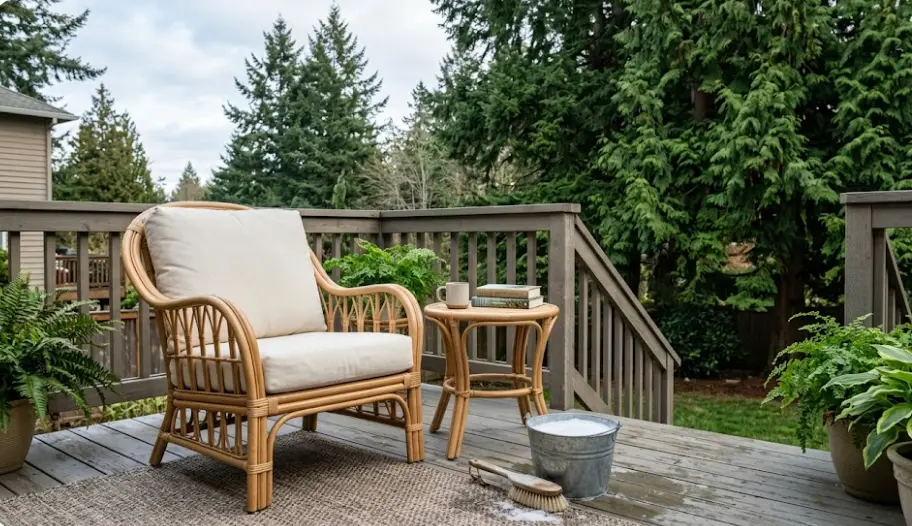
Three types of outdoor furniture get grouped together at every garden center and on nearly every Seattle patio — wicker frames, rattan pieces, and cushioned fabric seating — and all three get cleaned wrong in the same predictable ways. The wicker gets hosed off when it shouldn't. The rattan gets left to dry in a damp garage. The cushions get stacked wet and pushed into storage, then brought out in spring with mold already working through the core. Most cleaning advice for these materials was written for Arizona or Southern California climates. Seattle and the surrounding area — Bothell, Kirkland, Woodinville, Edmonds — are a fundamentally different situation, and what you're working with materially changes everything before you pick up a brush.
The practical problem starts with terminology. Rattan, wicker, and outdoor fabric all get used as if they mean the same thing. They don't, and the differences between them determine which cleaning methods are appropriate and which will cause damage you won't see for a few months. Getting this distinction right before you start is the step most cleaning guides skip.
Rattan is a specific raw material: the solid inner core of a climbing palm vine that grows in tropical Asia and Africa. Wicker is a weaving technique, not a material — furniture described as wicker may be woven from rattan, but also from willow, reed, rush, bamboo, or plastic. The majority of wicker patio furniture sold at Costco, Home Depot, and mid-range outdoor retailers in the last decade is synthetic resin wicker: HDPE polyethylene woven over an aluminum or steel frame. It looks similar at a glance but behaves almost oppositely when wet.
The quickest way to tell them apart: look at the underside of a strand where it wraps around a frame piece. Natural wicker has visible grain, subtle color variation strand-to-strand, and a slightly fibrous texture under a fingernail. Synthetic wicker is uniformly smooth, slightly glossy, and either consistent in color or has a very subtle repeating pattern. Tap a strand — natural wicker gives a woody sound, synthetic gives a light plastic tap. Most outdoor furniture purchased in the past ten years is synthetic, even when it's labeled "rattan" or "wicker" in the product description.
Cleaning Natural Wicker and Rattan
Natural wicker and rattan need to be treated as materials that genuinely dislike water — not materials that can be sealed against it, but materials that will degrade structurally if moisture is allowed to sit in them. The weave holds together through tension and the moisture balance the fibers had when dried and shaped. Force water in unevenly and you get uneven swelling: some strands tighten, some loosen, and eventually the piece loses the rigidity it was built with. In Seattle, where outdoor relative humidity runs between 75 and 90 percent from October through May, furniture that gets wet and doesn't dry fast will develop mold growth inside the weave structure — not just on the surface where you can see it, but through the core of each strand — before you can address it.
The correct cleaning sequence for natural wicker starts completely dry. Use a soft-bristle brush — a clean painter's brush with natural bristles, a soft toothbrush for tight areas, or a dedicated wicker brush — and work through the weave first to dislodge loose debris, pollen, and anything caught in the gaps. Go with the direction of the weave rather than against it, and take the time to get into corners where the chair legs meet the frame, where debris accumulates and moisture gets trapped. This dry pass is not optional; it determines how much liquid you'll need to use in the next step.
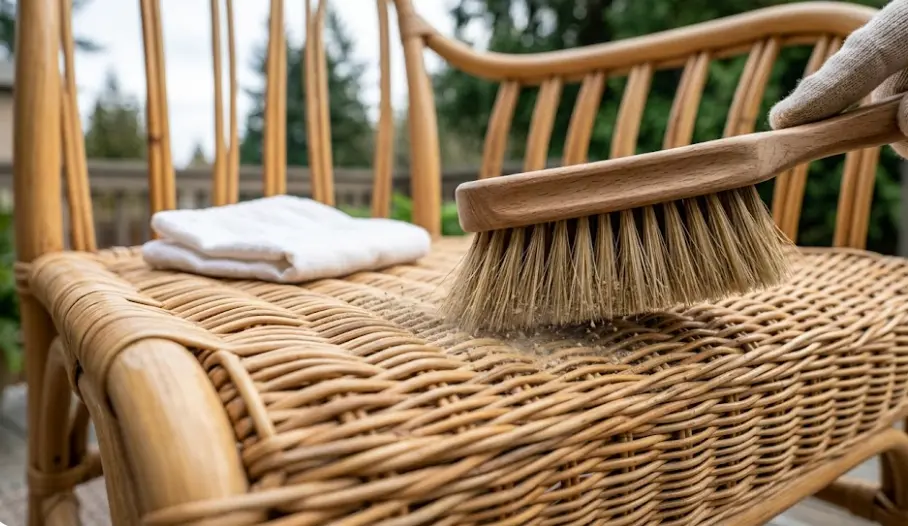
After the dry pass, use a barely damp cloth — not wet, damp — with a diluted Murphy's Oil Soap solution, roughly a teaspoon per cup of water. Murphy's is appropriate here because it's formulated for wood and wood-derived materials, cleans effectively without stripping the natural oils that keep plant fibers from becoming brittle, and leaves no residue that requires rinsing. Wipe each surface and work the cloth lightly into the weave with a finger, but don't saturate. If you're cleaning a full set of chairs and a table, you'll go through several cloths. Refresh the solution when it looks cloudy.
For mold already established on natural wicker, the approach changes. Don't use bleach. Bleach kills mold but also attacks the lignin in natural plant fibers, leaving the weave brittle and pale at the cleaned spots. An enzyme-based cleaner — Bac-Out by Biokleen, available at PCC Natural Markets and many Seattle-area grocery co-ops — works by breaking down the organic material mold feeds on, without attacking the fiber itself. Apply, let it dwell for 15 minutes, brush gently with a soft bristle brush, then remove residue with a barely damp cloth and dry as described above. If the mold on natural rattan shows up as soft patches in the rattan tubes themselves, or if lacquered areas are peeling and the underlying core is discolored or soft to pressure, cleaning the surface won't address what's actually happening structurally. That's a job for someone who can assess the piece in person.
One honest note: natural rattan doesn't belong outside year-round in Seattle's climate. It was designed for covered verandas in climates with low humidity. If you have it on an uncovered deck, you're working against the material. Keeping it under a quality furniture cover during the wet season, or bringing it inside, extends its lifespan significantly more than any cleaning method will.
Cleaning Synthetic Resin Wicker
Synthetic resin wicker is forgiving in ways natural wicker isn't, and cleaning it correctly is mostly about effort rather than technique. The HDPE strands don't absorb water into a fibrous structure. A bucket of warm water and a moderate amount of dish soap — Dawn works fine — applied with a soft scrub brush, followed by a thorough rinse with a garden hose, handles routine maintenance. You can do this on a dry August afternoon in 20 minutes per chair and get good results.
The real concern with synthetic wicker isn't the woven surface — it's the frame underneath. Aluminum frames are corrosion-resistant and typically hold up well for many years. Steel frames, especially on lower-priced furniture, are powder-coated but vulnerable at joints where the coating gets scraped during assembly, shipping, or regular use. In Seattle's wet climate, a small rust spot at a joint in year two becomes a significant structural problem by year five. During any cleaning, after the furniture is rinsed and while it's still wet, inspect every joint point on the frame. Surface rust spotted early can be treated with a rust-converter product and a touch of matching powder-coat spray before it progresses. Ignored, it eventually means replacing the piece.
Algae is the other Seattle-specific issue with synthetic wicker. The green biofilm that coats north-facing surfaces and anything that stays damp is ubiquitous here, and synthetic wicker with a textured weave surface holds algae well. A solution of one part white vinegar to two parts water, applied with a scrub brush, addresses algae without damaging the plastic. Let it sit for five minutes before brushing — the acid needs contact time to work — then rinse. Avoid oxygen-bleach products like OxiClean on colored synthetic wicker; prolonged use can fade the tinted HDPE over time.
Fabric Cushions: Material Type Changes the Approach
The tag sewn into every outdoor cushion cover carries a cleaning code that almost nobody reads. It matters more than any other factor in choosing how to clean the piece. "W" means water-based cleaners only. "S" means solvent-based only — the dry-clean equivalent, no water. "W/S" means either approach. "X" means vacuum and brush only, no liquid cleaning of any kind. Most outdoor cushion covers are W or W/S. If the tag is missing or the code has faded, treating it as a W/S and testing any cleaner on an inconspicuous seam area first is the conservative approach.
Sunbrella is the most common premium outdoor fabric, and it's solution-dyed acrylic — the color is embedded in the fiber rather than applied to the surface. This is why Sunbrella's care instructions explicitly permit diluted bleach for mold removal: one cup of bleach per gallon of water with a small amount of approved dish soap, applied to the fabric, left for 15 minutes, then rinsed thoroughly. This is the exception. Polyester outdoor fabrics, olefin, and most generic outdoor-grade materials should not be treated with bleach, which can strip UV-protective coatings and cause permanent discoloration in ways that look fine immediately but show up clearly within a few weeks.
Mold and algae on cushion fabric are different organisms that need different approaches. Algae — the green coating that forms on surfaces that stay damp — lives on the surface and responds to white vinegar solution or a mild cleaner like Simple Green Outdoor Odor Eliminator applied with a soft brush. Mold — black or gray spotting that appears in seams, stitching, and the fabric weave itself — requires either the diluted bleach approach on Sunbrella, or an enzyme cleaner on other fabric types. Both approaches need adequate dwell time: apply, let it work for 10 to 15 minutes, then scrub gently and rinse. Neither approach addresses mold that has penetrated into the foam insert. If you clean the cover thoroughly and the mold smell persists after the cover has dried, the foam is the source. Foam with significant internal mold should be replaced — it's not cleanable in any practical sense.
| Code | Meaning | Common for |
|---|---|---|
| W | Water-based cleaners only | Most polyester outdoor cushions |
| S | Solvent/dry-clean only | Some indoor-grade fabrics used outdoors |
| W/S | Either approach | Sunbrella, solution-dyed acrylic |
| X | Vacuum and brush only — no liquids | Delicate decorative fabrics |
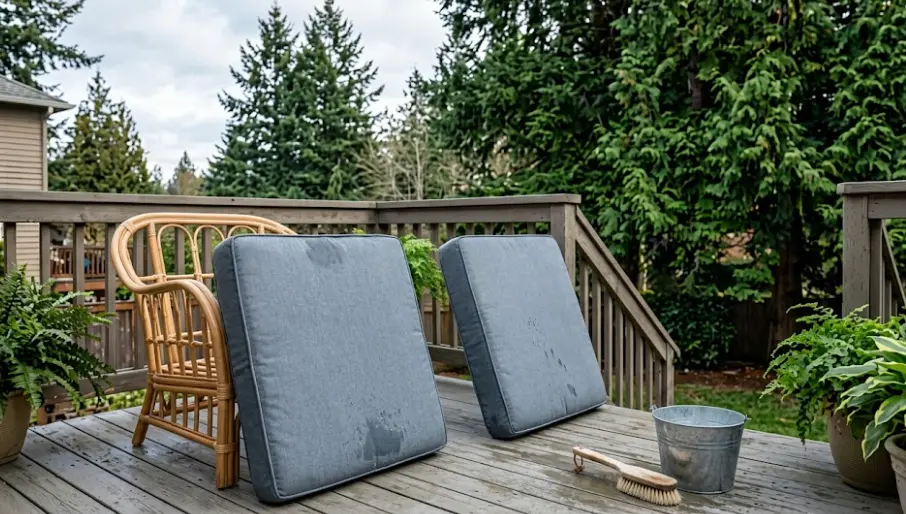
The drying step after cushion cleaning is where Seattle's climate creates the most consistent problems. Outdoor cushion foam retains significant moisture long after the outer fabric feels dry — this is not a minor point. Stack a just-cleaned cushion flat in a damp garage and the foam stays wet for three to five days in Pacific Northwest conditions. Over those days, any mold spores present start establishing themselves in the now-damp foam interior. The correct approach is to stand cushions on their edge in the most ventilated, sun-exposed location available and leave them long enough. On a dry July day, a 4-inch-thick cushion standing on edge in direct afternoon sun can dry completely in 12 to 18 hours. On an overcast June day, 36 to 48 hours is more realistic. Leaning them against a fence rail or deck railing — separated so air can circulate between them — works better than leaning them against each other or against a wall.
Before covering or storing cleaned cushions, do the towel test: press a clean dry cloth firmly against the thickest part of the cushion for 30 seconds. If any moisture transfers to the cloth, the foam isn't fully dry. This check takes 30 seconds and reliably prevents the mold problems that otherwise don't show up until six weeks after the cushions went back into use — by which point the mold has worked through several layers of foam and no amount of cover cleaning will remove the smell.
Timing Matters More Than Technique in Seattle
The most technically correct cleaning approach produces poor results if it's done at the wrong time of year. Late May through mid-June is the best window for a full seasonal clean of all three materials — wicker frames, rattan, and cushions. The main wet season has ended, temperatures are reliably above 55°F (which matters for cleaning solutions to activate properly and for any fabric protector to cure), and there are typically enough consecutive dry days to allow complete drying before the furniture returns to regular use. August and early September work for a mid-season refresh if the furniture has had heavy use through summer.
October cleaning is a trap. Cushions cleaned in late fall frequently don't fully dry before the wet season returns, and furniture that goes into storage slightly damp comes out in May in noticeably worse condition than furniture that was properly dried before storage. If the fall season catches you with dirty cushions, a surface vacuuming and a spray of fabric protector are better than a wet clean that won't dry in time. Schedule the deep clean for the following spring.
If you've taken on a patio set that's been stored wet or left out through a Seattle winter without covers, what you're dealing with may be beyond routine cleaning — particularly if the wicker has lost structural integrity, the rattan joints show softening, or the cushions have black mold that smells through the covers. That's when professional furniture cleaning makes practical sense, not because the work is complicated, but because the inspection step — understanding what the material can actually recover from — changes the scope of what you do next.
Natural Rattan vs. Synthetic Rattan: The Cleaning Rules Are Different
The most important distinction in rattan furniture care that most guides skip over: natural rattan and synthetic (resin) rattan require different cleaning approaches — and using the wrong one causes damage.
Natural rattan is a plant fiber. It absorbs water readily, and prolonged exposure causes it to sag, warp, crack, and become brittle. The fibers can split when saturated and dried too quickly.
Cleaning rule: Minimal water exposure only. Use a barely damp (not wet) cloth. Never hose down, soak, or pressure-wash.
Best method: Vacuum with upholstery attachment → wipe with damp cloth → dry immediately with a clean towel → allow to air-dry fully before use.
For mold: 50/50 white vinegar and water in a spray bottle. Spray, wait 15 minutes, scrub gently with a soft toothbrush, wipe dry immediately.
Synthetic wicker (polyethylene resin) is weather-resistant and handles water well. Most outdoor wicker furniture sold today is synthetic. You can use more water without risk of warping.
Cleaning rule: Soap and water freely. Rinse with a garden hose (not pressure washer). Can be left outdoors in rain.
Best method: Brush off debris → scrub with soap solution and soft brush → rinse with hose → air dry.
For mold: Same 50/50 vinegar spray, or diluted dish soap. Rinse well after either method.
To identify which type you have: natural rattan is usually lighter in weight, warm-toned (cream to light brown), and has visible grain texture. Synthetic rattan feels slightly plastic-like, is often darker or more uniform in color, and is heavier per strand. Most Seattle patio retailers sell synthetic almost exclusively for outdoor use; natural rattan is primarily found in indoor furniture.
