Commercial Patio Furniture Cleaning for Seattle Restaurants and Hotels
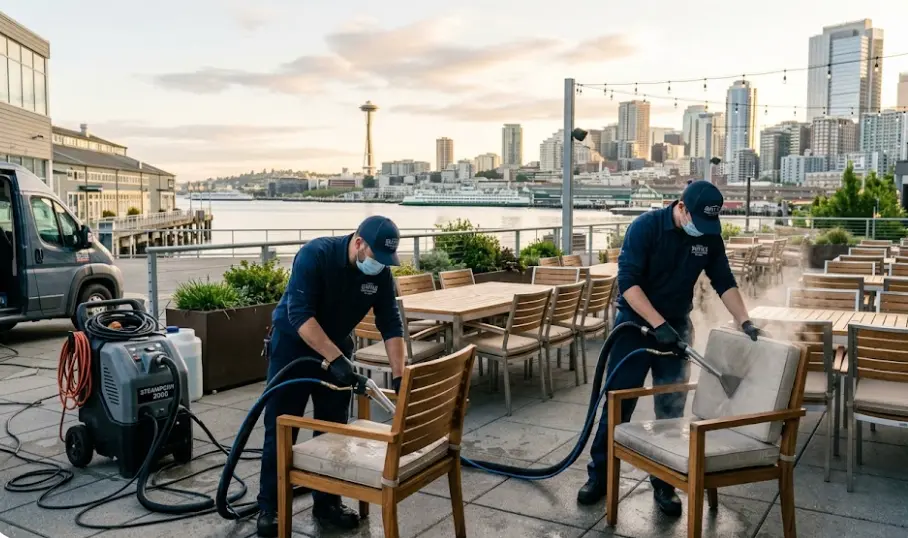
A restaurant patio table in Seattle sees more spilled merlot, drizzled sauce, and sunscreen residue in one busy Saturday than a residential set accumulates in an entire summer. Add the morning condensation from Pacific Northwest spring nights, the bird traffic that treats uncovered outdoor furniture as a perch, and the grease that travels from the kitchen with every server who passes — and you have a set of cleaning challenges that are categorically different from anything a residential hose-down addresses. Hospitality-grade furniture can handle it, but only if the cleaning keeps up with the use. When it doesn't, the signs show up in guest reviews before they show up in a manager's cleaning schedule.
This guide covers commercial outdoor furniture cleaning in Seattle from the perspective of what actually works for restaurants, hotels, breweries, and event venues operating in this climate: the specific soiling patterns in commercial outdoor settings, the cleaning frequency that keeps furniture looking good between seasons, scheduling around service hours, and the health compliance angle that residential guides don't need to address. If you manage outdoor seating in the Seattle area and you're evaluating whether your current approach is adequate, this is the honest breakdown of what professional restaurant patio cleaning involves and what it delivers.
Why Commercial Outdoor Furniture Cleaning Is Not a Scaled-Up Residential Job
The difference between cleaning residential and commercial outdoor furniture is not just volume — it's the nature of the soiling, the regulatory context, and the tolerance for service disruption. A residential homeowner whose cushions smell musty has a problem. A restaurant whose patio cushions smell musty has a Yelp review problem.
| Factor | Residential | Commercial |
|---|---|---|
| Daily use intensity | Weekend barbecues, occasional evening use | Multiple full table turns per day, 5–7 days per week during season |
| Soiling type | Mold, pollen, bird droppings, general grime | Food grease, alcohol, sauce stains, sunscreen, high body-oil contact — all setting deeply with repeated heat from sun and body warmth |
| Cleaning frequency needed | 2× per year professional clean | 3–6× per year professional deep clean; daily staff spot-cleaning between visits |
| Health compliance | No regulatory requirement | Seattle-King County Public Health inspection standards apply to outdoor seating surfaces in food service establishments |
| Scheduling constraint | Any convenient day | Must be completed before service opens; early-morning or after-hours only |
| Equipment required | Garden hose, brush, bucket | Commercial-grade hot-water extraction for deep soiling; professional cleaning agents formulated for food-service environments |
| Consequence of visible soiling | Aesthetic only | Direct impact on guest seating decisions, online reviews, and potential health inspection findings |
The soiling that accumulates on commercial outdoor furniture is also compositionally different from residential grime. Restaurant patio cushions absorb cooking oils carried on outdoor air near kitchen exhaust — this type of soiling binds to fabric fibres and becomes increasingly difficult to remove the longer it's allowed to build. It also acts as a mold substrate in Seattle's climate: oil-soaked fabric that absorbs morning condensation creates excellent conditions for mold, often within a single wet week. Commercial venues that clean their outdoor furniture twice a year on the residential schedule consistently find cushions deteriorating faster than the manufacturer's expected lifespan, and often attribute it to fabric wear rather than cleaning frequency.
Commercial Outdoor Seating Across Seattle: What Each Setting Requires
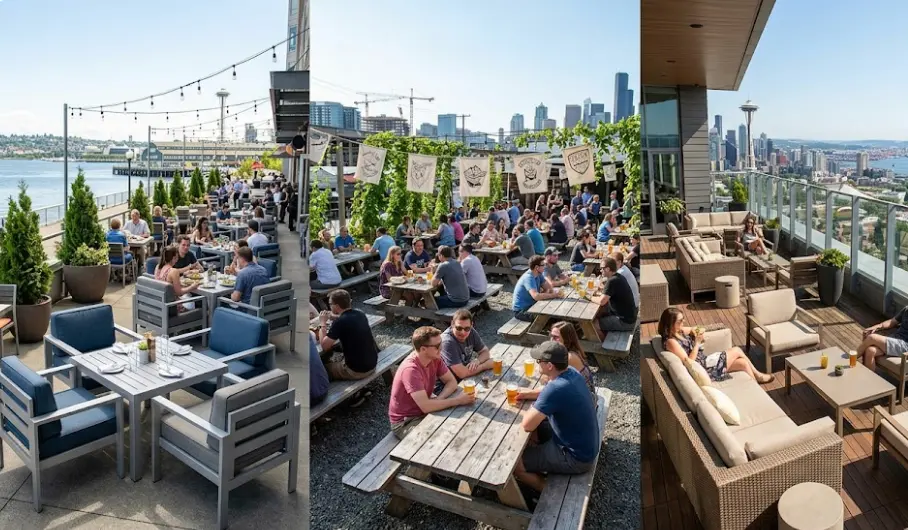
Seattle's hospitality sector spans waterfront restaurants, rooftop hotel terraces, brewery taprooms with large outdoor spaces, boutique hotel courtyards, and office campus outdoor dining areas — each with different furniture types, soiling patterns, and scheduling constraints. Here's the breakdown by setting:
Full-Service Restaurants
Soiling profile: The most demanding in the hospitality category. Food grease migrating from kitchen exhaust, sauce and wine spills absorbed into cushion fabric across multiple daily seatings, and body-oil contact from high-volume covers. In Seattle's climate, morning condensation on uncovered restaurant patio furniture combines with food residue from the previous day — mold establishment on restaurant cushions can happen within 10–14 days of neglected spot-cleaning in Pacific Northwest spring conditions.
Materials typically used: Commercial-grade cast aluminum or steel frames, Sunbrella or commercial solution-dyed acrylic cushions in most established Seattle venues. Lower-cost resin wicker in casual concepts — these show soiling faster and require more frequent attention.
Cleaning frequency: Professional: 4× per year minimum plus daily staff spot-cleaning protocol. Pre-season deep clean before Memorial Day opening, mid-season July clean, September clean before the wet season, and post-season before storage.
Hotels and Boutique Properties
Soiling profile: Lower food-contact volume than restaurants but higher expectations for appearance. Hotel guests evaluating a property for events, weddings, or extended stays make significant judgments about overall quality from the condition of outdoor terrace furniture — stained or mildewed cushions on a $300/night hotel terrace communicate the same quality signal as a dirty lobby. Hotel rooftop bars combine food/beverage soiling with the elevated UV and wind exposure characteristic of Seattle's higher floors.
Materials typically used: Premium teak, marine aluminum, or custom commercial pieces in upscale properties. Pool deck furniture — often resin or commercial vinyl — requires specific cleaning approaches that don't leave chemical residue near water features.
Cleaning frequency: Professional: 3–4× per year for most hotel outdoor areas; rooftop bars and pool decks with food and beverage service treated on the restaurant schedule.
Breweries and Taprooms
Soiling profile: Beer and beverage spills are the primary soiling agent, and they behave differently from restaurant food contact. Beer residue is sugary and fermentable — it becomes sticky, attracts insects, and creates an ideal substrate for both mold and bacterial growth on fabric when combined with Seattle's ambient humidity. Large brewery outdoor spaces — picnic table benches, Adirondack chairs, communal tables — accumulate soiling across the entire surface, not just at individual place settings. Woodinville wine country properties have similar profiles with wine contact.
Materials typically used: Picnic tables, Adirondack chairs, and commercial benches in solid wood or composite. Less cushion-heavy than restaurants, but wood surfaces that absorb beer residue develop permanent staining without regular professional treatment.
Cleaning frequency: Professional: 3× per year with monthly staff cleaning during peak season. Wood surfaces treated with protective sealant annually.
Event Venues and Corporate Campuses
Soiling profile: Irregular use patterns with high-intensity events — a venue hosting a 200-person outdoor wedding reception in June followed by two weeks of no use presents different cleaning needs than continuous daily restaurant service. Redmond and Bellevue corporate campuses with outdoor dining terraces are in daily use through the work week and often neglected over weekends and holidays, allowing soiling to set before the next week's use.
Materials typically used: Higher-end commercial teak and aluminum in corporate and event settings. Stack chairs and folding furniture for events — these accumulate soiling in stacked storage between events and need attention before deployment, not just after use.
Cleaning frequency: Event venues: pre-event and post-event. Corporate campuses: 3× per year professional plus weekly staff maintenance.
What Professional Commercial Outdoor Furniture Cleaning Actually Involves
A professional commercial outdoor furniture clean for a Seattle restaurant or hotel is not a residential clean scaled up. The equipment, products, process sequence, and documentation are different. Here is what a professional visit covers:
Pre-Clean Assessment and Condition Documentation
Every commercial visit starts with a walk-through of the entire outdoor seating area. We photograph current condition of all furniture components before cleaning — this documentation matters for commercial clients both as a record of the work scope and as baseline documentation for insurance and health compliance purposes. We note any pieces that have deteriorated beyond cleaning (cushions with foam-core mold contamination, frames with structural rust or damage) and flag these for replacement rather than cleaning. Cleaning damaged cushions that need replacement wastes time and budget on a piece you're going to change anyway; the honest assessment upfront changes the scope and cost.
Frame Cleaning by Material Type
Commercial outdoor furniture frames — typically cast aluminum, powder-coated steel, teak, or commercial wicker — are cleaned with material-appropriate products. For aluminum: commercial degreaser to address the kitchen-exhaust oil film that builds on all outdoor surfaces near restaurant operations, followed by aluminum cleaner for any oxidation, then protective wax application. For teak: commercial teak cleaner (oxalic acid-based) applied with a soft brush along the grain, rinsed, and treated with sealant on the annual cleaning visit. For powder-coated steel: grease degreaser, mild detergent wash, thorough rinse. Every joint, weld point, and horizontal surface is checked for rust initiation during the frame clean — small chips caught early take five minutes to address; the same spots missed for a season initiate rust that eventually requires frame replacement.
Cushion Deep Cleaning with Commercial-Grade Extraction
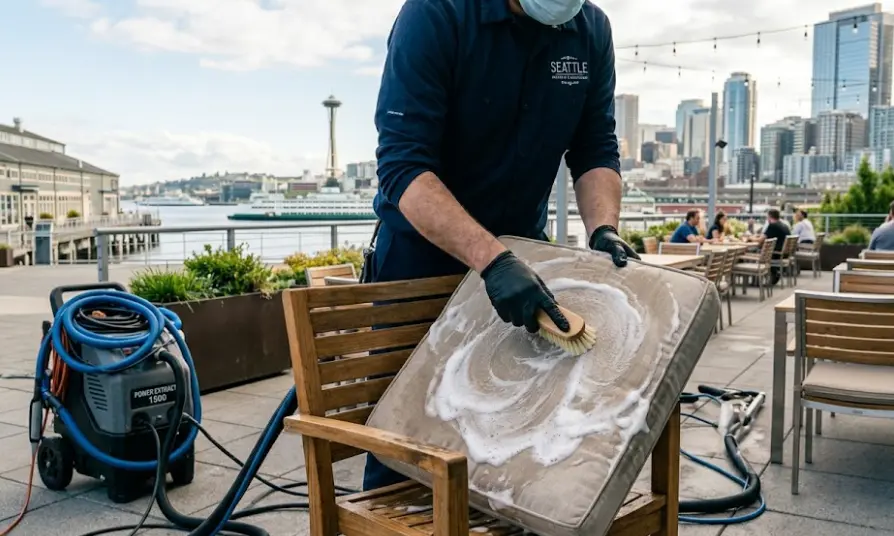
Restaurant and hotel outdoor cushions receive the most intensive treatment of the visit. The soiling in commercial cushions is compositionally different from residential — the combination of cooking oils, alcohol, and food proteins creates a bonded layer in the fabric that standard soap-and-water brushing does not fully lift. We use commercial-formulation hot-water extraction at appropriate temperature and pressure: the heat breaks down the grease bond in the fabric fibres while the extraction simultaneously removes both the dissolved soiling and the cleaning solution. Both faces of every cushion are treated — the underside accumulates moisture and mold in Seattle's damp climate regardless of how often the top surface is wiped down. For Sunbrella and other solution-dyed acrylic fabrics, which represent the vast majority of commercial outdoor cushions in Seattle, a periodic bleach-based treatment during the deep clean cycle maintains the level of sanitation appropriate for a food-service environment. See our dedicated guide on Sunbrella fabric cleaning in Seattle for the technical detail on bleach-safe treatment for acrylic commercial fabrics.
Targeted Stain Treatment
Wine, sauce, grease, and sunscreen stains that have been on commercial cushions through multiple wet-dry cycles require targeted pre-treatment before the extraction pass. Red wine and berry juice stains respond to enzyme-based pre-treatment that breaks down the tannin compounds causing the discoloration. Oil-based stains — sunscreen, cooking oil, and butter — respond to a citrus-based degreaser applied with a soft brush. These targeted treatments are applied during the dwell phase, before the extraction pass, so that the extraction removes both the pre-treatment and the dissolved stain together rather than just rinsing the surface. Not every stain from a commercial use history is recoverable — particularly old sunscreen oxidation and some red wine staining on lighter fabrics — but the majority of commercial staining on quality Sunbrella or solution-dyed polyester responds well to professional treatment.
Drying and Reassembly Before Service Opens
Commercial scheduling means everything must be dry, reassembled, and ready before the venue opens. For early-morning cleaning starts (6–7 AM), cushions cleaned first are placed upright for air circulation while frames are being cleaned — by the time frame work is complete, cushions cleaned in the first phase have typically had 2–3 hours of drying time and are ready to reassemble. In Seattle's frequently overcast mornings, we assess drying conditions at the start of each visit and adjust the sequence to ensure the cushions that need the most drying time are cleaned first. Commercial portable dryers are available for same-visit use on days when weather conditions would not allow natural drying before service. We do not consider a commercial visit complete until every piece of furniture is dry, reassembled, and back in its service position.
Protective Treatment and Service Documentation
After cleaning, fabric protectant is applied to all cushion covers — this re-establishes the water-repellent coating that commercial use degrades, and is the step that most extends the interval between professional cleans. Frames receive appropriate protective treatment: wax on aluminum and steel, oil or sealant on teak. We provide written service documentation for every commercial visit — what was cleaned, what products were used, what was noted for attention, and before/after photographs. For Seattle-King County Public Health inspections, this documentation demonstrates a maintained professional cleaning schedule for outdoor seating areas, which is increasingly relevant as inspection criteria for food-service outdoor spaces have been tightened.
Scheduling Around Your Service Hours
Every commercial outdoor furniture cleaning we perform is scheduled around the venue's operating hours. For most Seattle restaurants, this means two viable windows:
Early Morning (6:00–10:00 AM)
The preferred window for most full-service restaurants. A 6 AM start on a typical Seattle June–August morning provides 4–5 hours before the standard 11 AM lunch open, which is sufficient for a full commercial patio clean including cushion extraction drying time. The morning light also makes condition assessment easier than under artificial lighting — we can see soiling and staining clearly before cleaning begins. For venues that open at 10 AM for brunch service, a 5:30–6 AM start with one additional technician is available to maintain the pre-service completion window.
After-Closing (10:00 PM–2:00 AM)
For venues with morning service or early-opening brunch operations where the morning window is insufficient, after-closing cleaning from 10 PM allows the full night for cushion drying — an advantage in Seattle's spring and autumn conditions when morning air temperatures are lower. Post-close cleaning is also effective for highly soiled commercial furniture where extended dwell times on stain pre-treatment are beneficial. We operate city-wide for post-close commercial cleaning with standard Seattle noise ordinance compliance — extraction equipment runs at or below 65 dB, which meets the Seattle SMC 25.08 commercial nighttime standard.
Health Code Compliance for Commercial Outdoor Seating in Seattle
Seattle-King County Public Health's Environmental Health Division has extended inspection standards to food-service outdoor seating areas. The specific provision that catches restaurant operators most often relates to seating surface cleanliness: outdoor seating that is visibly soiled, mold-affected, or cannot be sanitised to food-contact surface standards is subject to compliance action during inspection.
In practical terms, this means two things for Seattle restaurant operators managing outdoor seating. First, cushioned outdoor furniture that shows mold growth or is permanently stained to a degree that prevents surface sanitation is not compliant for continued food-service use — it needs to be cleaned to a level where sanitising is possible, or replaced. Second, a documented professional cleaning schedule is considered evidence of due diligence in maintaining outdoor seating to food-service standards.
Documentation We Provide
Written service records with date, scope, products used, and pre/post photographs for every commercial visit. This documentation is appropriate for presentation during Public Health inspections as evidence of a maintained professional cleaning programme for outdoor seating.
Food-Safe Cleaning Products
All commercial outdoor furniture cleaning uses products appropriate for food-service environments — no residues that create food-contact surface contamination risk. Sunbrella and solution-dyed acrylic fabrics cleaned with diluted bleach solutions are thoroughly rinsed and dried before any food service contact.
When to Act Before Inspection
If your outdoor seating shows visible mold growth, persistent odour, or staining that cannot be removed by daily staff cleaning, schedule professional cleaning before a health inspection visit rather than after a compliance notice. Reactive cleaning after an inspection finding takes more time and creates a compliance record — pre-emptive cleaning removes the issue entirely.
Outdoor Furniture Receiving Inspection: What Seattle Restaurants and Hotels Need to Know
When a restaurant or hotel takes delivery of new commercial outdoor furniture, a receiving inspection before installation protects the investment and documents the condition for warranty purposes. This is particularly important for Seattle's hospitality industry, where Puget Sound humidity and UV exposure from June–September can reveal manufacturing defects within the first season.
| Inspection Point | What to Check | Why It Matters |
|---|---|---|
| Frame welds and joints | Cracks, sharp edges, unfinished weld points | Weld failures on commercial frames under daily guest load are a liability issue |
| Fabric tension and alignment | Sling or cushion fabric evenly stretched; no puckering at corners | Misaligned fabric collects water in Seattle rain rather than shedding it |
| Powder coat or finish integrity | Chips, thin spots, exposed bare metal | Bare metal rusts within one wet Seattle winter; warranty coverage requires documenting pre-delivery |
| Cushion fill density | Press seat cushions — should resist, not compress fully | Under-filled cushions flatten within 6 months of commercial use |
| Hardware (screws, levelers, caps) | All present, threads intact, glides fitted | Missing levelers damage deck surfaces and create trip hazards |
Fresh Furnish Cleaners offers a commercial first-season setup service: we clean, inspect, and apply protective treatment to new outdoor furniture installations before the first guests use them — establishing a documented baseline condition and extending the usable life of the investment from day one. Call (425) 287-3619 to discuss scheduling around your delivery date.
Commercial Outdoor Furniture Cleaning: Cost and What It Protects
The economics of commercial outdoor furniture maintenance are different from residential. The relevant comparison is not cleaning cost versus doing nothing — it's cleaning cost versus early replacement cost, plus the revenue impact of substandard outdoor seating appearance.
| Property Type | Typical Patio Scale | Professional Clean Cost (per visit) | Annual Season Maintenance |
|---|---|---|---|
| Small café / bistro patio | 8–12 sets | $180–$320 | $550–$950 (3 visits) |
| Mid-size restaurant patio | 15–25 sets | $350–$600 | $1,100–$2,200 (4 visits) |
| Brewery / taproom with large outdoor space | 30–60 seats | $500–$900 | $1,500–$2,700 (3 visits) |
| Hotel terrace / rooftop bar | Quoted by area + scope | $600–$1,400 | $1,800–$4,200 (3–4 visits) |
| Event venue / corporate campus | Variable | Quoted per event or per scheduled visit | Varies by use frequency |
Estimates for Seattle metro area, 2026. Final pricing depends on material type, soiling level, cushion count, and whether frame restoration work is included.
Staff Maintenance Protocol Between Professional Visits
Professional deep cleaning 3–4 times per year is not a substitute for a daily staff maintenance protocol — it works in combination with it. The goal of the daily staff routine is to prevent soiling from setting and to catch issues before they require professional intervention. Here is the protocol we recommend for restaurant and hotel patio staff:
Opening Setup (Daily)
- Wipe all table surfaces with a food-service sanitiser solution — this removes overnight condensation, pollen, and any bird contact before the first seating
- Inspect all cushions visually — flip seat pads to check underside for mold spots or excessive moisture. Remove any cushion showing active mold and set aside for treatment
- Remove visible debris (leaves, cigarette butts on covered patios) before guests arrive
- Check chair and table frames for stability — report any wobbling joints or loose hardware to management before service
Closing Protocol (Daily)
- Treat any visible food or beverage spills on cushions immediately at close — a wine spill treated within 30 minutes of occurrence removes fully; the same spill left overnight sets into the fabric
- Stack or bring in cushions on nights when rain is forecast — this single habit is the most effective thing staff can do to extend cushion life in Seattle's climate
- Wipe down all table and chair frames with a damp cloth to remove food residue before it dries overnight
- Secure furniture covers on nights with wind or heavy rain forecast
What Staff Cleaning Cannot Replace
Daily staff wiping with sanitiser solution maintains surface hygiene but does not penetrate cushion fabric to remove the grease, oils, and food proteins that accumulate over the season. Nor does it reach the underside of cushions or the interior of foam where moisture and mold develop. Staff cleaning is maintenance between professional visits — it keeps the furniture usable and presentable daily, but the deep soiling that builds over weeks of commercial use requires professional hot-water extraction to fully address. Venues that attempt to substitute increased staff cleaning frequency for professional deep cleans consistently find cushions deteriorating faster and requiring earlier replacement.
Seattle Hospitality Clients
"We run a 22-table patio at our Eastside restaurant and were replacing cushion sets every two to three years because of staining and mold odour. We switched to Fresh Furnish for quarterly professional cleaning eighteen months ago and have not replaced a single cushion since. The cost of four annual cleans is less than one set of replacement cushions. The scheduling has been flawless — they're always done before our 11 AM open, no exceptions."
"Our hotel terrace gets used for private events through most of the summer. After a busy event weekend the furniture can look rough, and we had guests commenting on it in reviews. We now schedule Fresh Furnish after every major event — usually a Monday morning clean before the week's regular terrace use. The documentation they provide was also useful when the health inspector came through and asked about our outdoor seating maintenance programme. That was something we'd never thought to document before."
Frequently Asked Questions
For full-service restaurants with active patio service, the baseline in Seattle's climate is 4 professional deep cleans per year: pre-season (April–May), mid-season (July), late-season (September), and post-season before storage or winter cover. High-volume establishments — breweries, rooftop bars, and waterfront restaurants — often benefit from monthly professional cleaning during peak season given the volume of food and beverage contact per day. Between professional visits, a daily staff protocol covering table wipe-down, cushion inspection, and spill treatment at close is essential. Seattle's climate — particularly the morning condensation pattern through spring and autumn — makes the combination of staff daily maintenance and professional quarterly deep cleaning significantly more effective than either approach alone.
Commercial outdoor furniture cleaning in Seattle is priced by scope rather than hourly. For a mid-size restaurant patio of 15–25 dining sets, professional deep cleaning typically ranges from $350–$600 per visit, with a full season's maintenance (4 visits) costing $1,100–$2,200. Hotels with larger terrace areas are quoted by the area and service scope. Commercial-grade outdoor dining sets retail at $600–$1,500 per set — a 20-set patio represents $12,000–$30,000 in furniture. Professional seasonal maintenance at under 10% of replacement cost per year, extended over a furniture lifespan that professional cleaning extends from 6–8 years to 12–15 years, represents one of the clearer ROI propositions in commercial property maintenance. We provide written no-obligation quotes within 24 hours for any commercial property in the Seattle metro.
Yes — this is a standard requirement for all commercial work. For restaurants, early morning cleaning starting at 6–7 AM allows full drying and reassembly before the 11 AM lunch service in most cases. For venues with earlier opening times, after-closing cleaning from 10 PM is available. For hotels with continuous terrace access, work is sectioned across phases so the entire terrace is never simultaneously out of service. All commercial scheduling includes a 30-minute buffer before your service open time. We confirm scheduling 48 hours in advance and send a technician arrival notification the morning of service. Commercial clients on seasonal maintenance agreements receive a confirmed annual schedule in April and priority response for unscheduled spot-cleaning requests.
In Seattle's wet climate, the most durable commercial outdoor furniture materials are: cast aluminum with quality powder coat (virtually rust-proof, easy to clean, maintains appearance with annual waxing); solid teak (naturally oil-rich, resists moisture and rot, designed for 20+ years with annual cleaning and oiling); and marine-grade aluminum with 304 or 316 stainless connections (used in higher-end hospitality, excellent longevity). For cushion fabrics, solution-dyed acrylic (Sunbrella, Outdura, Dickson) is the unambiguous choice for commercial use — it's the most mold-resistant, UV-stable, and cleanable fabric available for outdoor commercial applications, and the only standard outdoor fabric that safely tolerates bleach-based cleaning for food-service hygiene compliance. Lower-cost powder-coated steel and resin wicker have shorter commercial lifespans in Seattle's climate without consistent maintenance.
Directly. In guest satisfaction surveys, outdoor seating appearance consistently ranks among the top factors influencing patio dining decisions and review sentiment. A 2024 Washington Restaurant Association survey found that 67% of respondents said visibly dirty or stained outdoor furniture would prevent them from sitting on a patio or contribute to a negative review. In Seattle's competitive market — where good outdoor patio weather is limited enough that it creates genuine demand — the condition of a restaurant's outdoor seating area directly affects whether guests choose to sit outside or inside, and whether they return. A professional clean before Memorial Day weekend and at mid-season costs a fraction of one weekend's patio revenue and ensures that the space performs as intended during Seattle's brief but high-value outdoor dining season.
Commercial outdoor furniture cleaning differs from residential in volume, soiling type, equipment, regulatory context, and scheduling. Commercial furniture sees multiple full table turns daily versus occasional residential use — the soiling accumulation is fundamentally different in both quantity and composition, with food grease, alcohol, and food proteins bonding into fabric over daily use cycles. This requires commercial-grade hot-water extraction equipment and professional-formulation cleaning agents rather than the bucket-and-brush approach adequate for residential cleaning. Commercial cleaning is also documented for health compliance purposes, scheduled strictly around service hours, and must be completed to a higher standard of appearance given the guest-experience implications. The equipment investment alone — commercial truck-mounted or high-capacity portable extractors — produces results that residential rental machines cannot replicate on heavily soiled commercial cushions.
Related Commercial Cleaning Guides
Restaurant Booth Cleaning
Indoor and outdoor upholstery care for food-service establishments — our restaurant booth upholstery cleaning service covers vinyl, fabric, and leather booth seating with after-hours scheduling and health-code compliance documentation.
Hotel Upholstery Cleaning
Full-property hospitality cleaning for lobby, guest room, and conference furniture — our hotel upholstery cleaning in Seattle covers all indoor hospitality seating with the same commercial scheduling standards as outdoor work.
Sunbrella Fabric Cleaning
Technical guide to Sunbrella and solution-dyed acrylic cleaning in Seattle — the standard commercial outdoor fabric — including bleach-safe mold treatment, correct rinsing protocol, and protectant re-application after commercial cleaning.
Schedule Commercial Outdoor Furniture Cleaning for Your Seattle Property
We work with restaurants, hotels, breweries, event venues, and corporate campuses across the Seattle metro — early-morning, after-hours, and scheduled seasonal maintenance programmes available. Written service documentation for every visit. No-obligation quote within 24 hours.
Service Around Your Hours
Early-morning from 6 AM and after-closing service available — cleaning completed before your service opens
Compliance Documentation
Written service records with before/after photographs for every visit — appropriate for health inspection documentation
Seasonal Programmes
Annual maintenance agreements with guaranteed scheduling through peak season — one call secures the full year
Serving Seattle, Bellevue, Kirkland, Redmond, Bothell, Woodinville, Lynnwood, Edmonds, Shoreline & surrounding areas
