Best Way to Protect Outdoor Furniture Fabric After Cleaning
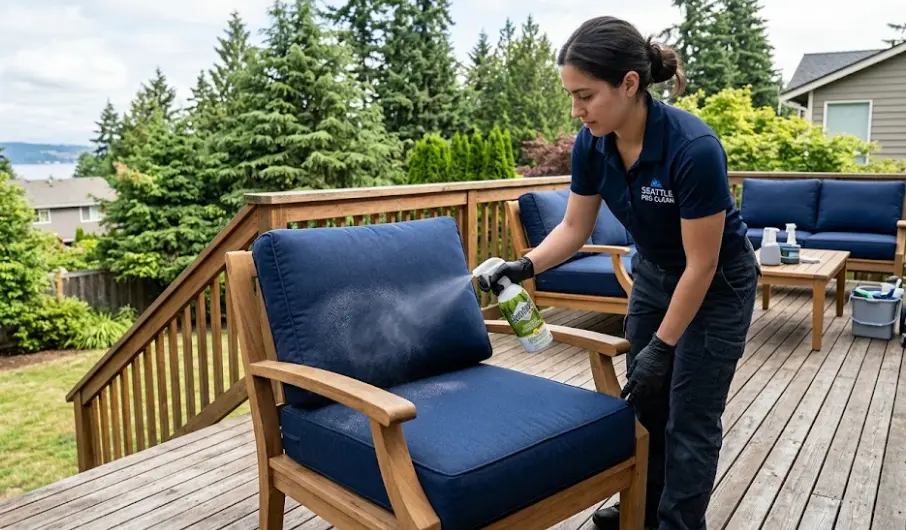
Most of the people we talk to about outdoor cushion care have never thought about what actually happens to the fabric when they clean it. They wash the cushions, let them dry, put them back on the furniture — and then, six months later, they notice the cushions are soaking up water instead of shedding it, and the fabric is trapping dirt at a rate it never used to. The cleaning didn't cause the problem, exactly. But it finished a job that the weather had started: stripping away the protective coating that came with the fabric in the first place.
That coating — technically called a DWR finish, for Durable Water Repellency — is what makes a well-maintained outdoor cushion look like it's shrugging off rain rather than absorbing it. It's also what makes dirt sit on the surface rather than working into the weave. It is not permanent. It degrades with UV exposure, with abrasion, with repeated wetting, and especially with detergents. Every cleaning cycle strips a little of it away. Once it's gone, the fabric itself is still there and structurally intact — but it behaves completely differently.
What the Protective Finish Actually Is — and Why Cleaning Degrades It
The DWR treatment on outdoor fabric works through a mechanism called surface energy modification. The coating — historically a fluoropolymer chemistry, though this is changing — lowers the surface energy of the fabric fiber so that water molecules are not attracted to it strongly enough to spread and absorb. Instead of wicking into the weave, water forms droplets and rolls off. Dirt particles carried by water go with them, which is why a properly treated cushion stays cleaner between washes than an untreated one.
Detergents are specifically designed to do the opposite: they're surfactants, molecules that lower the surface tension of water and allow it to penetrate and mix with oils and soils. Applied to outdoor fabric, even a mild dish soap solution attacks the DWR coating at a chemistry level — not catastrophically in a single wash, but the effect is cumulative. By the third or fourth deep clean with a standard soap solution, a fabric that originally had strong water repellency is often down to a fraction of its original treatment. The fabric looks the same, feels the same, and is still perfectly clean — it just no longer sheds water the way it did when it was new.
UV exposure compounds this. Sunlight breaks down the fluoropolymer chains in the DWR coating through the same photochemical process that eventually degrades the fabric dye itself. A cushion that lives on an uncovered west-facing deck in Bellevue for a full summer is going to lose DWR faster than one stored under a cover — the UV alone, even without any cleaning, degrades the coating over months of continuous exposure.
There's a reason this matters specifically in Seattle's climate rather than, say, a drier inland climate: outdoor furniture here lives through October to March weather that can involve weeks of near-continuous rain and sustained high humidity. A cushion without its DWR coating absorbs that moisture rather than shedding it, stays wet for longer, and creates exactly the conditions where mildew colonizes the foam insert. By the time spring arrives, you're dealing with a cushion that's structurally compromised, not just wet.
The Step That Gets Skipped Most Often: Fully Dry Before You Protect
The most common mistake we see when homeowners apply fabric protector to outdoor cushions is applying it too early. The surface of the fabric can feel dry to the touch within a few hours of cleaning, especially on a warm day, but that tells you nothing about the moisture state of the foam insert inside. A standard outdoor cushion insert — typically 3–4 inches of open-cell foam — holds a significant amount of water, and in Seattle's climate that moisture works its way out slowly.
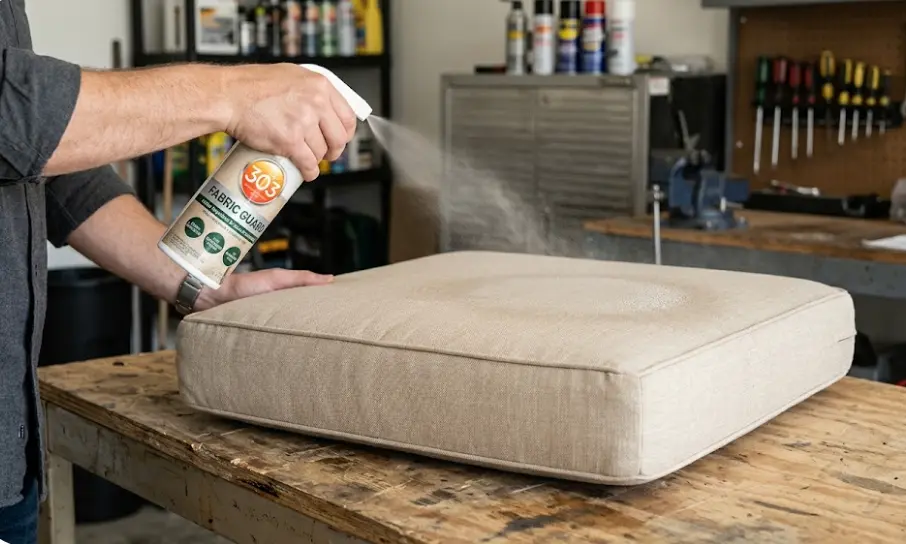
When you apply a fabric protector to a cushion that's surface-dry but internally damp, the product doesn't bond correctly. The outgassing moisture from the foam disrupts the curing process, and the result is an uneven finish that fails within weeks of the first rain. If you've ever applied a protector and found it barely seemed to work at all, this is often why.
Stand Cushions on Edge, Not Flat
After cleaning, stand cushions upright on their shortest edge in a well-ventilated area rather than laying them flat. Laying flat means the top dries while the underside stays against a surface — standing on edge allows air circulation across all faces simultaneously. If you have a rack, use it. If not, lean them against a wall with an inch or two of space behind each one.
Allow 24–48 Hours Minimum in Seattle's Climate
On a warm, breezy day in July, thick outdoor cushions may be genuinely dry through in 12–16 hours. In May or September, with higher ambient humidity and lower temperatures, plan on 24 to 48 hours for any cushion thicker than 3 inches. If the forecast shows another wet day tomorrow, you're better off waiting — applying to fully dry fabric once beats reapplying over a poor first attempt.
The Paper Towel Test
Before applying any protector, press a clean, dry paper towel firmly against the thickest part of the cushion — usually the center — and hold it there for 30 seconds. If the paper towel picks up any moisture at all, wait longer. This is the most reliable field test for internal moisture without any equipment, and it takes half a minute.
Which Products Actually Work — and the Difference Between Them
The outdoor fabric protector market has more options than it used to, and the chemistry is shifting because of regulatory pressure on PFAS compounds — the fluorinated chemicals historically used in high-performance DWR coatings. What this means practically is that some products you might remember from a few years ago have been reformulated, and the performance characteristics have changed. Here's what we've seen work consistently on Seattle-area outdoor furniture.
303 Fabric Guard
Best for Sunbrella & acrylic
The formulation that Sunbrella itself recommends for restoring water repellency to its fabric. Bonds very well to solution-dyed acrylic fibers, adds a UV inhibitor component that slows future fading, and holds up through sustained Pacific Northwest wet-season exposure better than most alternatives. Applied correctly to fully clean and dry Sunbrella, a single application holds its effectiveness through a Seattle summer and into early fall. Available at REI and most Seattle-area hardware stores.
Scotchgard Outdoor
Best for polyester blends
Scotchgard's Heavy Duty Outdoor Water Shield is reformulated with fluorine-free chemistry and performs well on polyester-blend outdoor fabrics — the kind you typically find on less expensive patio sets from Target or Home Depot. The fluorine-free version doesn't last quite as long on heavy rain exposure as the original fluoropolymer formula did, but it's easier to find and safe for all outdoor fabric types. Expect to reapply each season or after a deep clean, not just every other year as was possible with the older chemistry.
Star Brite Waterproofing
Marine-grade durability
Originally formulated for marine canvas — boat covers, sail bags, Bimini tops — Star Brite's fabric waterproofing spray handles sustained wet exposure better than products formulated primarily for occasional rain. Worth considering if your cushions are on an uncovered deck that gets direct rain exposure for weeks at a time. It's heavier-duty than most household alternatives and takes longer to cure fully (allow 48 hours before rain exposure), but the durability is noticeably better for outdoor fabric that doesn't get the benefit of being brought inside.
How to Apply — The Technique Most People Get Wrong
There's a common assumption that applying fabric protector is like applying sunscreen — cover the surface, rub it in, done. The reality is that application technique matters considerably, and the mistakes made here account for most cases where people report a product "didn't really work."
Apply Light, Even Coats — Not One Heavy Saturating Pass
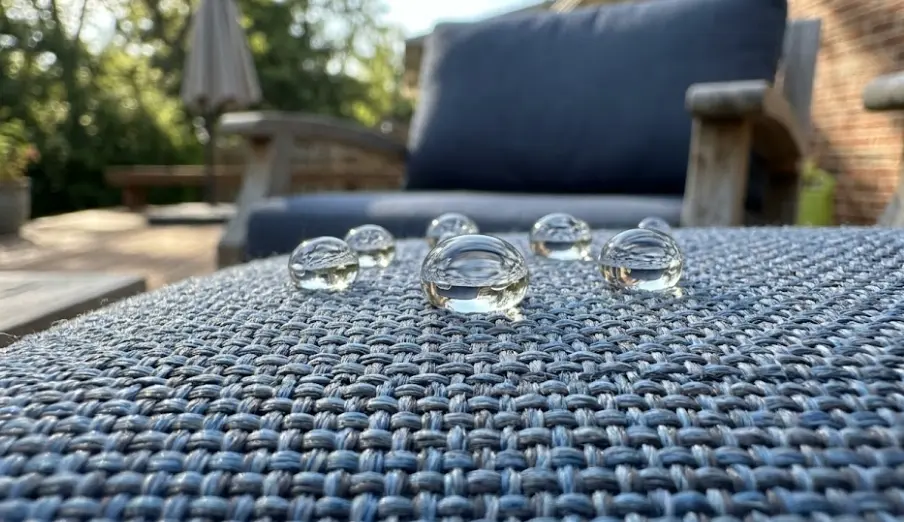
Hold the spray can or bottle 6–8 inches from the fabric and use a steady sweeping motion. The goal is a light, even mist that just barely wets the surface — not a soaking spray. Two or three light coats, with 20–30 minutes between each to allow the solvent carrier to evaporate, produce a more uniform and durable result than one heavy application. Oversaturation in a single pass causes the product to pool in the fabric weave and cure unevenly, leaving some areas overly stiff and others undertreated.
Don't Skip the Seams, Piping, and Underside
The seams and piping cord on outdoor cushions are where water reliably pools and where the fabric is under the most mechanical stress — these are the first areas to lose DWR through wear. They're also the first areas where mildew appears. Give the seam lines and the edge piping an extra pass beyond what the flat faces of the cushion receive. And treat the underside — it's the surface that sits against the furniture frame and is often the first to develop mildew from trapped moisture and reduced airflow.
Allow Full Cure Before Rain Exposure
Most fabric protectors need 24–72 hours to fully cure, depending on the formulation and ambient temperature and humidity. In Seattle, where even a "dry" May afternoon can turn to light drizzle by 8 PM, check the weather forecast before you start. A cushion that gets rained on 10 hours after application — before the product has cured — will have the treatment partially washed out before it's ever had a chance to work. If Seattle's forecast is uncertain, do the application indoors or in a covered garage and bring cushions back outside only after the cure window has passed.
Heat-Activate If Possible
For products that support it (check the label), light heat application after spraying — using a hair dryer on medium heat, moving it continuously like a spray can — improves how well the coating bonds to the fiber. This is particularly effective on solution-dyed acrylic fabrics like Sunbrella. The heat helps the DWR polymers cross-link with the fiber surface rather than just sitting on top of it. In practice this adds about 10 minutes to the process and meaningfully extends how long the first application lasts.
Timing for Seattle's Season — When to Apply and How Often
In Seattle's climate, the outdoor season and the high-rain season are essentially adjacent. Summer (June–September) is when furniture gets the most use and the most UV exposure. October–March is when it faces the most sustained moisture. Getting the timing of protection right means the fabric goes into each of those phases in the best condition possible.
Late April – Mid May
Main rainy season has passed. Temperatures reliably above 50°F. UV exposure has begun but summer peak hasn't arrived. 24h dry weather windows are achievable. Ideal for post-cleaning protection before summer use.
September
Good option for a second application going into fall. Weather is still reliably dry. Protects fabric heading into October–November wet season. Most important if cushions stay outdoors through winter.
June – August
Works fine when needed after a mid-season deep clean. Dry weather and warm temperatures support good curing. Main limitation is finding 24+ hours without rain in a busy outdoor season.
November – March
Too humid, too cold, too little drying time. Even on a rare clear February day, nighttime humidity prevents proper curing. If cushions aren't stored, cover them rather than attempting late-season application.
For most Seattle homeowners with standard outdoor cushions, once per season — applied in late April or early May after any post-winter cleaning — is the right cadence. Cushions that get heavy use, live in full sun without a cover, or sit on an uncovered deck that collects direct rain benefit from a second application in early September going into fall. Cushions stored through winter need an application in spring when they come out, and that's usually sufficient.
What Protection Does and Doesn't Do for Different Fabric Types
Outdoor furniture fabric is not a single category, and the way a protector behaves — and how long it lasts — varies considerably depending on what the fabric is actually made of. Getting this wrong means either reapplying more often than necessary or using the wrong product for the fiber type.
Solution-Dyed Acrylic (Sunbrella, Outdura)
Responds best to 303 Fabric Guard. The acrylic fiber has good affinity for the fluoropolymer and silicone components in quality protectors, and the treatment bonds well and lasts longer than on most other fiber types. One properly applied treatment on clean, dry Sunbrella typically holds water repellency through a full Seattle summer. The UV inhibitor in 303 also adds meaningful protection against the color fading that UV exposure causes in Sunbrella's pigment over multiple seasons.
Polyester and Polyester Blends
More common on mid-range and value-priced patio sets. Polyester fibers hold DWR coatings less tenaciously than acrylic, so reapplication more often — annually rather than every other season — is the realistic expectation. Scotchgard or any general outdoor fabric protector works. The bigger limitation with polyester is that the base fiber itself has somewhat less inherent UV resistance than solution-dyed acrylic, so the protector is working against a faster-degrading substrate. Worth treating, but manage expectations on how long a single application lasts.
Olefin (Polypropylene)
Olefin is a naturally hydrophobic fiber — it doesn't absorb water by its chemistry, which is why it's used in some outdoor fabrics. The practical implication is that a protector spray adds soil repellency and helps with surface staining, but the water-shedding benefit is less dramatic than it is on other fiber types, because olefin already sheds water reasonably well. Still worth treating once a season for the soil-repellency benefit — outdoor fabric gets dirty through airborne particles and contact soil, not just liquid spills.
Vinyl Sling and Mesh
Fabric protectors don't work on vinyl strapping or PVC-coated mesh sling fabrics, because these surfaces are sealed and non-porous — the protector has nothing to bond to and simply sits on the surface until it wears off. For vinyl and mesh chairs, cleaning with a UV protectant for vinyl (like 303 Aerospace Protectant, which is a different product from 303 Fabric Guard) addresses both cleaning and UV protection for that material. If you have a mixed patio set with fabric cushions and mesh chairs, you need two different products.
What We Hear From Seattle Homeowners
"We had Fresh Furnish clean our Sunbrella sectional cushions last May, and they took the time to explain the whole DWR thing — I'd honestly never heard of it. Applied the 303 Fabric Guard afterward while they were still there to walk us through the technique. That was the first summer in three years our cushions didn't have that grey grimy cast by August. The water still beads completely when I tested it in September."
"I'd been applying a fabric spray every year but kept seeing it fail by July. Fresh Furnish pointed out I'd been doing it right after cleaning when the cushions were still damp inside — I hadn't even thought about that. Waited the full 48 hours this time, applied on a warm day in May, used the heat gun technique they recommended. Same product I've always used, but it's held up much better. Still beading water after two months of regular use."
Protection Product Quick Reference
| Product | Best For | Reapply | Note |
|---|---|---|---|
| 303 Fabric Guard | Sunbrella, polyester, olefin outdoor fabric | Yearly or after deep cleaning | Restores DWR finish; most-recommended by Sunbrella |
| Scotchgard Outdoor | General outdoor cushion fabric | Every 6–12 months | Widely available; lighter coverage than 303 |
| Rust-Oleum NeverWet | High-water-exposure areas (cushion undersides) | Every 12–18 months | Very strong water repellency; changes fabric texture slightly |
| Teak oil / sealer | Teak and hardwood frames only | Once yearly | Do not apply to fabric — causes staining |
What Protection Cannot Fix
It's worth being direct about this, because a fabric protector is sometimes suggested as a solution to problems it can't actually address. If your cushions have already absorbed mold deep into the foam insert, a surface protector won't solve that — the mold is inside the structure, and a waterproof exterior layer just traps moisture alongside it rather than letting it dry out. If the fabric coating has broken down to the point of chalking or cracking (a sign of advanced UV degradation of the fabric finish itself), a DWR treatment bonds to a compromised substrate and won't hold the way it would on intact fabric.
Protection works best, and lasts longest, when it's applied as maintenance to fabric that's in good condition — structurally sound, thoroughly clean, and not yet at the end of its useful life. Think of it as sunscreen for fabric: it meaningfully slows damage and keeps the surface performing well, but it doesn't reverse damage that's already happened. If you're applying it in the context of a full seasonal care routine — clean thoroughly, inspect for damage, apply protector to healthy fabric, cover or store properly through winter — the results are very good. If you're applying it to fabric that's already in trouble as a last resort, manage expectations accordingly.
If you're genuinely unsure whether your cushion fabric is in good enough condition to be worth treating, a quick test is to check whether the fabric passes the bead test after a good surface cleaning but before any protector application. If water still partially beads on clean fabric, there's residual DWR worth building on, and treatment will give good results. If clean fabric soaks up water immediately from every area, the original finish is fully depleted — still worth treating, but recognize you're starting from zero rather than extending existing protection.
Professional Cleaning and Protection Together
For homeowners who want to make sure the cleaning and protection steps are both done correctly — the full sequence, not just one of them — we handle both as part of a single outdoor cushion care visit. That includes a fabric assessment before cleaning, an appropriate cleaning method for the specific fabric type, complete drying before any product is applied, and the protection application itself with the heat-activation step where applicable. We service cushion sets across Seattle, Bellevue, Kirkland, Redmond, Bothell, Edmonds, and the greater Eastside.
If you have questions about which product is right for your specific fabric type, or you're dealing with cushions that have partially lost their DWR and aren't sure whether they're still worth treating, our contact page has a photo submission option — send us a photo and describe what you're seeing, and we can usually give you a straight answer about whether treatment makes sense or whether you're better off with replacement covers. We'd rather give you an honest assessment than send you chasing a solution that won't hold.
Frequently Asked Questions
Yes — cleaning gradually strips the DWR (Durable Water Repellency) finish from outdoor fabric. After two or three deep cleans, fabric that used to bead water will instead allow it to soak in. Reapplying a fabric protector after every thorough cleaning cycle, once the fabric is completely dry, restores this barrier and significantly slows the rate at which the fabric gets dirty again.
303 Fabric Guard is the most consistently effective product for Sunbrella and solution-dyed acrylic fabrics — it bonds well to acrylic fiber, adds UV inhibition and water repellency, and holds up through Seattle's wet winters. For polyester-blend outdoor cushions, Scotchgard Heavy Duty Outdoor Water Shield is a strong option. Marine-grade Star Brite Waterproofing is worth considering for cushions on uncovered decks that face sustained wet exposure.
Applied correctly to clean, dry fabric, a quality fabric protector like 303 Fabric Guard typically provides effective water repellency for one full outdoor season if cushions are left uncovered. Cushions kept under a furniture cover when unused often hold protection into a second season. The honest test is the bead test: pour a small amount of water on the fabric — if it beads and rolls off, the protector is still working; if it soaks in, it's time to reapply.
Completely dry — not just surface dry. Outdoor cushion foam inserts retain moisture long after the fabric surface feels dry to the touch. Applying fabric protector while the core is still damp prevents the product from bonding correctly, producing uneven water repellency that fails within weeks. After a thorough cleaning, allow cushions to stand on edge for at least 24–48 hours in Seattle's climate. The paper towel test — pressing a dry towel firmly against the thickest part for 30 seconds — tells you whether the interior is dry before you apply anything.
The best window in Seattle is late April to mid-May — after the main rainy season, before summer UV begins, with temperatures reliably above 50°F. Apply on a day with at least 24 hours of rain-free weather forecast. A second optional application in September protects fabric heading into fall and winter. Avoid November through March — temperatures and humidity make proper curing unreliable.
Indirectly, yes. A water-repellent coating slows moisture absorption, so cushions dry faster after rain and stay drier longer — both reducing conditions mold needs. But it doesn't kill existing mold spores, and if cushions stay wet for extended periods during Seattle's fall and winter, even freshly treated fabric can develop mildew. Mold prevention comes primarily from allowing cushions to dry fully, covering them during sustained rain, and proper winter storage. The protector supports that system but doesn't replace it.
Related Outdoor Cushion Guides
Deep Cleaning Outdoor Cushions
The foundation of any protection routine is a properly cleaned surface. Our outdoor furniture cushion cleaning guide covers fabric identification, cleaning methods for each fabric type, and how to handle removable covers and foam inserts.
Sunbrella Fabric Care
Sunbrella responds better to fabric protection than most outdoor materials — but it has specific cleaning requirements worth knowing before you deep clean it. Our Sunbrella cleaning guide covers what works, what to avoid, and how to restore water repellency to this specific fabric.
Mold on Patio Cushions
If mold has already established itself before you get to the protection step, the cleaning process is different. Our guide to mold on patio cushions covers treatment by severity, what kills mold spores rather than just removing surface discoloration, and when the foam insert needs to be replaced.
Want the Cleaning and Protection Done Right, Together?
Fresh Furnish Cleaners handles the full outdoor cushion care sequence — fabric assessment, appropriate deep cleaning, complete drying, and protective treatment — as a single visit across Seattle, Bellevue, Kirkland, Redmond, Bothell, and the greater Eastside.
Fabric Assessment First
We identify your fabric type before cleaning — the right method for Sunbrella is not the same as for polyester blend, and the wrong approach degrades the finish faster
Protection Applied Correctly
We apply fabric guard only to fully dry fabric, with heat activation where applicable — the step most DIY applications skip that makes the protection last
Same-Day Service
Call before 2 PM for same-day outdoor furniture cleaning and protection across the Seattle metro area
Serving Seattle, Bellevue, Kirkland, Redmond, Bothell, Woodinville, Lynnwood, Edmonds, Shoreline & surrounding areas
