Recliner Chair Cleaning: Hidden Dirt You Don't See
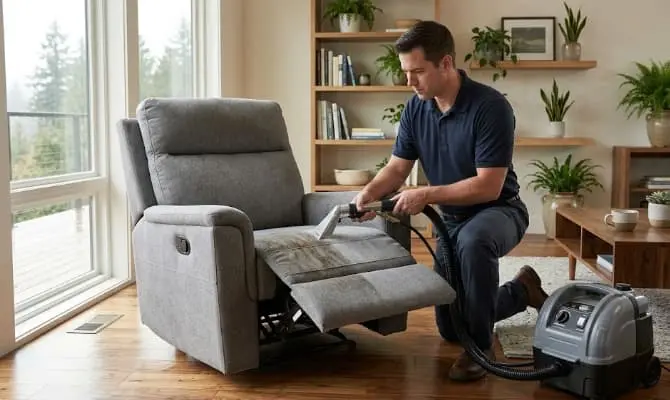
The Chair You Sit in Every Day Is Dirtier Than You Think
Your recliner is probably the most-used piece of furniture in your home. You sink into it after work, watch movies in it for hours, nap in it on weekends. And every single time, you leave something behind — skin cells, sweat, hair, body oils — that builds up layer by layer inside the fabric, the seams, and the mechanical gaps of the recliner frame.
The problem with recliners is not just the surface dirt you can see. It's what hides underneath: inside the footrest hinge folds, along the armrest seams, under the seat cushion, and deep in the backrest padding. Standard vacuuming cannot reach these areas. Regular spot cleaning misses them entirely. Only professional recliner cleaning service with the right equipment and techniques gets to the hidden layers.
This guide explains exactly what accumulates inside your recliner, why it matters for your health and your furniture's lifespan, and how professional armchair upholstery cleaning restores it completely.
Where Hidden Dirt Accumulates in a Recliner
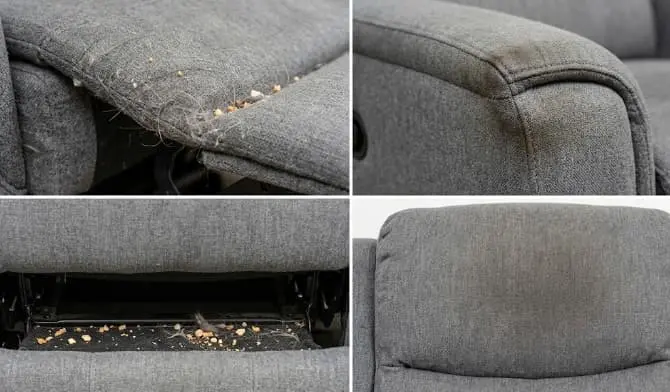
A recliner's mechanical design — its hinges, folding footrest, reclining backrest, and padded armrests — creates multiple hidden zones that trap contaminants. Most people only clean the visible surface. Here is what actually builds up inside:
Footrest Fold Zone
Every time the footrest folds down and retracts, fabric creases into tight gaps. These folds trap:
- Dead skin cells shed from bare feet and legs
- Sock lint and fabric fibers
- Food crumbs and drink residue
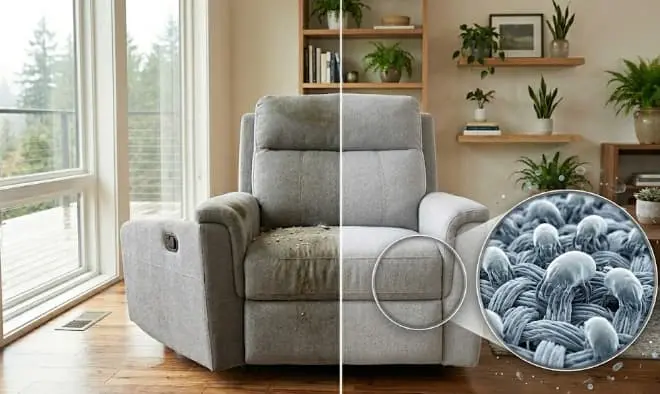
- Dust mites feeding on the organic debris
- Pet hair pushed in with each footrest movement
Why it matters: The footrest fold is the single dirtiest area in most recliners — completely invisible unless you fully extend and closely examine the crease zones.
Armrest Seam Channels
Armrests absorb more body contact than almost any other surface. Along the seams where fabric meets padding:
- Sweat and skin oils soak into the padding layers
- Hand lotion, food grease, and drink spills accumulate
- Bacteria thrive in the warm, protein-rich environment
- Dark discoloration forms over time from oil buildup
- Odor-causing compounds embed in the foam backing
Why it matters: Armrest contamination is often the primary source of recliner odors and the area most likely to cause fabric degradation over time.
Under-Cushion Base
The gap between the seat cushion and the recliner base acts as a collection point for everything that falls while you sit:
- Food crumbs — often years of accumulation
- Coins, receipts, and small items
- Pet fur and dander pressing against the base fabric
- Dust accumulating in the undisturbed zone
- Moisture from spills that wicked downward
Why it matters: Organic debris in this zone feeds dust mite colonies and can cause localized mold if any moisture is present.
Backrest and Headrest Zone
The backrest and headrest area absorbs what the armrests don't — everything from the back of the body:
- Hair and scalp oils embedding into the headrest fabric
- Back sweat soaking into padding during long sitting sessions
- Hair product residue — gels, sprays, conditioners
- Fabric darkening and stiffening from repeated oil absorption
- Allergens including pet dander and pollen carried in from outdoors
Why it matters: Headrest contamination is directly at face and nose level — making it the most relevant zone for allergy sufferers and respiratory health.
What the Numbers Say: Recliner Contamination by the Facts
| Contaminant | Where It Hides in a Recliner | Health Relevance | Removed by Professional Cleaning |
|---|---|---|---|
| Dust Mites | Deep padding, footrest folds, cushion base | Major trigger for asthma and allergies | Yes — hot extraction eliminates mites and allergens |
| Dead Skin Cells | All fabric surfaces, seam channels | Primary food source for dust mites | Yes — deep extraction removes organic buildup |
| Bacteria | Armrests, headrest, footrest | Can cause skin irritation and odor | Yes — sanitizing treatments eliminate bacteria |
| Pet Dander | Entire surface and padding layers | Potent allergen, persists for months | Yes — enzyme treatments break down dander proteins |
| Mold Spores | Areas with past moisture or spills | Respiratory irritant, worsens with humidity | Yes — antimicrobial treatment prevents regrowth |
| VOCs from Body Oils | Armrests, headrest, seat cushion | Cause fabric degradation and persistent odor | Yes — enzyme-based solutions neutralize compounds |
Why Recliners Are Harder to Clean Than Standard Chairs
A standard dining chair or armchair has a relatively simple structure — a seat, a back, and armrests. A recliner is mechanically complex, and that complexity creates cleaning challenges that require professional expertise:
Multiple Fabric Zones
Recliners have distinct fabric panels — the seat, back, armrests, footrest exterior, footrest underside, and side panels. Each zone has different wear levels and contamination types. A single cleaning method rarely suits all zones equally.
Mechanical Gap Access
The reclining mechanism creates gaps between moving parts that standard cleaning tools cannot enter. Professional technicians work the recliner through its range of motion during cleaning to access and treat all hidden crease zones.
Moisture Management
Over-wetting a recliner risks moisture reaching the metal mechanism, causing rust, and soaking deep into thick padding where it cannot dry — leading to mold. Professional low-moisture methods clean effectively while protecting the mechanism.
Our Professional Recliner Cleaning Process
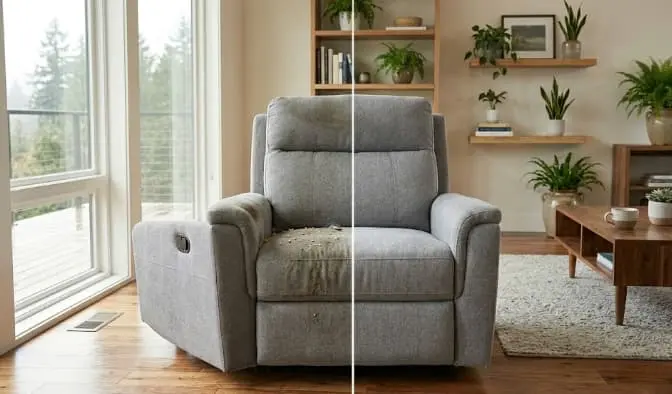
At Fresh Furnish Cleaners, our recliner cleaning service follows a structured process designed specifically for the unique challenges of recliner upholstery:
-
Full Recliner Assessment
We identify the fabric type (microfiber, polyester blend, velvet, leather, faux leather), check manufacturer care codes, test colorfastness, and assess contamination zones before selecting any treatment.
-
Mechanical Extension Inspection
We fully recline and extend the footrest to expose all hidden zones — examining the footrest folds, side panel gaps, and under-seat areas that are invisible in the closed position.
-
Dry Vacuuming All Zones
We use crevice attachments and upholstery tools to extract loose debris from every surface and gap — including the footrest fold, armrest seams, cushion borders, and headrest area.
-
Targeted Pre-Treatment
Stained, soiled, and high-contact areas receive pre-treatment appropriate to the fabric type — enzyme formulas for organic stains, solvent treatments for oil-based residue, gentle solutions for delicate fabrics.
-
Deep Cleaning with Appropriate Method
Depending on the fabric, we use hot water extraction, low-moisture cleaning, or dry-cleaning methods. We clean with the recliner in multiple positions to reach all surfaces properly.
-
Mechanism Gap Treatment
We treat the crease zones and mechanical gap edges — the areas most people miss — using narrow applicators and controlled moisture to clean without over-wetting near the frame.
-
Sanitizing and Deodorizing
Antimicrobial treatment neutralizes bacteria and mold spores. Enzyme-based deodorizing eliminates odor compounds at the molecular level rather than masking them with fragrance.
-
Optional Fabric Protection
We apply fabric protector that forms an invisible barrier against future spills and soiling, significantly extending the time between necessary professional cleanings.
Recliner Upholstery Types: What Changes the Approach
Not all recliners are cleaned the same way. The upholstery material determines which methods and products are safe and effective. Our armchair upholstery cleaning technicians are trained across all common recliner fabric types:
Microfiber is the most popular recliner upholstery — soft, durable, and deceptively hard to clean correctly. Water alone can leave permanent watermarks. Incorrect cleaning products can cause stiff, rough patches or color loss.
- Requires solvent-based or water-based cleaning depending on the specific microfiber grade
- Must be brushed during drying to restore the nap and prevent stiffening
- Pre-testing is essential — different microfibers react differently to water
- Professional low-moisture methods prevent the watermark problem entirely
Woven fabric and polyester blend upholstery is highly receptive to professional hot water extraction cleaning, which provides the deepest clean available for these materials.
- Hot water extraction removes embedded allergens and deep soiling effectively
- Drying time: 2 to 4 hours with proper ventilation
- Responds well to enzyme pre-treatments for stain removal
- Fabric protector application highly recommended after cleaning
Leather recliners require cleaning and conditioning as a combined process. Cleaning without conditioning strips the natural oils from leather, causing premature cracking and drying — a common mistake with DIY cleaning.
- pH-balanced leather cleaners only — standard upholstery products damage leather
- Conditioning treatment restores suppleness and prevents cracking
- Seam and crease zones require careful attention — leather cracks first at stress points
- No drying time required — leather is ready immediately after professional service
Velvet recliners are among the most visually striking and most cleaning-sensitive. The pile direction determines how products must be applied and how the fabric must be dried to avoid permanent marking.
- Dry-cleaning methods generally preferred for traditional velvet
- Performance velvet (Crypton, Sunbrella) is more water-tolerant — requires different approach
- Brushing in the correct pile direction during and after cleaning is essential
- Professional assessment required before any cleaning attempt
Signs Your Recliner Needs Professional Cleaning Now
Immediate Signs
- Persistent odor — a smell that doesn't go away after airing out, especially after sitting in it
- Dark patches on armrests or headrest — oil and sweat buildup that has changed the fabric color
- Visible staining — food, drink, pet accidents that weren't fully addressed when fresh
- Allergy symptoms worsening at home — sneezing, watery eyes, or congestion that improves when away
- Pet odor — dander and oils embedded in the upholstery long after the pet last used the chair
Time-Based Indicators
- More than 18 months since last professional cleaning — even if it looks acceptable on the surface
- Daily use for 12+ months — daily contact means daily contamination accumulation
- After illness in the household — bacteria and viruses can persist in upholstery
- After a pet has regularly used the chair — dander, oils, and hair require thorough extraction
- Before allergy season — reducing allergen load in furniture before pollen season provides significant relief
What Customers Say About Our Recliner Cleaning Service
"I had no idea how dirty my recliner actually was until the technician showed me the extraction water after cleaning. It was dark brown. The chair is 4 years old and I thought I kept it reasonably clean. Never again waiting this long."
"My leather recliner had a smell I couldn't get rid of no matter what I sprayed on it. One professional cleaning and conditioning treatment completely eliminated it. They also caught a beginning crack in the seam that I hadn't noticed."
"My son has dust mite allergies and his symptoms were worst in the living room. After having the recliner and couch professionally cleaned, his nighttime symptoms improved significantly. Worth every penny for that alone."
"Two cats use our recliner constantly. I was skeptical that professional cleaning could actually make a dent in the pet hair and smell. It completely transformed the chair — fresh, clean, and the cats hadn't noticeably left their mark anymore."
Between Professional Cleanings: Recliner Maintenance Tips
Weekly Habits That Make a Difference
- Vacuum the seat, back, and armrests using an upholstery attachment — go slowly to lift embedded fibers
- Use a crevice tool along the seat cushion border and the armrest seams
- Fully extend the footrest weekly and vacuum the fold zone and underside
- Wipe leather recliners with a lightly damp microfiber cloth to remove surface oils
- Rotate a throw blanket or armrest cover to distribute wear on high-contact areas
Spill Response — Do This Immediately
- Blot, never rub — rubbing spreads the stain and pushes it deeper into the padding
- Use a clean white cloth — colored cloths can transfer dye to damp upholstery
- Work from the outside edge of the stain inward to prevent spreading
- For pet accidents: use an enzyme-based cleaner to break down urine proteins and prevent odor
- Never use hot water on fresh stains — it sets protein stains (blood, milk, pet accidents) permanently
- Call for professional follow-up if the stain soaked deep — surface treatment alone leaves residue in the padding
Frequently Asked Questions About Recliner Cleaning
For daily-use recliners, professional cleaning every 12 to 18 months is the standard recommendation. Households with pets, young children, or allergy sufferers benefit from cleaning every 6 to 12 months. Regular vacuuming between professional visits extends the time between necessary cleanings.
No — when done by trained technicians who understand recliner construction. The key is moisture control: professional low-moisture methods clean the upholstery thoroughly without saturating the fabric near the metal frame. We specifically avoid over-wetting near mechanical components and work with the recliner extended to avoid moisture wicking into gap zones.
We provide in-home recliner cleaning service throughout Washington State. There is no need to move the furniture — we bring all equipment and supplies to your home and complete the entire cleaning on-site. Recliners are typically too heavy and bulky to transport for off-site cleaning, and in-home cleaning is equally effective.
A standard recliner cleaning service takes approximately 45 minutes to 1.5 hours depending on the size, fabric type, and contamination level. Heavily soiled recliners or those requiring multiple treatments take longer. We'll give you an accurate estimate after assessing the chair.
Serving Washington State — Recliner Cleaning Near You
Our Service Area
Fresh Furnish Cleaners provides professional recliner cleaning service and armchair upholstery cleaning throughout the greater Seattle and Puget Sound region, including:
- Seattle and all neighborhoods
- Bellevue and the Eastside
- Kirkland and Redmond
- Bothell and Mill Creek
- Everett and Lynnwood
- Edmonds and Shoreline
- Sammamish and Issaquah
- Woodinville and Snohomish
Related Upholstery Cleaning Services
Chair Cleaning Seattle
Professional cleaning for all types of chairs — dining, accent, office, and lounge — throughout Seattle.
Chair Cleaning in SeattleSofa Cleaning Kirkland
Deep sofa and sectional cleaning service for Kirkland and Eastside homes and businesses.
Sofa Cleaning in KirklandUpholstery Cleaning Seattle
Full-service upholstery cleaning for all furniture types across Seattle and the greater Puget Sound area.
Upholstery Cleaning in Seattle
Ready to Clean Your Recliner?
Get professional recliner cleaning service in Washington State. We come to your home, bring all equipment, and restore your recliner to genuinely clean — not just surface clean.
Serving Seattle, Bellevue, Kirkland, Redmond, Bothell, Everett & surrounding areas
