How to Remove Water Stains and Mineral Deposits from Outdoor Cushions
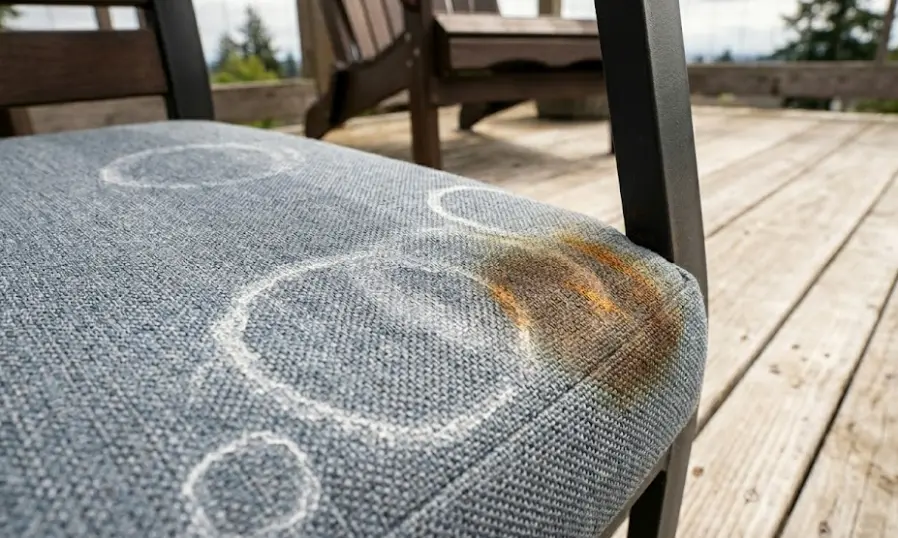
There is a specific kind of frustration that comes from cleaning your outdoor cushions thoroughly — scrubbing, rinsing, drying in the sun — and then noticing the chalky white rings are still there. The mold is gone, the dirt is gone, but those pale circular marks where rain pooled and dried are unmoved by anything you threw at them. That is because water stains and mineral deposits on patio cushions are a different category of problem from mold or general soiling, and the standard cleaning solutions do almost nothing to remove them.
This guide covers the three types of water-related staining that appear on outdoor cushions in the Seattle area — mineral deposits, rust transfer, and tannin staining from pooled rain — and the specific treatments that actually work on each one. There is real chemistry involved, and understanding it is what separates a clean that works from one that moves the problem around without solving it.
Identifying What Type of Water Stain You Are Dealing With
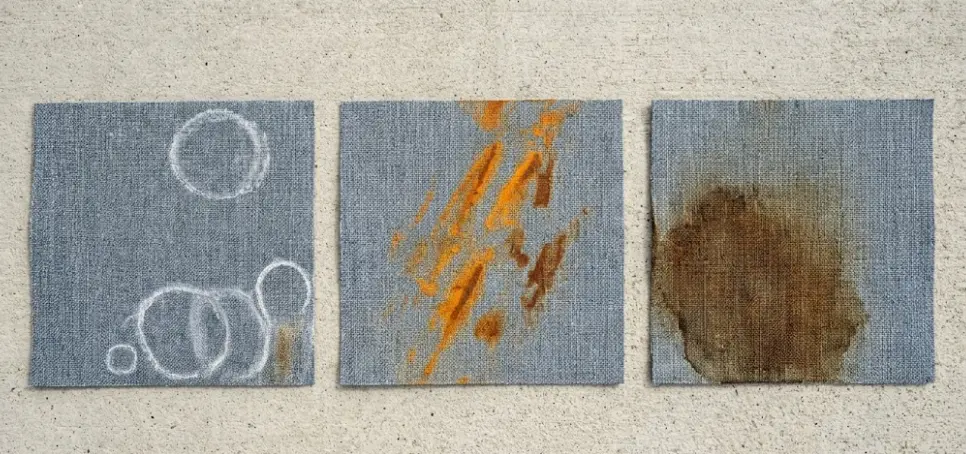
The appearance and location of the staining tells you its source, which tells you what will remove it. These three types behave completely differently on outdoor fabric:
Mineral / Hard Water Deposits
White or grey-white
What it looks like: Chalky, slightly rough to the touch. Usually ring-shaped — the concentrated white outline of where water pooled and then evaporated. Can cover large areas if cushions sit in standing rain water regularly.
Where it appears: Anywhere water pools and dries. Top surfaces, depressions in the fabric, around the piping, on low-lying seats near sprinkler coverage.
What it is: Calcium carbonate, magnesium carbonate, and silica — minerals left behind when the water evaporates.
Iron / Rust Transfer Staining
Orange, rust-brown
What it looks like: Orange to rust-brown coloration, often spreading outward from a specific contact point. Can appear as a concentrated spot or as a diffuse orange wash over areas that iron-rich water regularly wets.
Where it appears: Adjacent to rusted metal furniture legs or hardware. On cushions in contact zones with iron frames. Sometimes as overall orange cast from iron-rich irrigation systems.
What it is: Iron oxide — either transferred directly from rusted metal, or deposited from water with elevated iron content (common in private well systems in Eastside communities).
Tannin Staining from Pooled Rain
Brown, amber, tea-colored
What it looks like: Brown to amber discoloration, often covering large areas of the cushion surface. Less defined edges than mineral rings. May have a slight yellowish tint on lighter fabrics.
Where it appears: On cushions that sat in standing water containing organic matter — leaves, pollen, dirt. Common after Seattle winters on cushions stored outdoors or in covered areas where water tracked in.
What it is: Tannins and humic acids leached from organic material that decomposed in pooled water. Similar to the staining from tea or red wine, biologically speaking.
Where Seattle Mineral Deposits Actually Come From
Seattle's municipal water supply from the Cedar River and South Fork Tolt River watersheds is relatively soft — typically 0.5 to 2.0 grains per gallon of hardness, which is well below the national average of around 10 grains per gallon. By the strict definition of hard water scale, Seattle city water should leave minimal mineral deposits. In practice, many Seattle-area homeowners see chalky staining on outdoor cushions regularly, and the cause is almost always something other than the tap water itself.
Concrete patios are the most common culprit. Rain water landing on concrete picks up dissolved calcium hydroxide — the alkaline byproduct of concrete curing — and carries it onto cushion fabric before evaporating. This process continues for years on any concrete or masonry surface, and it produces the ring-shaped white deposits that are so distinctive on outdoor cushion fabric near the piping and on low-profile seats. If your cushions sit directly on a concrete patio rather than elevated on a furniture frame, the concentration of mineral transfer is significantly higher.
The second major source in the Seattle metro area is irrigation. Automatic drip or sprinkler systems in Kirkland, Bellevue, Mercer Island, and rural Eastside communities frequently draw from private wells rather than city supply. Groundwater in the Eastside has consistently higher mineral content than Seattle's mountain-reservoir supply. A drip system running nightly that catches the edge of a cushion deposits a small amount of mineral water each cycle — which over a summer season builds into visible white scale concentrated at the drip points.
Removing Mineral Deposits: The Chemistry and the Process
Calcium carbonate — the primary mineral in hard water deposits — is an alkaline compound. It dissolves predictably in mild acids. This is the entire chemical basis for the standard mineral-removal treatments, and understanding it helps you choose the right product and understand why dwell time matters: the acid needs time to react with and dissolve the mineral, not just rinse it off the surface.
White Vinegar Solution
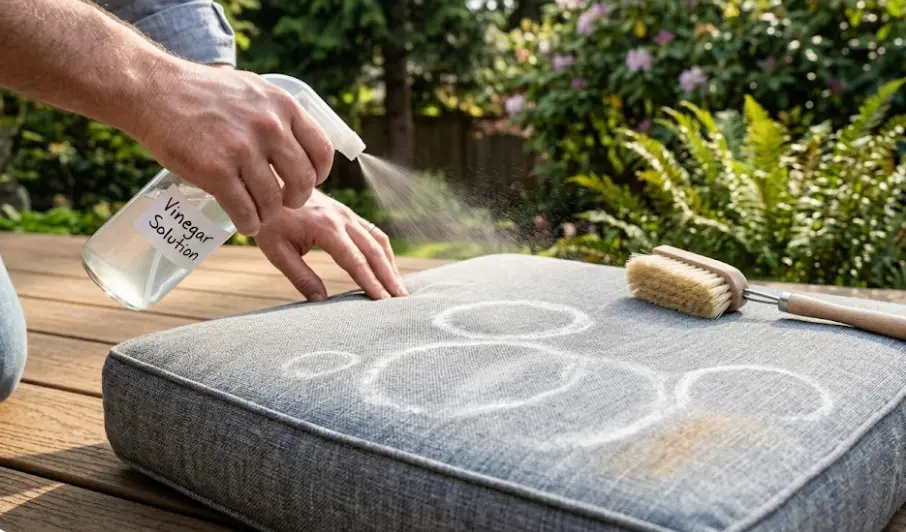
Concentration: Equal parts white vinegar and water (2.5% acetic acid). For heavy deposits, use vinegar undiluted.
Best for: Sunbrella, polyester, solution-dyed acrylic fabrics. The most widely available and effective option for most outdoor cushion materials.
Limitation: Has a strong odour that lingers until fully rinsed and dried. Does not leave residue if thoroughly rinsed, but inadequate rinsing leaves a vinegar smell. Some pH-sensitive natural dyes on cotton canvas may shift slightly with repeated undiluted treatment — always test first on natural-fibre fabrics.
Dwell time needed: 10–15 minutes for moderate deposits. 20–30 minutes for heavy, long-standing scale.
Citric Acid Solution
Concentration: 1 tablespoon citric acid powder dissolved in 1 cup of warm water. Available at hardware stores, homebrew suppliers, and some grocery stores.
Best for: All outdoor fabric types including cotton-canvas blends. Gentler on fabric dyes than white vinegar, no lingering odour, and equally effective on calcium carbonate at equivalent concentrations.
Limitation: Slightly more expensive and less immediately available than white vinegar. Not meaningfully better than vinegar on Sunbrella or polyester — the advantage is primarily on more colour-sensitive natural fabrics.
Dwell time needed: 10–20 minutes. Citric acid reacts slightly slower than acetic acid at household concentrations.
Dry-Brush the Deposit Before Wetting
For heavy mineral deposits — the thick, crusty kind that have built up over multiple seasons — start with a dry soft-bristle brush before applying any liquid. Brush the affected area gently to knock loose any scale that is sitting on the surface rather than embedded in the fabric. This step is skipped by most people but it matters: you want the acid treatment to penetrate the remaining embedded minerals, not spend its reactive potential on the loose surface layer. Work outdoors, as brushing dry mineral deposits releases fine calcium dust.
Wet the Fabric Before Applying the Acid Solution
Pre-wet the stained area with plain water before applying your vinegar or citric acid solution. This prevents the acid from being immediately absorbed unevenly into dry fabric — a dry fabric pulls the solution in quickly at certain points and shallowly at others, which produces uneven treatment and can leave tide marks at the edges of the treatment zone. Wet fabric allows the acid solution to distribute more evenly across the surface. This is particularly important on Sunbrella and woven polyester, where the weave structure can cause uneven liquid absorption.
Apply the Solution and Wait — the Dwell Time Is the Treatment
Apply your acid solution generously to the stained area. For a vinegar solution, the area should be visibly wet and saturated, not just dampened. Set a timer for 10–15 minutes and leave it alone. The temptation is to scrub immediately, but scrubbing before the acid has reacted with the mineral just spreads it around. The chemical reaction between acetic acid and calcium carbonate is what dissolves the deposit — the scrubbing afterward is just for dislodging the loosened residue. On very heavy deposits, you may see mild fizzing as the acid reacts with the calcium — this is the reaction working correctly.
Scrub, Then Assess
After dwell time, scrub the treated area with a soft-bristle brush using back-and-forth strokes following the fabric weave direction. The mineral residue should come away relatively easily if the acid treatment worked — you should see the chalky material loosening. If significant white deposit remains after the first application and scrub, apply the solution a second time for another 10 minutes rather than scrubbing harder. Mechanical force on a partially treated deposit can drive remaining particles deeper into the weave. Apply and wait again, then scrub a second time. Two light applications are more effective than one aggressive scrub.
Rinse Extensively
Rinse the treated area very thoroughly with a garden hose. The rinsing step here does two things: removes the dissolved mineral residue and removes the acid solution from the fabric. If you are using white vinegar, the smell test during rinsing tells you when you have rinsed enough — rinse until the smell is completely gone. Insufficient rinsing leaves dissolved mineral particles in the fabric that can re-deposit in a different pattern when they dry, creating new marks rather than removing old ones. For cushions on a covered patio, use the hose liberally rather than trying to be conservative with the water — thorough rinsing is what produces a clean result.
Dry Completely and Assess the Result
Stand the cushions on edge so air circulates on both faces and allow to dry fully — 6–12 hours in direct Seattle sunlight, longer on overcast days. Do not assess the result while the cushion is still damp: mineral deposits that have been partly removed may be invisible when wet and reappear as they dry. Only once fully dry can you see accurately what remains and whether a second treatment is needed. A single thorough treatment removes most light-to-moderate mineral deposits completely. Deposits that have accumulated over multiple seasons without treatment may require two or three applications over several days, which is normal — you are reversing years of mineral buildup, not a single rain event.
Rust Staining: A Different Problem That Needs a Different Approach
Iron oxide staining is orange to rust-brown, appears at contact points with metal furniture parts, and does not respond to the vinegar treatment that works on calcium deposits. The two are chemically unrelated: calcium carbonate is alkaline and dissolves in acid; iron oxide does not. The correct treatment for rust staining on outdoor cushion fabric is oxalic acid — a naturally occurring acid found in plants and available commercially as the main active ingredient in Bar Keepers Friend powder.
The process is straightforward: wet the stained fabric thoroughly with plain water, make a paste by mixing Bar Keepers Friend powder with just enough water to form a spreadable consistency, apply to the rust stain, and allow 5 minutes of dwell time. Do not exceed 10 minutes — oxalic acid is more reactive than acetic acid and can affect fabric dyes with prolonged contact on some materials. Scrub gently with a soft brush and rinse very thoroughly. On Sunbrella and polyester, this treatment is generally safe for a single application. On cotton or linen-blend fabrics, test in a hidden area first.
Do Not Use Chlorine Bleach on Rust Stains
Chlorine bleach does not remove rust staining and actively makes it worse by oxidising the iron further, permanently fixing a darker rust-brown mark into the fabric. This is one of the most common mistakes in outdoor cushion stain treatment. If you have already applied bleach to a rust stain, the remaining mark may be permanent — professional cleaning with a commercial iron-removing product is your best remaining option. For all future rust treatment, stick to oxalic acid products only.
If rust staining on your cushions comes from ongoing contact with a rusted furniture leg or bracket — not just a one-time transfer — treating the cushion alone will not solve the problem. The rust source on the furniture frame needs to be addressed: sand the rusted area back to clean metal, apply a rust-inhibiting primer, and repaint with outdoor-rated enamel. Our full guide on patio furniture restoration in Seattle covers wrought iron and steel frame treatment in detail. Cleaning rust staining off cushions while leaving the source untreated means the staining returns within one rain event.
Brown Tannin Staining from Pooled Rainwater
The tea-colored brown staining that develops on outdoor cushions left in standing water is caused by tannins — organic compounds that leach out of decomposing leaves, pollen, and other plant material that collect in pooled water. Chemically, tannin staining is similar to the staining from strong tea or red wine on fabric: it binds to the fabric fibres and darkens over time if left untreated. It does not respond well to acid treatment (vinegar), and it does not respond to salt or mechanical scrubbing alone. Oxygen bleach is the correct treatment.
Oxygen Bleach Treatment
Dissolve 1/4 cup of oxygen bleach powder (sodium percarbonate — sold as OxiClean, Sodium Percarbonate, or similar) in one gallon of warm water. Apply to the stained area generously, ensuring the fabric is saturated. Allow 20–30 minutes of dwell time — longer than for mineral treatment, because the oxidising reaction that breaks down tannin molecules works more slowly than acid on calcium. Scrub gently and rinse very thoroughly. For Sunbrella fabric, this is a safe treatment on all colours. For polyester and olefin, safe. For cotton canvas, test first on a light colour — oxygen bleach can lighten some natural fibre dyes slightly.
Stubborn tannin staining may require repeating the treatment after drying and reassessing. Very old tannin staining — set in over an entire winter — sometimes cannot be fully removed from natural-fibre fabrics, though it can be significantly lightened.
Time Is the Enemy with Tannin
Tannin staining sets into outdoor fabric quickly — within 48 to 72 hours at room temperature, and more slowly in Seattle's cool climate, but progressively harder to remove the longer it sits. A cushion that soaked in organic-matter-laden standing water for an entire Seattle winter will have significantly more embedded tannin than one that was spot-treated within a week of the staining event.
If you bring cushions in at the end of the season and notice brown staining, treat it immediately rather than storing the cushions for winter untreated. Tannin that sets for six months in a storage bag in a garage is very difficult to remove; tannin treated in autumn before storage is usually straightforward.
Quick Reference: Which Treatment for Which Stain
| Stain Type | Colour / Appearance | Correct Treatment | Avoid |
|---|---|---|---|
| Mineral / Hard Water Deposits | White, grey-white, chalky rings, slightly rough texture | White vinegar (50/50 with water) or citric acid solution. 10–15 min dwell. Scrub and rinse thoroughly. | Bleach (does nothing to mineral). Soap only (does not dissolve calcium). |
| Iron / Rust Staining | Orange to rust-brown, concentrated at metal contact points or diffuse from iron-rich water | Oxalic acid (Bar Keepers Friend paste). 5–10 min dwell. Rinse very thoroughly. | Chlorine bleach (permanently sets rust staining). Vinegar (ineffective on iron oxide). |
| Tannin from Pooled Rain | Brown, amber, tea-colored, large area coverage, soft edges | Oxygen bleach solution (1/4 cup per gallon warm water). 20–30 min dwell. Rinse thoroughly. | Vinegar (ineffective on tannin). Scrubbing without dwell time (moves not removes). |
| White marks — mold / mildew (not mineral) | Flat powdery white or grey film, smells musty when wet, slightly fuzzy texture | Oxygen bleach. On Sunbrella: diluted chlorine bleach option. See our mold on patio cushions guide. | Vinegar alone (limited on mold). Dry scrubbing that releases spores indoors. |
Preventing Water Staining: What Actually Works
The most effective prevention depends on which staining type you are dealing with. There is no single solution that addresses all three.
For mineral deposits from concrete or irrigation: the primary prevention is eliminating standing water contact. Cushions that dry quickly after rain develop minimal deposits because the water does not sit long enough to evaporate and concentrate minerals. This means elevating cushions off flat concrete surfaces (furniture legs rather than direct patio contact), angling the furniture slightly so water runs off rather than pooling on the fabric surface, and storing or covering cushions when not in use during extended rain periods. A breathable furniture cover during Seattle's wet autumn and winter significantly reduces deposit accumulation over the season. If your irrigation system is hitting the cushions, adjust the spray radius to exclude furniture entirely — this is the single most effective change available if irrigation is the primary deposit source.
For rust staining from metal furniture: maintain the paint coat on any iron or steel furniture components. A single spot of bare metal against wet fabric is enough to transfer rust staining within a few rain events. Check furniture frames in spring before the outdoor season and touch up any chips or scratches with a rust-inhibiting primer and outdoor enamel paint. See our patio furniture restoration guide for the full iron frame treatment process.
For tannin staining: keep cushions free of standing organic debris — leaves particularly — and do not allow water containing decomposing organic matter to pool on fabric surfaces for extended periods. In Seattle's leaf-fall season, a weekly brush-down of outdoor cushions during October and November removes the organic material before rain has a chance to steep it into the fabric.
What Seattle Homeowners Have Found
"We have been fighting white ring stains on our cushions for three summers. I tried every cleaner I could find and nothing touched them. A friend told me it was mineral deposits from our concrete patio — we have a drip irrigation system running near the furniture. I tried the white vinegar method described here and the marks that had been there for two seasons were almost completely gone after two treatments. No magic product, just the right approach. I also adjusted our irrigation heads so they no longer hit the patio furniture area."
"Our wrought iron set was leaving orange staining on the cushions wherever the fabric touched the frame. I tried oxygen bleach — nothing. Tried vinegar — made it slightly worse actually. Called Fresh Furnish and they immediately identified it as rust transfer and used the right product for it. The cushions came back clean and they also showed us where the paint on the frame had chipped and was actively rusting at the leg contacts. Once we touched up the paint, the problem stopped completely. The source matters as much as the treatment."
When Professional Cleaning Makes Sense for Water Staining
Mineral deposits and tannin staining that have built up over multiple seasons without treatment — particularly on lighter-coloured cushions — can require professional extraction methods to remove completely. The issue is that deeply embedded mineral scale and set-in tannin reach beyond what surface-applied solutions and hand scrubbing can reach into a foam-backed outdoor cushion. Hot water extraction at professional pressure, combined with the correct pH-balanced treatment product applied at the right concentration and dwell time, can address deposits that have not responded to repeated DIY attempts.
Rust staining that has been inadvertently treated with bleach — which sets the stain permanently — is one of the more challenging situations in outdoor cushion cleaning. In some cases, professional treatment with a commercial iron chelating agent can reduce (though rarely eliminate entirely) bleach-set rust marks. If you have applied bleach to an orange stain and the mark darkened, call before attempting further DIY treatment — additional products on top of a bleach reaction can cause further permanent change to the fabric.
If the staining is severe enough that it might affect your decision to keep or replace the cushion set, a professional assessment before purchasing replacements is a cost-effective step. Fresh Furnish Cleaners serves Seattle, Bellevue, Kirkland, Redmond, Bothell, and the greater Eastside metro — contact us for a no-obligation assessment and quote for outdoor cushion stain treatment.
Borax Method for Stubborn White Mineral Rings
White chalky rings that don't fully respond to the vinegar-and-water method often respond well to a borax solution, which combines mild alkalinity with light abrasive action to break down calcium deposits without damaging most outdoor fabrics.
- 1 tablespoon 20 Mule Team Borax
- 1 teaspoon dish soap
- 4 cups lukewarm water
- Spray bottle + soft brush
- Mix borax, dish soap, and water in spray bottle
- Spray generously onto the stained area
- Let dwell 15 minutes
- Scrub gently with soft brush
- Rinse very thoroughly with clean water
- Air dry upright in sun if possible
Note: Test in an inconspicuous spot first on cotton-canvas blends or dark-colored fabrics — borax is safe for Sunbrella and most solution-dyed acrylic outdoor fabrics but can lighten some natural-fiber dyes with extended contact.
Frequently Asked Questions
The method depends entirely on what type of water stain it is. For white or grey chalky mineral deposits (the most common type in Seattle): mix equal parts white vinegar and water, apply generously to the pre-wetted stained fabric, wait 10–15 minutes for the acid to react with the calcium deposits, scrub gently with a soft brush, and rinse very thoroughly until no vinegar smell remains. For orange or rust-brown staining from iron transfer: use an oxalic acid product (Bar Keepers Friend powder made into a paste) — 5 minutes dwell time, gentle scrub, thorough rinse. For brown tannin staining from pooled organic-matter water: oxygen bleach solution (1/4 cup per gallon of warm water), 20–30 minutes dwell, scrub, rinse. Identify first, then treat — using the wrong treatment on the wrong stain type is ineffective at best and counterproductive at worst.
White marks after rain are mineral deposits — calcium carbonate and related compounds that are carried onto the fabric by water and left behind as the water evaporates. The minerals rarely come from the rainwater itself, which is nearly mineral-free. They come from surfaces the water contacts before reaching the cushion: concrete patios leach calcium as rain splashes; irrigation systems running over concrete or stone carry dissolved minerals onto fabric; water dripping from metal frames can carry iron deposits. The ring-shaped pattern — a distinct white outline around where water pooled — is the classic sign. A rougher texture compared to the surrounding clean fabric, and no odour when wet, distinguishes mineral deposits from mold or mildew.
Yes, white vinegar is effective for calcium and magnesium mineral deposits on outdoor cushion fabric. The acetic acid in household vinegar (5% concentration) dissolves calcium carbonate — the main mineral component in hard water scale. Use equal parts white vinegar and water applied to pre-wetted fabric, with a dwell time of 10–15 minutes before scrubbing and rinsing. The key point most people miss is the dwell time: the acid needs time to react with the mineral. Scrubbing immediately after application and before the chemistry has worked produces poor results. Citric acid (1 tablespoon per cup of warm water) is an odour-free alternative that works equally well and is slightly gentler on colour-sensitive natural fibres. On Sunbrella and polyester outdoor fabrics, both are safe. Test on natural-fibre cotton canvas first.
Rust and iron staining on outdoor cushion fabric requires an oxalic acid treatment — Bar Keepers Friend powder is the most accessible product. Wet the fabric thoroughly first, mix Bar Keepers Friend to a paste consistency with a small amount of water, apply to the rust stain, allow 5 minutes (maximum 10 minutes) of dwell time, scrub gently, and rinse very thoroughly. Safe on Sunbrella and polyester with a single treatment. Test on cotton or linen-blend fabrics in a hidden area first. The critical thing to avoid is chlorine bleach on rust stains: it oxidises the iron further and permanently deepens the staining into a dark rust-brown that is very difficult to remove afterward. If bleach has already been applied to a rust stain, professional treatment is the remaining option — home methods are unlikely to reverse the bleach-set mark.
The simplest test: dampen the white area and smell it. Mineral deposits are completely odourless when wet. Mold and mildew produces a musty, earthy smell that intensifies when the area is moistened. Visually, mineral deposits tend to have defined ring shapes with relatively hard edges — the boundary of where water pooled and dried. The surface feels slightly rough or grainy. Mold/mildew appears as a flatter, powdery or slightly fuzzy film, often less geometrically defined, and can have a grey-green or grey-white colouration depending on the mold species. The treatments are different: mineral deposits require acid treatment (vinegar or citric acid); mold requires oxygen bleach or, for Sunbrella, diluted chlorine bleach. Applying the wrong treatment confirms the diagnosis quickly — vinegar on mold reduces the mold slightly at best; bleach on mineral deposits has no visible effect.
Seattle's city water from the Cedar River watershed is relatively soft (0.5–2.0 grains per gallon), so the water itself is rarely the direct source of mineral deposits. The deposits most commonly come from the surfaces the water contacts: concrete patios leach calcium into water that splashes or pools; irrigation systems in Eastside communities often use harder well groundwater that carries more dissolved minerals; automatic drip systems can deposit concentrated mineral residue wherever they regularly wet fabric. Homes in Redmond, Kirkland, Sammamish, and rural Eastside areas using private wells for irrigation can experience significantly more mineral staining than Seattle proper, where city water is the irrigation source. If you are on the Eastside and have persistent mineral staining, testing your irrigation water hardness with an inexpensive test strip is a useful first step before investing effort in repeated treatment.
Related Outdoor Furniture Guides
Mold on Patio Cushions
White marks but no odour? Mineral deposit, probably. Musty smell when wet? That is mold territory. Our full guide on removing mold from outdoor cushions covers identification, severity assessment, and the correct DIY and professional treatment for each level of mold contamination.
Full Pre-Season Cushion Cleaning
Mineral treatment is one part of a complete spring clean. Our outdoor furniture cushion cleaning guide covers fabric identification, the full DIY step-by-step process, and how to handle removable covers and foam inserts.
Restoring the Frame Too
If rust staining on cushions is coming from a rusted iron frame, the source needs to be addressed. Our patio furniture restoration guide covers wrought iron rust treatment, aluminum oxidation, and what is genuinely worth restoring vs. replacing in Seattle's climate.
Staining That Won't Respond to DIY? We Can Assess and Treat It Properly
Mineral deposits, iron staining, and set-in tannin that has not responded to home treatment often requires professional extraction and the correct professional-grade treatment chemistry. Fresh Furnish Cleaners provides outdoor cushion stain assessment and professional cleaning across Seattle, Bellevue, Kirkland, Redmond, Bothell, and the greater Eastside — same-day service available when you call before 2 PM.
Stain Identification
We identify the stain type before treating — no guesswork, no wrong products
Same-Day Service
Call before 2 PM for same-day outdoor furniture and cushion cleaning across the Seattle metro
Photo Quote
Send a photo of your cushion staining for a no-obligation assessment and quote within the hour
Serving Seattle, Bellevue, Kirkland, Redmond, Bothell, Woodinville, Lynnwood, Edmonds, Shoreline & surrounding areas
