Cat Urine on Sofa: Professional Cleaning Solutions
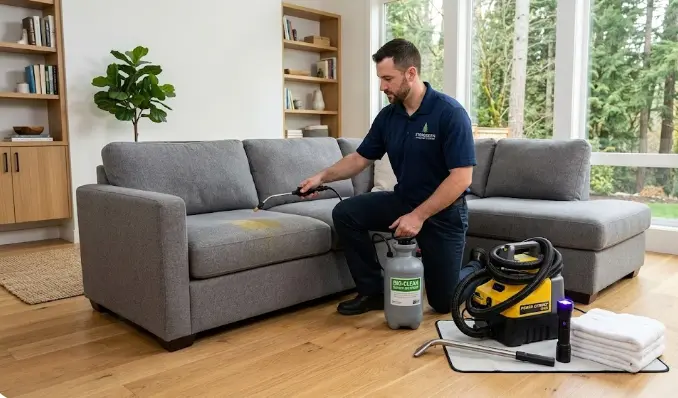
Why Cat Urine Is the Hardest Sofa Stain to Remove
Cat urine is not a simple stain. It is a chemically complex substance that behaves differently from almost any other sofa contaminant — and that is exactly why most DIY cleaning attempts fail, and why the smell keeps coming back even after you think you've dealt with it.
The problem is uric acid. Unlike most organic compounds, uric acid forms crystite crystals that bond tightly to fabric and foam fibers. These crystals do not dissolve in water, do not respond to standard cleaning products, and — crucially — reactivate every time humidity rises. That is why a sofa that seemed clean in winter suddenly smells strongly of cat again in warm, humid weather: the crystals never left.
Effective cat urine sofa cleaning requires enzyme-based treatment specifically formulated to break down uric acid at the molecular level. Everything else — baking soda, vinegar, enzyme sprays from pet stores, steam cleaning — either masks the odor temporarily or, in the case of steam, heat-sets the problem permanently. This guide explains what actually works and why professional treatment is the only reliable solution for removing cat smell from a couch completely.
The Chemistry of Cat Urine — Why It Behaves Differently
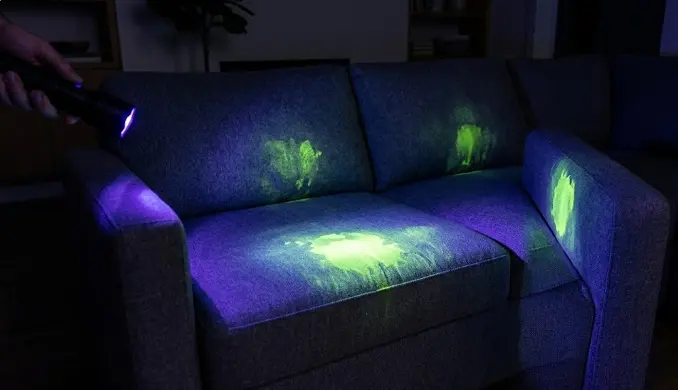
Fresh cat urine is made up of several compounds, each presenting a different cleaning challenge:
| Component | What It Does | Why It's Hard to Remove | What Breaks It Down |
|---|---|---|---|
| Uric Acid Crystals | Causes the persistent, reactivating odor | Insoluble in water; bonds to fabric fibers; reactivates with humidity | Specific enzyme formulas (uricase enzymes) |
| Urochrome | The yellow pigment that stains fabric | Oxidizes over time, turning from yellow to orange-brown | Oxidizing agents combined with enzyme treatment |
| Ammonia | Immediate sharp odor after urination | Encourages repeat marking by cats — signals a toilet location | Enzymatic breakdown; neutralizing agents |
| Bacteria | Feed on the urine as it ages, amplifying odor | Thrive deep in warm sofa padding | Antimicrobial treatment alongside enzyme cleaning |
| Felinine (in male cat urine) | Territorial marking compound; intensifies odor | Especially resistant to standard cleaning; degrades into foul-smelling compounds | Professional enzyme formulas designed for feline urine |
Why DIY Methods Fail at Cat Urine Removal
Pet owners try dozens of home remedies for cat urine odor on sofas. Here is why the most common ones do not solve the problem:
Baking Soda & Vinegar
What people expect: The chemical reaction neutralizes the urine.
What actually happens: Vinegar's acetic acid neutralizes the ammonia smell briefly — but does nothing to uric acid crystals. Baking soda absorbs surface odor temporarily. Neither penetrates the foam padding where most uric acid is concentrated after the initial soak-through.
Result: Smell returns within days, often stronger as humidity activates the untouched crystals deeper in the cushion.
Store-Bought Enzyme Sprays
What people expect: Enzymes break down the uric acid completely.
What actually happens: Consumer enzyme products contain lower enzyme concentrations than professional formulas. More importantly, spraying the surface does not deliver enzymes to the uric acid deep in the foam — which is where the persistent odor lives after the initial absorption.
Result: Surface smells better, but the source of the odor in the padding is untouched. Smell returns, especially when sofa warms up from use.
Steam Cleaning
What people expect: High heat sanitizes and removes the odor.
What actually happens: Heat permanently bonds uric acid proteins to fabric fibers — the same process that sets protein stains. Steam cleaning cat urine without prior enzyme pre-treatment often makes the odor permanently worse. High heat also creates ideal humidity conditions that immediately activate any remaining uric acid crystals.
Result: Odor is heat-set into the fabric. Professional remediation becomes significantly harder after steam treatment.
Odor-Neutralizing Sprays & Diffusers
What people expect: Fresh scent eliminates the cat odor.
What actually happens: Masking compounds mix with cat urine odor — often creating a worse combined smell. The uric acid crystals remain entirely intact, continuing to release odor as soon as the masking product wears off.
Result: Temporary improvement that degrades quickly. Repeated application trains the nose to ignore the combined smell while the sofa becomes increasingly saturated.
How Professional Cat Urine Sofa Cleaning Actually Works
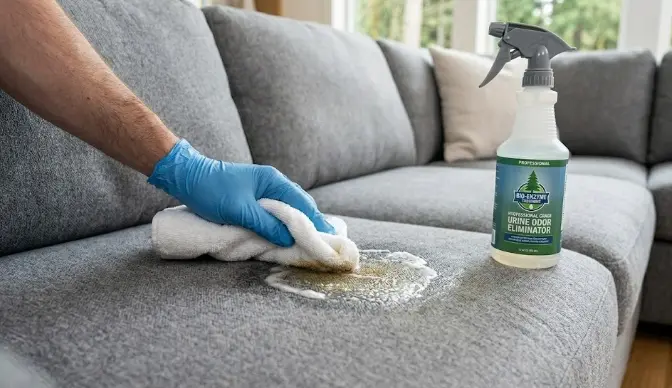
Professional cat urine sofa cleaning is fundamentally different from any DIY approach because it addresses the full depth of contamination — not just the surface. Here is the complete process:
-
UV Light Inspection — Map All Affected Areas
We use professional UV/black light to scan the entire sofa surface. Uric acid fluoresces under UV light, revealing exactly where contamination is present — including areas the cat has used repeatedly that show no visible stain. This is critical: treating only visible areas misses the actual odor sources.
-
Fabric Assessment and Pre-Test
We identify the upholstery type (microfiber, polyester, linen, leather, velvet) and test colorfastness in a hidden area before applying any treatment product. Different fabrics require different enzyme formulas and application methods.
-
Enzyme Pre-Soak — The Critical Step
We apply professional-grade enzyme solution — significantly more concentrated than consumer products — and work it through the fabric into the foam padding below. The enzyme formula must reach the same depth as the urine did when it was absorbed. We then allow adequate dwell time (typically 15–30 minutes) for the enzymes to fully break down the uric acid crystals.
-
Deep Extraction Cleaning
Using upholstery extraction equipment, we flush and extract the treated urine residue, enzyme solution, and broken-down compounds from the fabric and padding. This step physically removes what the enzyme treatment has broken down — critical for eliminating both odor and staining.
-
Antimicrobial Treatment
Cat urine supports bacterial colonies in sofa padding. After enzyme treatment and extraction, we apply an antimicrobial agent to eliminate remaining bacteria and prevent the odor-amplifying bacterial activity that accelerates urine smell over time.
-
Secondary UV Check
After treatment and initial drying, we re-scan the treated areas under UV light to confirm that uric acid fluorescence has been eliminated. Any remaining areas of activity receive a second enzyme application and extraction cycle.
-
Odor Confirmation Test
We assess the treated areas while the fabric is slightly warm (which activates any remaining uric acid) to confirm the odor is fully eliminated rather than just temporarily suppressed. This real-world test catches incomplete treatment before we leave.
-
Optional Fabric Protection
We can apply a fabric protector that creates a barrier against future accidents — making them much easier to treat quickly and preventing them from soaking through to the foam padding. Highly recommended in multi-cat households.
Where Cat Urine Hides in a Sofa — What You Can't See
The visible wet spot from a cat accident is rarely the full extent of the contamination. Understanding where urine actually goes inside a sofa explains why surface treatment almost never solves the problem:
Foam Padding Layers
Sofa cushions typically have 3 to 6 inches of foam padding. Cat urine soaks through the fabric immediately and saturates the foam to its full depth within minutes. The foam acts as a reservoir — absorbing urine and releasing odor compounds slowly over months and years. Standard surface treatment reaches only the top 5–10mm of a 100mm foam cushion.
Sofa Frame and Base
On sofas with fixed or attached cushions, urine that saturates the seat cushion can wick down into the base frame area — absorbing into the dust cover fabric on the underside, into wooden frame joints, and into any padding on the base. These areas are completely inaccessible to surface cleaning and require professional extraction to address.
Armrests and Backrest
Cats frequently spray or urinate on vertical surfaces — armrests and the back of the sofa. These areas are often missed because there is no visible wet puddle, only a faint smell. UV inspection routinely finds armrest and backrest contamination that the owner was unaware of, often from spraying behavior rather than direct urination.
Before and After: What Professional Treatment Achieves
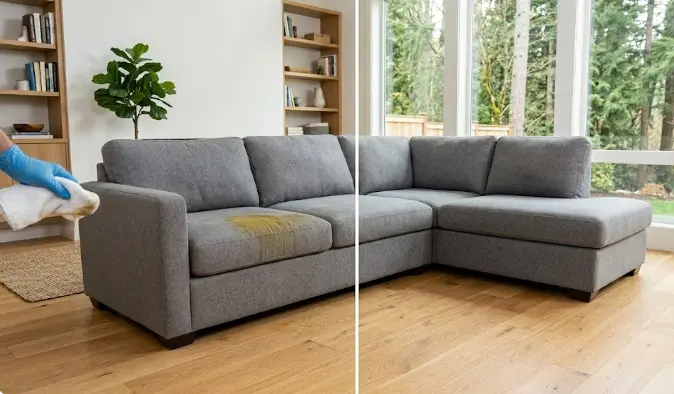
Before Professional Treatment
- Visible staining — yellow to orange-brown discoloration on fabric
- Persistent odor — smell intensifies when sofa is warm or the room is humid
- Repeated marking — cat returns to the same spot because residual ammonia signals a toilet location
- Failed DIY attempts — smell partially masked but returns, often within hours in warm conditions
- Invisible contamination — UV scan reveals additional urine sites not noticed by smell alone
After Professional Treatment
- Stain removed or significantly reduced — urochrome pigment extracted along with uric acid
- Odor eliminated — not masked; uric acid crystals broken down and extracted, cannot reactivate
- Marking behavior reduced — without residual ammonia signal, most cats stop returning to the spot
- UV confirmation — treated areas no longer fluoresce under UV light
- Fabric restored — fabric texture and color largely or fully restored depending on age of staining
Acting Fast: What to Do Immediately After an Accident
The faster you respond to a cat urine accident on your sofa, the easier and more complete the professional treatment will be. Here is the correct immediate response:
Do This Immediately
- Blot — do not rub. Use clean white cloths or paper towels. Press firmly to absorb as much liquid as possible before it reaches the foam padding.
- Work from outside in. Start at the edges of the wet area and blot toward the center to avoid spreading.
- Apply cold water — not hot. A small amount of cold water dilutes the uric acid concentration. Hot water begins heat-setting the proteins immediately.
- Blot again. Remove the diluted urine with clean dry cloths.
- Do not allow to dry untreated. As the fabric dries, uric acid crystals form their bond with the fibers. Call for professional treatment before the area fully dries if possible.
Never Do These
- Do not use hot water or steam. Heat permanently bonds uric acid proteins to fabric. Even a hair dryer used to speed drying makes professional treatment harder.
- Do not rub the stain. Rubbing pushes urine deeper into the foam padding and spreads the contaminated area.
- Do not apply vinegar. Vinegar neutralizes ammonia but has zero effect on uric acid crystals — the real odor source.
- Do not apply strong chemical cleaners. Bleach, hydrogen peroxide, or strong detergents can permanently damage upholstery fibers and may react with urine compounds to create additional staining.
- Do not let it dry and ignore it. Each warm, humid day activates the uric acid further and embeds it more deeply.
Cat Urine on Different Sofa Fabrics — What Changes
The upholstery material significantly affects how urine behaves and which cleaning approach is used. Our technicians adjust the treatment for every fabric type:
Microfiber absorbs cat urine rapidly due to its fine fiber structure — this means uric acid reaches the foam padding faster than with woven fabrics. Microfiber also shows watermarks easily, so treatment technique must control moisture levels carefully.
- Enzyme pre-treatment must be applied generously enough to penetrate to the foam depth
- Low-moisture extraction preferred to prevent watermark rings during drying
- Nap direction must be maintained during treatment and drying to prevent stiffening
- Fabric protector application highly effective on microfiber — future accidents stay on the surface longer
Woven fabrics absorb more slowly than microfiber but can hold more total volume. The open weave structure allows enzyme solution to penetrate effectively to the foam below, making hot water extraction combined with enzyme treatment the preferred method.
- Best response to hot water extraction combined with enzyme pre-treatment
- Staining often more visible but also more responsive to combined enzyme and oxidizing treatment
- Drying time: 2 to 4 hours with good ventilation after professional treatment
- Most durable fabric type for post-treatment fabric protection application
Leather's non-porous surface means cat urine does not absorb through the leather itself — but it does seep into seams, perforations, stitched edges, and any cracks. Uric acid also attacks leather chemically, causing discoloration and surface damage if left untreated.
- pH-neutral enzyme formulas only — standard enzyme products can damage leather finish
- Seam and perforation treatment critical — these are primary entry points
- Leather conditioning required after treatment to restore oils stripped by uric acid
- Older staining on leather may cause permanent discoloration — professional treatment prevents further damage
Velvet requires the most careful treatment — pile direction, moisture sensitivity, and the risk of permanent crushing make DIY attempts particularly risky. Performance fabrics (Crypton, Sunbrella) are more forgiving but still require the correct enzyme formula and extraction method.
- Traditional velvet: dry-extraction methods preferred; avoid over-wetting
- Performance velvet: more tolerant of moisture-based enzyme treatment
- Pile must be brushed back into direction during and after treatment
- Professional assessment essential before any product application on velvet
What Our Customers Say
"I had tried everything — vinegar, baking soda, three different enzyme sprays from the pet store. The smell would go away for a day and then come back. One professional cleaning completely eliminated it. That was eight months ago and there's been no smell since."
"The UV light inspection was eye-opening. I thought there was one spot on the sofa. They found four additional areas I had no idea about — including two on the back cushions where my cat apparently sprays. No wonder I couldn't get rid of the smell treating only one place."
"I was ready to throw away a two-year-old sofa over cat urine. The technician said it was very treatable before I even got a word in about replacement. After the cleaning, no stain, no smell. The sofa looks and smells completely normal."
"My elderly cat has accidents occasionally on our leather sofa. After the first professional cleaning, I started booking annual maintenance visits. The fabric protection they applied also means small accidents now stay on the surface long enough to blot up without soaking in."
Frequently Asked Questions
Yes — when treated with professional enzyme-based cleaning that reaches the full depth of contamination. Enzyme treatments break down uric acid crystals at the molecular level, eliminating odor at the source. The key is reaching the foam padding where most uric acid is concentrated after absorption, not just treating the fabric surface.
Uric acid crystals remain in the foam padding and reactivate when humidity or warmth triggers them. Surface-only treatment — including most consumer enzyme sprays — does not deliver enzymes to the depth where the crystals are concentrated. The smell returns because the source was never treated. Professional extraction cleaning physically removes broken-down uric acid from the foam, not just the fabric surface.
Most fabric sofas are ready for light use within 2 to 4 hours after professional treatment, with full drying in 4 to 6 hours depending on fabric thickness and room ventilation. We use low-moisture extraction methods that minimize drying time. Leather sofas are ready immediately after treatment and conditioning.
Complete removal of the ammonia and uric acid scent significantly reduces — and in most cases eliminates — the behavioral trigger that brings cats back to the same spot. Cats return to marked spots because residual odor signals an established territory toilet location. Once professional cleaning fully eliminates that scent signal, most cats stop returning. We recommend addressing any underlying veterinary or behavioral issues alongside the cleaning.
Our Service Area — Cat Urine Sofa Cleaning in Washington State
We Come to You — Throughout the Greater Seattle Area
Fresh Furnish Cleaners provides in-home professional cat urine sofa cleaning throughout Washington State. No need to transport your furniture — we bring all equipment and supplies directly to your home.
- Seattle and all neighborhoods
- Bellevue and the Eastside
- Kirkland and Redmond
- Bothell and Mill Creek
- Tacoma and Pierce County
- Everett and Lynnwood
- Edmonds and Shoreline
- Sammamish and Issaquah
- Woodinville and Snohomish
- Renton, Kent, and Federal Way
| Sofa Type / Situation | Estimated Cost | Notes |
|---|---|---|
| Standard sofa + surface odor | $155–$220 | Single enzyme treatment + deep extraction |
| Standard sofa + moderate saturation | $185–$260 | Extended enzyme dwell time, full extraction |
| Sectional + cat urine (any level) | $240–$360 | Multiple enzyme applications across all sections |
| Severe long-term saturation (any piece) | Quoted on-site | May require foam pad replacement — assessed before starting |
Related Cleaning Services
Dog Odor Removal from Upholstery
Professional pet odor removal for dog urine, dander, and odor from sofas, chairs, and all upholstered furniture.
Dog Odor Removal GuideCouch Cleaning Kent WA
Professional couch and sofa cleaning for Kent households — East Hill, West Hill, Panther Lake, and Downtown Kent. Enzyme pet treatment included.
Couch Cleaning in KentUpholstery Cleaning Seattle
Professional upholstery cleaning for all furniture types throughout Seattle and the greater Puget Sound region.
Upholstery Cleaning in Seattle
Ready to Eliminate Cat Urine Odor From Your Sofa?
Stop masking the smell. Professional enzyme treatment removes cat urine from your couch permanently — not just the surface, but the foam padding where the odor actually lives.
Serving Seattle, Bellevue, Kirkland, Redmond, Bothell, Everett & surrounding Washington communities
