Can Dirty Upholstery Cause Allergies? What's Living in Your Couch

Your Couch May Be the Biggest Allergen Source in Your Home
Most people look to carpets and HVAC filters when trying to reduce indoor allergens. Few think about the sofa they sit on for hours every day. Yet upholstered furniture is consistently one of the highest-concentration allergen reservoirs in a home — accumulating dust mites, pet dander, mold spores, pollen, and shed skin cells deep inside the fabric where regular vacuuming cannot reach.
If your allergy symptoms are worse at home than outdoors, or if you notice sneezing and itchy eyes specifically while sitting on your sofa, upholstery allergens are a likely factor. This guide explains what lives in dirty upholstery, why it triggers allergic reactions, which fabrics are highest risk, and what professional cleaning actually removes.
What Allergens Accumulate in Upholstered Furniture
Dirty upholstery does not just look and smell unpleasant — it is a biological environment. Here is what builds up inside a typical sofa over months and years of use:
Dust Mites and Their Waste
Dust mites are the primary upholstery allergen in most homes. Microscopic and invisible to the naked eye, they feed on the shed skin cells (dead skin flakes) that accumulate in fabric at a rate of roughly 1.5 grams per person per hour of contact.
The mites themselves are not the allergen — their fecal pellets and shed exoskeletons contain the protein Der p 1 and Der p 2, which are among the most potent indoor allergens known. These particles are light enough to become airborne from the slightest disturbance — sitting down, shifting position, or even a fan nearby.
Ideal conditions: Dust mites thrive at temperatures between 65–80°F and humidity above 50% — conditions that match Seattle homes for much of the year.
Pet Dander
Pet dander — microscopic flakes of animal skin shed by cats, dogs, and other pets — is the second most common sofa allergen. It is not pet fur that causes allergic reactions but the dander attached to it, which also contains the protein Fel d 1 (cats) and Can f 1 (dogs).
Dander is extremely light and sticky — it clings to upholstery fibers and embeds deep into the fabric backing. A sofa used by a cat can retain high levels of Fel d 1 for six months or longer after the pet has been removed from the home. This is why allergy symptoms can persist in a new home even without a pet present.
Note: Regular vacuuming removes surface dander but does not reach the embedded allergen layer. Professional extraction is required for significant reduction.
Mold and Mildew Spores
Mold grows inside upholstery when moisture is introduced and not fully dried — from spills, humidity, or damp cleaning attempts. In the Pacific Northwest climate, where indoor humidity is persistently elevated in autumn and winter, mold in furniture is more common than homeowners expect.
Mold inside a sofa is invisible from the outside — it grows in the cushion foam and fabric backing. It releases spores that become airborne and trigger respiratory symptoms, coughing, worsening asthma, and in sensitive individuals, systemic reactions. A musty smell from a sofa with no obvious staining is a reliable sign of mold inside the cushions.
Seattle risk: Homes with single-pane windows, poor ventilation, or rooms that stay cool and damp in winter are at highest risk for sofa mold.
Pollen and Outdoor Allergens
Upholstered furniture near windows or in households where outdoor shoes are worn inside accumulates significant seasonal pollen. Tree pollen in the Seattle area — particularly alder, birch, and cedar — is produced in high volumes from February through May. This pollen enters on clothing and settles into sofa fabric.
Grass pollen follows in late spring and summer. Unlike dust mite allergens, pollen is seasonal — allergy symptoms that spike in spring and worsen on the sofa may have an outdoor pollen component trapped in the fabric from daily contact with clothing.
Practical note: Professional spring cleaning of upholstery is particularly effective for Seattle-area pollen allergy sufferers.
Dust Mites in Your Couch: The Scale of the Problem
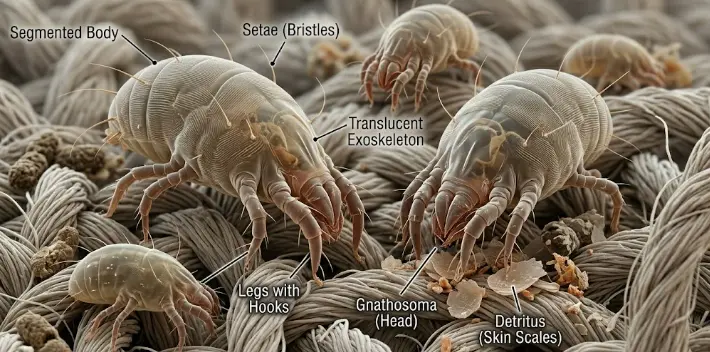
Dust mites deserve special attention because they are present in virtually every home and their allergen levels in upholstered furniture are almost always higher than people expect. Understanding the scale of the problem makes clear why surface cleaning is insufficient:
| Metric | Reality |
|---|---|
| Dust mites per gram of sofa dust | Up to 1,000 mites in a typical home sofa |
| Fecal pellets per gram of sofa dust | Up to 250,000 — the actual allergen |
| Skin cells shed per person per hour of sofa contact | Approximately 1.5 grams — the mite food source |
| Ideal humidity for dust mite reproduction | Above 50% — common in Seattle homes October–April |
| Depth dust mites penetrate into upholstery | Through fabric, into cushion fill and backing layer |
| Vacuuming effectiveness at removing dust mites | Surface debris only — does not reach deep allergen layer |
| Professional hot-water extraction effectiveness | Removes up to 90% of dust mite allergen load |
Signs Your Couch May Be Triggering Your Allergies
Upholstery allergens do not always announce themselves obviously. These are the patterns that suggest your sofa or upholstered furniture is a significant allergen source:
Symptom Patterns to Watch For
- Symptoms worse at home than outdoors — a reliable sign of indoor allergen exposure
- Sneezing or runny nose shortly after sitting on the sofa — direct airborne allergen exposure
- Itchy or watery eyes in the living room — dust mite and pet dander in the air disturbed from upholstery
- Morning allergy symptoms that improve after leaving home — overnight allergen exposure from bedroom upholstery or mattress
- Asthma flare-ups at home with no obvious trigger — upholstery allergens are a common unidentified cause
- Symptoms worse in autumn and winter — when homes are sealed up and humidity rises, dust mite populations spike
Physical Signs in Your Furniture
- Musty odor from sofa or chair cushions — indicates mold or mildew growth inside the cushion
- Visible dust cloud when cushions are disturbed — heavy allergen accumulation near the surface
- Fabric darker in high-contact areas — embedded skin cell and oil buildup, which is the primary dust mite food source
- Persistent pet odor despite surface cleaning — dander embedded deep in fabric alongside the odor source
- More than 18 months since last professional cleaning — allergen load is almost certainly at a clinically significant level
- New-to-you furniture with unknown cleaning history — inherits the allergen load from previous owners
Which Upholstery Materials Hold the Most Allergens
Not all sofas accumulate allergens at the same rate. The fabric type is one of the biggest factors in allergen load — both how much builds up and how deeply it penetrates:
Highest Allergen Accumulation
- Velvet and chenille — high pile traps pet dander and dust mite waste deeply
- Wool upholstery — natural fiber, open weave, high moisture retention
- Cotton and linen — natural fiber weaves allow deep allergen penetration
- Older or worn fabric — degraded fibers hold more debris
Moderate Allergen Accumulation
- Standard polyester — synthetic, but looser weaves allow penetration
- Microfiber (standard) — traps surface allergens well but allows some deep penetration
- Linen-polyester blends — mixed fiber performance
- Tweed and textured weaves — surface texture catches and holds particles
Lowest Allergen Accumulation
- Leather and faux leather — non-porous surface, allergens sit on top and wipe off
- Performance fabrics (Crypton, Sunbrella) — tightly woven, allergen-resistant
- Tight-weave microfiber — fine fibers create a surface barrier
- Vinyl and coated fabrics — wipeable surface, minimal allergen penetration
What Professional Upholstery Cleaning Removes
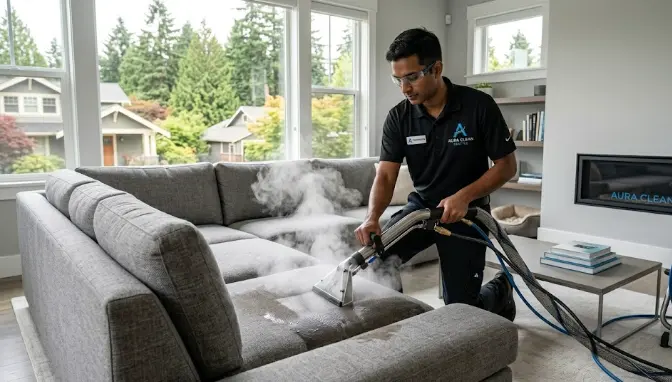
Hot-water extraction — the method used by professional upholstery cleaners — works differently from vacuuming or surface wiping. Here is what a professional cleaning actually removes compared to what you can achieve at home:
What Professional Extraction Removes
- Dust mites and their waste — physically extracted from deep within the fabric and cushion backing
- Pet dander (Fel d 1, Can f 1) — proteins extracted from all fabric layers, not just the surface
- Mold spores — removed along with the moisture conditions that allow mold to persist
- Pollen — seasonal allergens trapped in fabric from clothing contact
- Accumulated skin cells — the primary food source for dust mites, removed at scale
- Bacteria — hot water extraction at 210°F kills bacteria on contact
- Odor-causing compounds — removed with the organic material they originate from
What Home Methods Cannot Remove
- Deep-layer dust mite waste — household vacuums cannot penetrate to the cushion backing where the majority of allergens accumulate
- Embedded pet dander — lint rollers and standard vacuums address only surface fur, not the dander proteins embedded in fibers
- Mold inside cushion foam — no surface treatment reaches mold growing inside the foam layer
- Deep-set skin cell accumulation — requires the water pressure and suction of professional extraction equipment
- Bacteria at depth — antimicrobial sprays treat only the surface layer that is accessible to topical application
How Often Should Allergy Sufferers Clean Their Upholstery?
The standard recommendation for professional upholstery cleaning is every 12 to 18 months for a household without allergy concerns. For allergy and asthma sufferers, the timeline is shorter:
| Household Situation | Recommended Cleaning Frequency |
|---|---|
| No allergies, no pets, adults only | Every 12–18 months |
| No allergies, with children | Every 12 months |
| Allergy sufferers, no pets | Every 6–12 months |
| Allergy or asthma sufferers, with pets | Every 4–6 months |
| Severe asthma or dust mite allergy diagnosis | Every 3–6 months — consult your allergist |
| After a spill or pet accident | Immediately — do not allow organic matter to sit |
| Post-renovation or after extended home closure | Once — construction dust and mold spores settle into all upholstered surfaces |
Between Professional Cleanings: What Actually Helps
Professional extraction is the only method that significantly reduces deep allergen load. But between appointments, these practices make a measurable difference for allergy sufferers:
Use a HEPA Vacuum Weekly
Vacuum upholstered surfaces with a HEPA-filter vacuum weekly. This removes the loose surface layer of allergens — not the embedded layer, but it limits how much migrates deeper over time. Use an upholstery attachment and cover all cushion surfaces, seams, and crevices.
Control Indoor Humidity
Dust mites cannot survive below 40% relative humidity. Running a dehumidifier in main living areas during Seattle's autumn and winter, and ensuring adequate ventilation, is one of the most effective non-cleaning interventions for dust mite control in upholstery. Keep indoor humidity between 40% and 50%.
Use Removable, Washable Covers
Slipcovers and removable cushion covers that can be washed at 60°C (140°F) kill dust mites and remove dander. Washing these every 2 to 4 weeks significantly reduces allergen accumulation on the sofa surface. Not all sofas have removable covers — check before purchasing if allergies are a priority.
Keep Pets Off Upholstered Furniture
If a household member is allergic to pet dander, restricting pet access to upholstered furniture reduces dander load significantly. This is most effective when combined with professional cleaning — cleaning removes existing embedded dander, and the restriction prevents rapid reaccumulation.
What Seattle Homeowners Say
"I had been dealing with morning allergy symptoms for two years — sneezing, runny nose, itchy eyes. Changed my air filter, got an air purifier, nothing really helped. My allergist suggested the sofa might be the issue. After professional cleaning, my morning symptoms dropped dramatically within a week. I wish I had done it two years ago."
"My daughter has a diagnosed dust mite allergy. Our allergist specifically recommended professional upholstery cleaning every six months. We have been doing it for two years now and her symptom frequency has dropped significantly. The technicians also told us the sofa was the highest-allergen item in the house — more than the carpet."
"We bought a used sofa last year and almost immediately I started sneezing whenever I sat on it. I assumed it was just an adjustment period. Turns out the previous owners had cats — the dander was embedded in the fabric. After professional cleaning with dander treatment, the sneezing stopped completely. I did not even know that was possible."
"I have asthma and noticed it was worse in autumn and winter — exactly when I was spending more time on the sofa watching TV. My pulmonologist mentioned dust mites as a possible factor. After professional sofa and mattress cleaning in October, this winter was noticeably better. I am scheduling it every autumn now."
Frequently Asked Questions: Upholstery Allergies and Dust Mites
Yes — dirty upholstery is one of the most significant sources of indoor allergens. Sofas and upholstered chairs accumulate dust mites, pet dander, mold spores, pollen, and skin cells deep inside the fabric. These allergens become airborne when you sit on the furniture and are inhaled directly. Symptoms including sneezing, runny nose, itchy eyes, and asthma flare-ups that worsen at home or specifically while sitting on the sofa are common signs that upholstery allergens are a factor.
A typical upholstered sofa can harbor hundreds of thousands to over a million dust mites depending on the fabric type, humidity levels, and how long since the last professional cleaning. Dust mites are microscopic and feed on shed human skin cells, which accumulate rapidly in fabric upholstery. They thrive in the Pacific Northwest climate where indoor humidity tends to be higher than in drier regions. The mites themselves are not the allergen — their fecal matter and shed exoskeletons are what trigger allergic reactions.
Professional hot-water extraction physically removes dust mites, their waste, pet dander, mold spores, and accumulated skin cells from deep within the fabric — down to the backing layer. Vacuuming alone only removes surface debris and does not penetrate to where the majority of allergens live. Professional cleaning combined with an antimicrobial treatment reduces allergen load by up to 90% immediately after cleaning. For allergy sufferers, professional upholstery cleaning every 6 to 12 months is one of the most impactful indoor air quality improvements available.
Natural fiber fabrics — cotton, wool, linen — hold more allergens than synthetic fabrics because their looser weave allows deeper penetration of skin cells and moisture. Velvet and chenille hold significantly more pet dander and dust mite waste than smooth, tight-weave synthetics due to their high pile. Microfiber and performance fabrics are the most allergen-resistant upholstery materials — their tight weave prevents deep penetration. Leather is the easiest to keep allergen-free as allergens sit on the surface and can be wiped away.
Allergy and asthma sufferers benefit most from professional upholstery cleaning every 6 months. For households with pets, every 4 to 6 months is recommended. The standard recommendation for non-allergy households is every 12 to 18 months. In the Seattle and Pacific Northwest area, higher ambient humidity accelerates dust mite populations in upholstered furniture compared to drier climates, making more frequent cleaning especially beneficial for allergy sufferers here.
Yes — mold can grow inside upholstered furniture, particularly in the Pacific Northwest where indoor humidity is elevated. It develops after liquid spills that were not fully dried, or in rooms with persistent high humidity. Mold grows inside the cushion foam and backing fabric where it is invisible from the outside. Mold spores released from upholstery are a potent allergen and can trigger respiratory symptoms, coughing, and asthma attacks. A musty smell from a sofa with no obvious staining is a reliable sign of mold inside the cushions. Professional extraction with antimicrobial treatment is the most effective way to address it.
Professional Upholstery Cleaning Pricing in Seattle
| Piece | Price Range | Notes |
|---|---|---|
| Loveseat | $85 – $120 | 2-seat sofa or loveseat |
| Standard sofa (3-seat) | $115 – $175 | Fabric; most common |
| Sectional | $195 – $350 | Depends on configuration |
| Leather sofa | $120 – $190 | Includes conditioning |
| Upholstered chair | $55 – $95 | Armchair or accent chair |
| Pet odor / enzyme treatment | +$35 – $65 | Add-on to any piece |
Prices as of September 2026. Call (425) 287-3619 for a free quote — most visits scheduled within the same week.
Reduce Allergens in Your Upholstery — Professional Cleaning in Seattle
Hot-water extraction removes up to 90% of dust mite allergens, pet dander, and mold spores from your sofa and chairs. Serving Seattle, Bellevue, Kirkland, Redmond, Bothell, and all of King and Snohomish Counties.
Free assessment before every job • No obligation • Same-week appointments available
Related Cleaning Guides
Dust Mites in Upholstered Furniture
A deeper look at dust mite biology, where they concentrate in upholstered furniture, and the most effective professional and home methods for reducing dust mite allergen load.
Read Dust Mite GuideProfessional Mattress Cleaning in Seattle
Mattresses accumulate more dust mites than any other household item. Learn how professional mattress cleaning reduces allergen load for better sleep and fewer symptoms.
Read Mattress Cleaning GuideRemove Pet Urine Smell from Couch
Pet accidents leave behind both odor and allergens. Learn how professional enzyme treatment permanently eliminates pet dander and urine allergens from upholstered furniture.
Read Pet Odor Removal Guide