How to Remove Pet Urine Smell from Couch Permanently
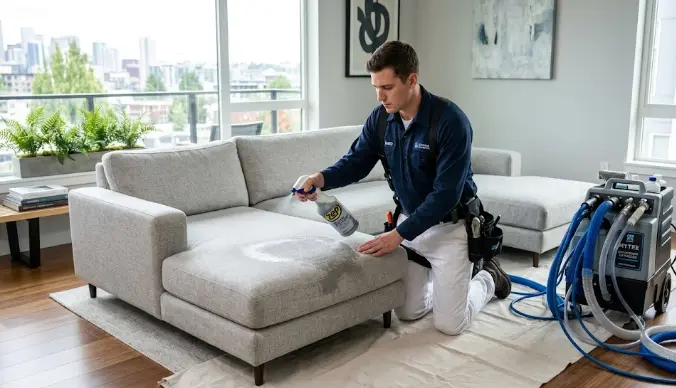
Why Pet Urine Smell Keeps Coming Back — The Real Reason
You cleaned the spot. You used the spray. You even tried baking soda overnight. And the smell came back within a week — sometimes stronger than before. If this sounds familiar, you are dealing with a chemistry problem that most cleaning products are not designed to solve.
The persistent odor in a pet-soiled couch is not caused by bacteria alone. It is caused by uric acid crystals — a component of pet urine that bonds chemically to fabric and foam fibers and becomes essentially insoluble in water. These crystals do not dissolve when you spray or blot. They do not wash out with regular detergent. And they do not stay dormant — every time humidity rises (from warm weather, body heat, or a rainy Seattle afternoon), they reactivate and release odor compounds back into the air.
Permanently removing pet urine smell from a couch means reaching and breaking down those uric acid crystals — all the way through the foam padding, not just on the fabric surface. This guide explains what that actually requires, why common DIY approaches fall short, and what professional pet odor upholstery cleaning does differently.
What Pet Urine Actually Contains — and Why Each Component Is a Problem
Understanding why pet urine is so difficult to remove permanently starts with what it is made of. Each component requires a different approach to eliminate:
| Component | What It Does | Why It Lingers | What Eliminates It |
|---|---|---|---|
| Uric Acid Crystals | Source of the persistent, reactivating odor | Insoluble in water; bonds to fibers; reactivates with humidity indefinitely | Specific enzyme formulas (uricase) — professional concentration only |
| Ammonia | The sharp, immediate smell after an accident | Signals pets to return to the same spot; encourages repeat marking | Enzyme neutralization; extraction removal |
| Urochrome | Yellow pigment causing visible staining | Oxidizes over time (yellow → orange → brown); sets deeper with heat | Oxidizing pre-treatment + enzyme cleaning + extraction |
| Bacteria | Feed on urine as it ages, amplifying odor over time | Thrive in warm sofa foam; produce additional odor compounds | Antimicrobial treatment after enzyme cleaning |
| Pheromones (marking compounds) | Signal territory to the pet; drive repeat accidents in the same spot | Remain in sofa foam even after surface cleaning — keeps triggering repeat behavior | Professional enzyme extraction — the only method that removes them from deep foam |
Why DIY Methods Don't Permanently Remove Pet Urine Odor
Every common DIY approach addresses one part of the problem while leaving the most stubborn components — uric acid crystals in the foam — completely untouched. Here is what each method actually does:
Baking Soda
What it does: Absorbs surface moisture and temporarily binds to some odor molecules on the fabric surface.
What it misses: Baking soda cannot penetrate the foam padding — the primary reservoir of uric acid. It does nothing to the crystals bonded to fabric fibers. Once it dries and is vacuumed off, the odor returns within days as humidity reactivates the untouched crystals.
Verdict: Temporary surface odor reduction only.
Vinegar
What it does: Neutralizes ammonia — the sharp initial smell — through an acid-base reaction.
What it misses: Vinegar has no chemical effect on uric acid crystals. The ammonia smell may fade, but the uric acid (the persistent reactivating odor) remains entirely intact. Some users report that vinegar actually makes the long-term odor worse by driving deeper penetration of liquid into the foam.
Verdict: Addresses ammonia only; leaves uric acid completely untouched.
Store-Bought Enzyme Sprays
What it does: Contains enzyme compounds that can break down uric acid — in theory.
What it misses: Consumer products have lower enzyme concentrations than professional formulas. More importantly, spraying the surface does not deliver enzymes to the foam padding 3 to 5 inches below. The enzymes treat the top layer of fabric while the main uric acid reservoir in the foam remains active.
Verdict: Right chemistry, wrong delivery. Cannot reach the source.
Steam Cleaning
What it does: High-temperature steam sanitizes and provides a deep clean for many types of soiling.
What it does to urine: Heat permanently bonds uric acid proteins to fabric fibers — the same way heat sets protein stains in laundry. Steam cleaning pet urine without prior enzyme pre-treatment often makes the odor impossible to remove. The high humidity created also immediately reactivates any remaining crystals.
Verdict: Can permanently worsen pet urine odor in sofas.
Where Pet Urine Actually Goes in a Couch
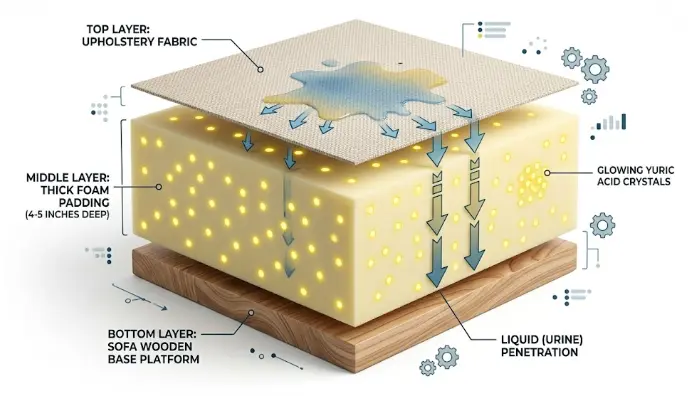
The visible wet spot on a couch cushion represents roughly 20% of the actual contamination. Here is what happens inside the sofa in the minutes after a pet accident:
The Fabric Layer
Urine passes through most upholstery fabrics in under 60 seconds. The fabric retains some uric acid and urochrome pigment (staining), but the bulk of the liquid immediately transfers to the foam below. Surface treatment addresses only this layer.
The Foam Padding
Standard sofa cushions have 3 to 6 inches of foam. Urine soaks this entire depth within minutes. As the foam dries, uric acid crystallizes throughout the full depth — creating a deep reservoir that releases odor continuously. This is the primary odor source that surface cleaning never reaches.
The Base & Frame
On fixed-cushion sofas, urine can wick down through the seat into the base platform, the dust cover underneath, and into wooden frame joints. These areas are completely inaccessible to surface cleaning and require professional extraction tools to address effectively.
What to Do Immediately After a Pet Accident on Your Couch
Fast action in the first 5 minutes dramatically improves the outcome of professional treatment and reduces the depth of foam contamination:
Do This Right Away
- Blot immediately — do not rub. Use clean white towels or paper towels. Press firmly to absorb as much liquid as possible before it reaches the foam. Rubbing spreads the urine and pushes it deeper.
- Work from the outside in. Start at the edges of the wet area and blot toward the center to prevent spreading.
- Add a small amount of cold water. This dilutes the uric acid concentration. Use cold water only — hot water begins heat-setting proteins immediately.
- Blot again thoroughly. Remove the diluted urine with fresh dry cloths.
- Do not allow to fully dry before professional treatment. Fresh urine is significantly easier to extract than dried, crystallized uric acid. Schedule professional treatment as soon as possible.
Never Do These
- Do not use hot water or a hair dryer. Heat permanently sets uric acid proteins into fabric fibers, making professional removal much harder.
- Do not rub or scrub the area. Rubbing pushes urine deeper into the foam and spreads the affected zone.
- Do not apply steam. Steam cleaning pet urine without prior enzyme treatment can permanently worsen the odor.
- Do not apply vinegar directly. Vinegar does not affect uric acid crystals and can add liquid that pushes the urine deeper into the foam.
- Do not use odor masking sprays. Masking sprays cover the ammonia smell without touching the uric acid — and the combined smell that results when the masking agent wears off is often worse than the original.
How Professional Pet Odor Upholstery Cleaning Actually Works
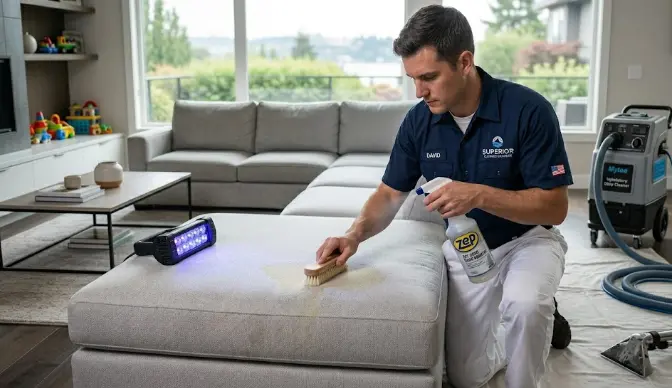
Professional pet odor upholstery cleaning is fundamentally different from any DIY approach because it delivers treatment to the full depth of contamination and physically extracts what it breaks down. This is the complete process we use:
-
UV Light Inspection
We scan the entire sofa with professional UV/black light. Uric acid fluoresces under UV — revealing all contaminated areas including repeat-marking spots the owner did not know about and armrest/backrest spray sites. Treating only known areas misses the actual odor sources.
-
Fabric Assessment & Colorfastness Test
We identify the upholstery type and check its care code. We test colorfastness in a hidden area before applying any treatment. Different fabrics — microfiber, polyester, linen, velvet, performance fabric — require different enzyme formulas and application methods.
-
Professional Enzyme Pre-Soak
We apply professional-grade enzyme solution — significantly more concentrated than consumer products — and work it through the fabric deep into the foam padding. The treatment must reach the same depth as the urine. We allow 15 to 30 minutes dwell time for the enzymes to fully break down the uric acid crystals before extraction.
-
Deep Extraction Cleaning
Using upholstery extraction equipment, we flush and extract the treated urine residue, broken-down enzyme compounds, and bacteria from the fabric and foam. This physically removes what the enzyme treatment has broken down — the step that makes elimination permanent rather than temporary.
-
Antimicrobial Treatment
After extraction we apply an antimicrobial agent to eliminate bacterial colonies remaining in the foam. Bacteria amplify pet urine odor significantly over time — removing them prevents odor regeneration after cleaning.
-
Secondary UV Verification
We re-scan all treated areas under UV light. Successfully treated areas no longer fluoresce. Any remaining active areas receive a second enzyme application. This step confirms elimination rather than masking before we pack up.
-
Warm-Area Odor Test
We check treated areas while slightly warm — this activates any residual uric acid. If any odor remains, we repeat the enzyme cycle before finishing. This real-world test catches incomplete treatment that a cold-surface check would miss.
-
Optional Fabric Protector
We can apply a professional fabric protector that creates a barrier against future accidents — making them much easier to blot up before they soak into the foam. Especially recommended in households with puppies, elderly pets, or multi-pet homes.
Before and After: What Professional Treatment Achieves
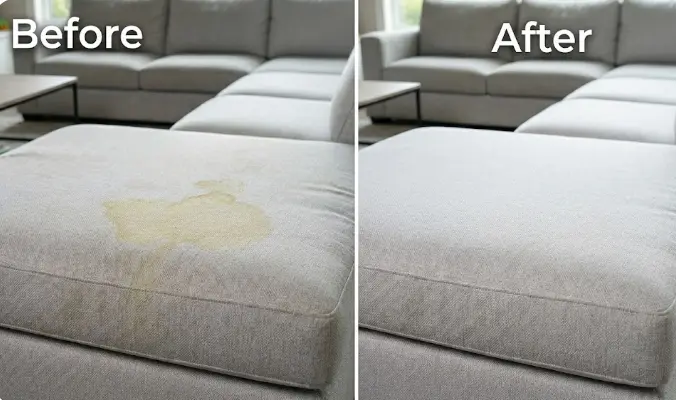
Before Professional Treatment
- Persistent smell that intensifies when the room is warm or humid
- Visible staining — yellow to brown discoloration on the cushion fabric
- Repeat accidents — pet returns to the same spot because pheromone markers in the foam signal a toilet location
- Failed DIY attempts — smell partially masked but returns within days
- Hidden contamination — UV scan reveals additional urine sites not detectable by smell alone
After Professional Treatment
- Odor permanently eliminated — not masked; uric acid crystals broken down and extracted, cannot reactivate
- Staining removed or significantly reduced — urochrome pigment extracted along with uric acid residue
- Pet marking behavior reduced — without pheromone markers, most pets stop returning to the spot
- UV confirmed clean — treated areas no longer fluoresce under UV light
- Fabric texture restored — cushions feel and smell like clean upholstery again
Which Sofa Fabrics Can Be Treated for Pet Urine
Most common upholstery types can be professionally treated for pet urine odor. The fabric type determines the cleaning protocol and what results to expect:
| Fabric Type | Pet Urine Treatment | Typical Result | Notes |
|---|---|---|---|
| Microfiber | Enzyme pre-soak + extraction | Excellent — full odor elimination, stain usually removed | Most common sofa fabric; responds very well to enzyme treatment |
| Polyester / Nylon Blend | Enzyme pre-soak + hot water extraction | Excellent — odor eliminated, stain removed in most cases | Durable fabric; absorbs treatment well; check care code first |
| Velvet / Velour | Low-moisture enzyme treatment + gentle extraction | Good — odor eliminated; staining may lighten but not always fully removed | Requires very careful approach to avoid pile damage or watermarking |
| Linen / Cotton Blend | Low-moisture enzyme treatment | Good — odor eliminated; shrinkage risk requires careful moisture control | Check care code; avoid oversaturation; professional pre-testing essential |
| Performance Fabric (Crypton, etc.) | Enzyme treatment + low-moisture extraction | Very good — built-in moisture barrier means less deep penetration | Urine may not reach foam as deeply; easier treatment; avoid over-saturation |
| Genuine Leather | pH-balanced leather cleaner + conditioning | Good for surface odor; deep foam contamination treated separately | Leather itself can be cleaned; foam padding accessed where possible |
| Bonded Leather / PU | Very gentle water-based enzyme treatment | Moderate — odor reducible; peeling risk if already degraded | Requires extra caution; pre-inspection essential; aggressive treatment not possible |
What Seattle Pet Owners Say
"We have two large dogs and our sectional had seen better days. I'd tried everything — enzyme sprays, baking soda, even a rental carpet cleaner. The smell always came back within a week. After one professional treatment the smell was completely gone. That was four months ago and it has not returned. I wish I'd called sooner instead of wasting months on DIY attempts."
"My elderly cat had been using a corner of my velvet sofa for months before I found out. I was certain the couch was ruined. They used a UV light to show me every spot — there were nine of them, not the two I knew about. After the treatment the UV showed completely clean. No smell at all — even when I press my face into the cushion. Incredible result."
"I was quoted $800 for a new sofa cushion set and decided to try professional cleaning first as a last resort. $160 later, the smell is completely gone and the cushion looks great. They explained everything they were doing and why — the UV inspection alone was eye-opening. Highly recommend before giving up on a sofa."
"New puppy, white linen sofa. Nightmare combination. They saved our couch. Treated it within 24 hours of the accident, which apparently makes a huge difference. No stain, no smell, no visible trace of the accident. We also got the fabric protector applied and already used it once when the puppy had another accident — blotted right up, no damage."
Frequently Asked Questions: Removing Pet Urine Smell from a Couch
Pet urine contains uric acid crystals that bond chemically to fabric and foam fibers. Standard cleaning products and water cannot dissolve these crystals — they remain in the sofa padding and reactivate every time humidity rises (from warm weather, body heat, or a damp day). The smell appears to go away and then returns because the crystals were never actually removed, only temporarily suppressed by surface treatment or masking agents.
Yes — with professional enzyme-based extraction cleaning. Enzyme formulas break down uric acid at the molecular level. Combined with extraction equipment that reaches the foam padding, professional treatment eliminates the odor at its source. Once uric acid crystals are fully broken down and physically extracted, the smell cannot return.
No. Baking soda absorbs surface odor temporarily. Vinegar neutralizes ammonia (the sharp initial smell) but has zero effect on uric acid crystals — the source of the persistent reactivating odor. Neither product penetrates the foam padding where most of the uric acid is concentrated after soaking through the fabric.
Most sofa pet urine treatments take 1 to 3 hours on-site, including UV inspection, enzyme soak dwell time, extraction, and antimicrobial treatment. Drying time with our low-moisture methods is typically 2 to 4 hours. Older or heavily saturated cushions may require a second treatment session.
Pet urine treatment for a standard sofa in Seattle typically ranges from $120 to $300 depending on the number of affected areas, fabric type, and severity of contamination. Heavily saturated pieces or sectionals may be higher. We inspect and quote before starting any treatment — no surprises.
Yes, though older contamination requires more intensive treatment. Dried uric acid crystals are fully bonded to fabric fibers and often deeper in the padding. Professional treatment uses extended enzyme dwell times, repeat applications where needed, and extraction equipment to address older contamination effectively. UV light inspection is especially important for old stains to map the full extent of all affected areas.
Ready to Remove Pet Urine Smell from Your Couch for Good?
Professional pet odor upholstery cleaning serving Seattle, Bellevue, Kirkland, Redmond, Bothell, Everett, Lynnwood, Edmonds, and the greater Puget Sound area.
Same-week appointments available • No hidden fees • Quote before we start
Related Guides
Cat Urine on Sofa: Cleaning Guide
Deep dive into cat-specific urine chemistry, why cat urine is especially persistent, and the professional treatment process for feline accidents.
Read Cat Urine Sofa GuideRemove Dog Odor from Upholstery
Why dog smell accumulates in sofas and furniture over time, and how professional cleaning addresses general dog odor beyond urine accidents.
Read Dog Odor Removal GuidePet Stain & Odor Removal Seattle
Full overview of professional pet stain and odor removal services for all furniture types across the greater Seattle area.
View Pet Stain Removal Services