Pet Hair and Odor on Outdoor Furniture: How to Clean It Properly
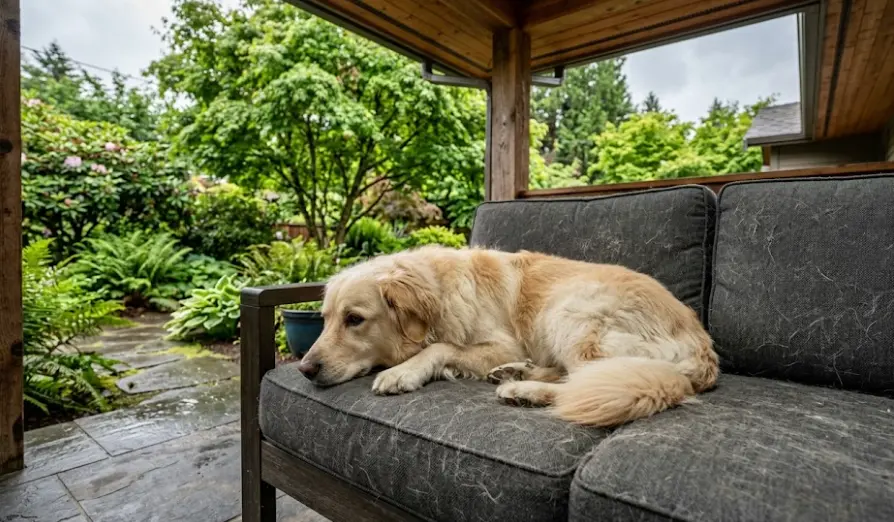
There is a specific kind of outdoor furniture problem that standard cleaning guides do not address: the cushion that has been claimed by a dog. Not dirty in the usual sense — no mold, no mineral staining — but occupied. One corner of the sofa has a compressed layer of dog hair embedded several millimeters into the weave, a faint smell that intensifies the moment the sun hits the fabric, and a surface texture that makes it immediately clear which seat is the dog's. The other cushions are fine. That one is a project.
Pet hair on outdoor furniture behaves differently from pet hair on indoor upholstery, and dog odor on outdoor cushions is a different chemical situation than indoor pet smell. The outdoor fabric, the sun cycling, the rain and humidity — each of these changes what actually works. This guide covers both problems: mechanical hair removal on outdoor fabrics and frames, and the chemistry of eliminating pet odor from cushions that have absorbed it.
Cat & Dog Hair Removal from Outdoor Cushions: Tool Comparison
The method that works depends on how embedded the hair is and what fabric you have. Outdoor weaves (Sunbrella, solution-dyed polyester, olefin) trap hair differently than indoor upholstery — here's what actually works:
| Tool | Best For | How to Use | Effectiveness |
|---|---|---|---|
| Rubber squeegee | Large flat cushion surfaces; embedded hair | Drag in one direction across fabric; hair clumps at the edge — lift by hand, rinse squeegee between strokes | ⭐⭐⭐⭐⭐ Best for outdoor fabric |
| Damp rubber glove | Cat hair on cushions and armrests | Lightly dampen, wipe in one direction; friction pulls hair into clumps | ⭐⭐⭐⭐ Good for light-medium buildup |
| Stiff dry brush | Wicker frames, resin rattan | Scrub in multiple directions; follow with vacuum to collect loosened hair | ⭐⭐⭐⭐ Essential for wicker gaps |
| Lint roller / tape | Surface hair only | Press and peel — works only before hair embeds into weave | ⭐⭐⭐ Good for fresh shedding |
| Vacuum (brush attachment) | After other methods; collecting loosened hair | Use upholstery brush; work in multiple directions; don't press hard — pushing embeds hair deeper | ⭐⭐⭐ Better as a follow-up tool |
| Pumice stone | Stubborn embedded hair on flat surfaces | Drag lightly across fabric; pulls hair up and out of weave gaps | ⭐⭐⭐ Use carefully — can pill fabric |
Key rule for outdoor fabric: Rain compresses cat and dog hair deeper into the weave as it dries. If your cushions have been rained on since the pet was using them, surface tools alone won't reach the embedded hair — start with the squeegee method, then follow up with a damp rubber glove pass.
Why Outdoor Fabric Traps Pet Hair Differently
Indoor upholstery — velvet, chenille, microfiber — has a surface pile or nap that catches hair and holds it at the surface where a lint roller can reach it. Outdoor fabrics like Sunbrella, solution-dyed polyester, and olefin have a flat, tight weave construction with no pile. The individual fibres run in opposing directions at the weave crosspoints, which creates microscopic gaps at each intersection — and hair gets driven into these gaps by the repeated pressure of sitting and lying, by rain that compresses it, and by wind that works it further in as it dries. Once embedded past the surface, adhesive tools cannot reach it, and a standard vacuum pass over the surface pushes hair into the weave as often as it removes it.
Sunbrella and similar outdoor acrylic fabrics also develop a characteristic that makes pet hair harder to remove as the fabric ages. New Sunbrella has a fluorocarbon surface treatment applied at the factory that makes the fabric slightly hydrophobic and slick — hair sits more on the surface than in it, and sheds more readily. After two or three Seattle outdoor seasons, UV exposure degrades this coating. The fabric still looks intact, but the surface becomes slightly rougher at a microscopic level, and pet hair embeds more deeply and requires more effort to remove. This is one reason why keeping the fabric treated with 303 Fabric Guard annually is practically useful beyond just water repellency — the restored surface coating also reduces how deeply pet hair and debris can penetrate the weave.
Removing Pet Hair: What Actually Works on Outdoor Fabric
The ranking of tools for pet hair on outdoor cushions is almost the inverse of what most people try first. Lint rollers — the instinctive first choice — are largely ineffective on outdoor weaves. The adhesive requires smooth, consistent contact with the surface to pick up hair, and outdoor fabric is too textured to allow that. The methods that work reliably are all based on friction and mechanical action rather than adhesion.
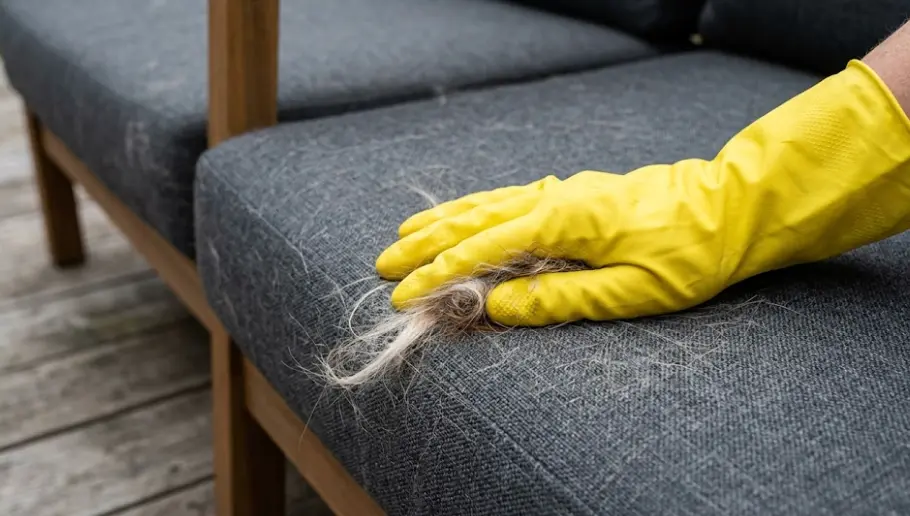
Damp Rubber Glove
Most effective
How it works: Dampen a rubber kitchen or cleaning glove with water — not soaking, just slightly wet. Drag your palm firmly across the cushion surface in one direction. The rubber creates friction and a mild electrostatic attraction that causes embedded hairs to clump together and pull out of the weave rather than being pushed further in. Work in long, consistent strokes in the same direction rather than circular motions.
Why it works on outdoor fabric: The rubber conforms to the texture of the weave and reaches into the crosspoints between fibres where hair is embedded, which neither adhesive tape nor vacuum attachments can do consistently.
Rubber Squeegee
Most effective on flat surfaces
How it works: A window squeegee dragged across a flat cushion surface in firm, overlapping strokes collects pet hair into rows that can then be gathered by hand or vacuumed up. Faster than the glove method on large flat seat cushions, though less effective on curved surfaces like back cushions or piped edges.
Best for: Large flat seat cushions on sectionals and sofas. Work from one edge to the other in parallel strokes, gathering the accumulated hair at the far edge. Rinse the squeegee between strokes so collected hair doesn't redistribute.
Stiff Dry Brush
Good — especially for wicker
How it works: A medium-to-stiff bristle scrub brush worked across the cushion fabric in multiple directions loosens embedded hair for collection. Less effective than the rubber methods on fabric but the correct tool for resin wicker frames, where hair accumulates in the gaps between wicker strands and cannot be reached by gloves or squeegees.
For wicker specifically: Work the brush across the weave in multiple directions — with the strand direction, across it, and diagonally. Then vacuum the loosened hair with a brush attachment before it re-settles into the gaps.
| Tool | Effectiveness on Outdoor Fabric | Best Application | Notes |
|---|---|---|---|
| Damp rubber glove | Excellent | All cushion surfaces, curved edges, piping | Best all-around; friction and static pull hair from weave |
| Rubber squeegee | Excellent on flat areas | Large flat seat cushions | Faster than glove on big surfaces; limited on curves |
| Stiff dry brush | Good | Wicker frames, cushion edges | Essential for wicker — only effective tool for gap hair |
| Vacuum with upholstery head | Moderate (surface only) | After glove/squeegee to collect loosened hair | Misses embedded hair; best used as a second step |
| Lint roller / tape | Poor | Very light surface hair only | Adhesive cannot make consistent contact with outdoor weave texture |
Dog Odor on Outdoor Cushions: Why It Requires Enzymatic Chemistry
The compounds responsible for dog smell are not the same as general dirt or mildew. Dog odor is primarily organic in origin: proteins from saliva and skin secretions, fatty acids from coat oils, sulfur-containing molecules from anal gland secretions, and urea compounds from minor urine contact (even from damp paws on a cushion the dog has sat on). These compounds are not water-soluble to any useful degree, which is why washing with soap and water cleans the fabric but does not eliminate the smell. The odor-causing molecules remain in the fabric and foam, and they off-gas continuously — more intensely when warmed by sun.
Enzymatic cleaners are the correct treatment because they actually break down these molecules rather than masking or diluting them. The active components are specific enzymes — protease for protein chains, lipase for fatty acids, amylase for carbohydrate compounds — produced by live bacteria (typically Bacillus subtilis and related strains) suspended in the product. When applied to contaminated fabric, the enzymes catalyse the decomposition of the odor-causing compounds into odorless carbon dioxide, water, and simple salts. The smell does not come back because the source molecules have been chemically eliminated, not covered over.
What Does Not Work for Pet Odor
Baking soda absorbs and neutralises acidic odors but does nothing to the protein and fatty acid compounds in dog smell — it is effective on bathroom odors, not on pet odor chemistry. White vinegar is acidic and breaks down some urine-odor compounds (uric acid crystals specifically) but leaves most dog odor compounds intact and adds its own strong smell during treatment. Febreze and similar fabric deodorisers contain cyclodextrin molecules that trap odor compounds temporarily, but the compounds remain in the fabric and the odor returns within days to weeks. None of these products are a substitute for enzymatic cleaner on outdoor furniture with established pet odor.
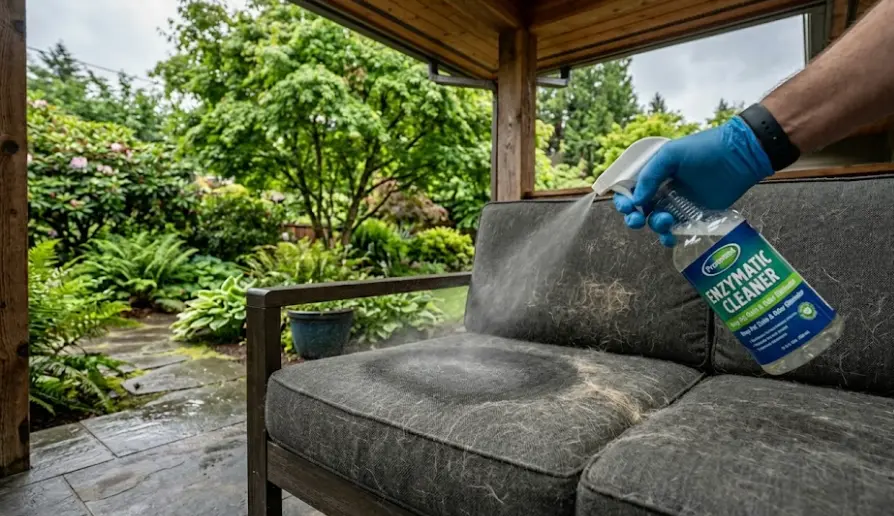
Remove Hair Before Treating for Odor
Mechanical hair removal comes first. Pet hair in the fabric physically blocks the enzymatic cleaner from reaching the fabric and foam where odor compounds are absorbed. A heavy layer of embedded hair creates a barrier that keeps the treatment at the surface rather than allowing it to contact the contaminated fibres beneath. Do the rubber glove or squeegee pass, collect the hair, then proceed to the enzymatic treatment on a hair-free surface.
Pre-Wet the Fabric and Apply Enzymatic Cleaner Generously
Pre-wet the cushion fabric with plain water before applying enzymatic cleaner — this prevents the product from being absorbed unevenly into dry fabric and helps it penetrate deeper toward the foam. Apply the enzymatic cleaner generously, enough that the fabric is visibly saturated. Do not dilute the product beyond the manufacturer's instructions — the enzyme concentration in the product is calibrated for the substrate. For cushions with established odor from months of pet use, use the product undiluted. Work the solution into the fabric with a soft brush so it contacts the fibres in the weave depth rather than just sitting on the surface.
Allow the Full Dwell Time — This Is Where the Chemistry Happens
The enzymatic reaction requires time: at minimum 15 minutes for light contamination, 30 minutes or longer for established or heat-cycled odor. The enzymes and bacteria need sustained contact with the organic material to catalyse the breakdown reactions. Wiping off or rinsing the product before the dwell time completes simply removes the treatment before it has finished working. Cover the treated area loosely to prevent premature evaporation in direct sun if you are treating in summer outdoor conditions — the enzymatic bacteria become less active as they dry out. On heavily contaminated cushions, a second application after the first treatment dries and is assessed is often needed.
Rinse Thoroughly and Assess When Fully Dry
After the dwell time, rinse the cushion thoroughly with a garden hose. Many enzymatic cleaners have a faint biological odor of their own that dissipates as the product dries — this is normal and temporary. The critical assessment happens after the cushion is completely dry: press your face against the previously contaminated area and smell it. The test must be done on dry fabric in warm conditions — ideally after 30 minutes in sun — because some residual pet odor compounds that survived the first treatment become more volatile when warm, making the result clearly evident. If odor remains, repeat the treatment.
Getting Treatment Into the Foam — The Step That Determines Whether Odor Returns
The most common reason dog odor returns after treatment is that the enzymatic cleaner addressed the fabric but not the foam core. Open-cell foam — the standard fill for outdoor seat cushions — absorbs organic compounds readily. A dog sitting on a cushion through a Seattle summer transfers saliva, skin oils, and coat compounds through the fabric cover and into the first centimetre or two of the foam over time. Surface treatment cleans the cover but leaves these absorbed compounds in the foam to continue off-gassing when the cushion warms in sun.
Getting enzymatic treatment into the foam without creating a saturated-foam situation — which leads to mold — requires applying a sufficient volume of product to penetrate the foam surface while managing the total liquid absorbed. The practical approach: apply the enzymatic cleaner to the fabric surface as described, then press firmly on the treated area with your palm in several spots. This forces the solution already absorbed in the fabric inward against the foam surface, driving some product contact with the foam without flooding it. Repeat the treatment on both faces of the cushion — the underside of the seat cushion (the face against the frame) often has more embedded contamination than the visible top face because that is the surface the foam is in direct contact with.
The Seattle Wet-Dog Cycle and Why It Creates a Specific Odor Problem
Seattle's climate creates a pet odor situation on outdoor furniture that is more persistent than in drier regions, and the mechanism is specific: the wet-dry cycle. A dog that spends time outdoors in Seattle's 155 annual rain days comes inside — or onto covered patio furniture — damp repeatedly. Wet dog fur releases more volatile organic compounds than dry fur; the water acts as a carrier, volatilising the skin oils and compounds that produce dog smell. When a wet dog lies on an outdoor cushion, a significantly higher concentration of odor compounds transfers to the fabric than from a dry dog.
The cushion then dries — in Seattle's cool, humid conditions, slowly — and the compounds bond to the fabric and foam fibres in the process. The next wet-dog contact adds another layer. Over a Pacific Northwest summer of regular outdoor furniture use, this cycle produces a level of embedded pet odor that requires more than a single enzymatic treatment to address, particularly on the back cushions and arm areas the dog contacts most frequently.
The odor also intensifies visibly during Seattle's brief sunny periods. Compounds that are relatively stable at cool outdoor temperatures become more volatile in heat — the same mechanism that makes the inside of a warm car smell strongly of whatever contamination it holds. This is why outdoor furniture that seems acceptable during the mild spring becomes noticeably pet-odored during the first heat wave of summer: the compounds were always there; the temperature simply made them more evident.
What Seattle Pet Owners Have Found
"We have two large dogs and a sectional on the covered back patio in Sammamish. Every spring it smelled terrible — we had tried every cleaning spray we could find and nothing stuck. Fresh Furnish identified that the issue was the foam inside two of the seat cushions, not just the cover fabric. They treated both faces of those cushions with an enzymatic product and let it work properly before rinsing. We had no pet smell return through the entire summer, which had never happened before. The difference was actually addressing the foam, not just cleaning the surface."
"The pet hair in our wicker sofa was the main frustration — not even a vacuum made a dent in it. I had no idea the rubber glove method existed. I tried it after reading a Fresh Furnish guide, and it took about 20 minutes to clear hair out of four cushions that had accumulated a full year of dog use. It looked completely different. The wicker itself needed a stiff brush into the gaps — I spent another 15 minutes on that and then vacuumed everything up. Total time about 40 minutes, no products, no special equipment. The results were genuinely better than professional cleaning attempts I had paid for previously."
When DIY Reaches Its Limits
Most pet hair situations on outdoor furniture are entirely manageable with DIY methods — the rubber glove technique removes hair effectively, and enzymatic cleaner properly applied addresses odor at the surface and foam-surface level. The situations where professional cleaning produces results that home treatment cannot are specific.
Foam that has absorbed pet odor compounds through multiple seasons of the wet-dog cycle without treatment develops contamination at depths that surface-applied enzymatic cleaner cannot reliably reach, even with the palm-pressure technique. Professional hot water extraction equipment applies enzymatic or oxidising treatment at high pressure and temperature into the foam, then extracts it along with the dissolved contamination — accessing depths that a hand application and garden hose rinse cannot. If you have treated a cushion with enzymatic cleaner twice, allowed full dwell time both times, rinsed thoroughly, and the odor returns within two weeks in sun, the contamination is likely deep in the foam and hot water extraction is the next step.
Foam that has visibly degraded — spongy, slow to spring back, with a persistent musty smell regardless of treatment — is a foam replacement situation rather than a cleaning situation. Fresh Furnish Cleaners can assess whether cushions need professional extraction or foam insert replacement, and handles outdoor furniture cleaning for pet households across the Seattle metro — contact us for an honest assessment before you invest further in DIY attempts on a cushion set that may need a different solution.
Frequently Asked Questions
The most effective method for outdoor fabric is the damp rubber glove technique: put on a rubber kitchen or cleaning glove, dampen it slightly with water, and drag your palm firmly across the cushion surface in one direction with long, consistent strokes. The rubber creates friction and a mild electrostatic effect that causes embedded hair to clump and pull out of the weave rather than being pushed deeper in. A rubber squeegee dragged across flat seat cushions works by the same principle and covers large areas faster. Lint rollers are largely ineffective on outdoor fabrics because the rough weave texture prevents consistent adhesive contact. For resin wicker frames, a stiff dry brush worked across the weave in multiple directions dislodges hair from the gaps between strands, which can then be vacuumed up. Vacuum cleaners alone tend to push as much hair into the weave as they remove — combine a rubber glove pass first, then vacuum what the glove loosened.
Enzymatic cleaner is the correct tool — not soap, not baking soda, not vinegar. Dog odor comes from proteins, fatty acids, and sulfur-containing organic compounds that standard cleaning products do not chemically break down. Enzymatic cleaners contain bacteria and enzymes that decompose these compounds into odorless byproducts. The process: remove pet hair first (a lint barrier reduces treatment effectiveness), pre-wet the fabric with plain water, apply enzymatic cleaner generously and work it into the fabric with a soft brush, allow 15–30 minutes of dwell time (longer for established odor), rinse thoroughly, and stand cushions on edge to dry. Assess odor only after the cushion is completely dry and warmed — some compounds that survived treatment become detectable when warm. If odor returns, the contamination has reached the foam core and a second deeper treatment or professional hot water extraction is needed.
Yes — enzymatic cleaner is the appropriate chemistry for pet-origin odors on outdoor furniture. The enzymes (protease, lipase, amylase) break down the specific types of organic compounds in dog odor rather than masking them. Effectiveness depends on whether the product reaches the source of the odor: for surface or shallow contamination, a standard application is effective. For odor that has been heat-cycled repeatedly by sun exposure into the foam core, the product needs to penetrate past the cover fabric. Apply generously, work into the fabric, use the palm-press technique to push some product toward the foam surface, and allow full dwell time. Enzymatic cleaners designed for outdoor or hard-surface use (rather than indoor carpet formulations) are more stable in variable temperature and light conditions. The smell does not return after successful enzymatic treatment because the compounds have been broken down, not temporarily masked.
The damp rubber glove is the single most effective tool for outdoor cushion fabric — it works on Sunbrella, polyester, olefin, and canvas-blend outdoor fabrics because the rubber conforms to the weave texture and creates friction and static that pull hair out of the fibre crosspoints where it is embedded. A rubber squeegee achieves the same result faster on large flat seat surfaces. For resin wicker, a stiff dry brush into the weave gaps is the only tool that reaches the hair compressed between strands. Standard vacuum cleaners with upholstery attachments are best used as a follow-up step after the rubber glove loosens the embedded hair — they collect what has been dislodged rather than extracting it from the weave directly. Lint rollers are largely ineffective on outdoor weave textures. No chemical product is needed for hair removal — all of the effective methods are purely mechanical.
The most common cause is that the cleaning addressed the cushion cover surface but not the foam core. Dog odor compounds absorb through the fabric and into the open-cell foam over time — particularly during the wet-dog contact cycle common in Seattle's climate. Washing the surface fabric removes what is at the surface level, but the foam continues to off-gas the absorbed compounds, particularly when warmed in sun. The second frequent cause is using a product that does not chemically break down pet odor — soap, baking soda, and vinegar clean or temporarily neutralise some surface odor but leave the organic compounds intact. Enzymatic cleaner applied in sufficient volume to reach the foam surface, allowed proper dwell time, is the treatment that addresses both. If enzymatic treatment applied twice has not resolved the odor, professional hot water extraction can treat the foam at depths that surface application cannot reach.
Resin wicker traps dog hair particularly effectively because the gap at every strand intersection holds hair that rain then compresses and dries in place. A stiff dry brush — a scrub brush or firm upholstery brush — worked across the wicker surface in multiple directions (with the strand direction, across it, diagonally) dislodges hair from the gaps. Follow immediately with a vacuum brush attachment to collect the loosened hair before it falls back into the wicker. On heavily contaminated wicker, dampening the brush slightly improves grip on the hair and causes it to clump more readily. Compressed air from a can of duster or low-pressure air compressor blows hair out of the gaps efficiently but scatters it widely — do this only outdoors with the furniture oriented so the air blows away from seating areas. Once the hair is removed, clean the wicker frame with a soft brush and soapy water to address any pet odor compounds that have transferred to the resin strand surfaces.
Related Outdoor Furniture Guides
Deep Cleaning an Outdoor Sectional
Pet hair and odor accumulate most heavily on the sectional sofa — the piece that functions as the outdoor living room. Our outdoor sofa and sectional cleaning guide covers the full cleaning sequence for multi-piece patio sets, including frame cleaning by material and foam drying protocol.
Mold on Patio Cushions
Pet-contaminated cushions stored damp are particularly prone to mold. If you are seeing both pet odor and dark spotting on outdoor cushions, our mold on patio cushions guide covers how to distinguish mold from other discoloration and the correct treatment by severity level.
Full Outdoor Cushion Cleaning
For a complete pre-season clean that addresses all outdoor cushion contamination types — not just pet hair and odor — our outdoor furniture cushion cleaning guide covers fabric identification, full DIY process, and removable cover handling.
Pet Odor That Won't Respond to DIY? We Can Assess and Treat It at the Foam Level
Established dog odor in outdoor cushion foam, multiple seasons of wet-dog contact, and hair-contaminated wicker frames are the situations where professional equipment makes the difference. Fresh Furnish Cleaners serves pet households across Seattle, Bellevue, Kirkland, Redmond, Bothell, Sammamish, and the greater Eastside — with an honest upfront assessment of what can be cleaned versus what needs foam replacement.
Pet Household Specialist
Enzymatic treatment at professional concentration and extraction depth — beyond what surface application reaches
Same-Day Service
Call before 2 PM for same-day outdoor furniture cleaning across the Seattle metro
Photo Assessment
Send a photo of your furniture — we will tell you whether cleaning or foam replacement is the right call before you book
Serving Seattle, Bellevue, Kirkland, Redmond, Bothell, Woodinville, Lynnwood, Edmonds, Shoreline & surrounding areas
