How to Restore Faded Outdoor Fabric Cushions
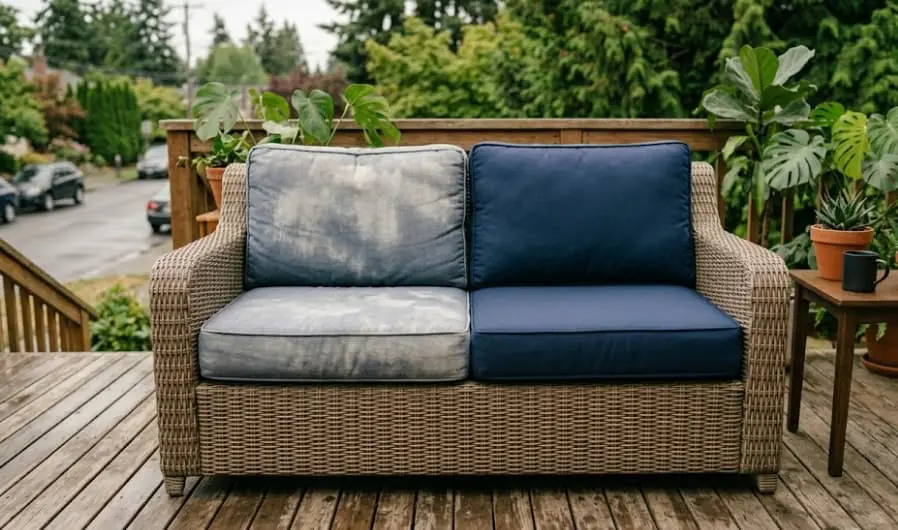
There's a moment every patio owner in the Seattle area eventually has — usually in May, when the cushions come out of winter storage or off the covered rack — where last year's cheerful navy or terracotta fabric looks like it's been left in a washing machine with bleach for a week. Nobody spilled anything. Nobody used the wrong cleaner. The cushions just sat outside, season after season, and the color quietly drained out of them.
The good news is that a meaningful portion of that "faded" look is reversible, and not all of it requires buying new cushions. The less good news is that some of it isn't reversible at all, and figuring out which category your cushions fall into before you spend money on a restoration product is the part most guides skip. This one doesn't.
Why Outdoor Fabric Fades Here, Even Without Much Direct Sun
People are often surprised that fading is a problem in Seattle at all. The reasoning makes sense on the surface — we don't get the brutal, all-day direct sun of Arizona or inland California, so why would fabric fade the way it does there? The answer is that UV radiation, the part of sunlight that actually breaks down fabric dye molecules, passes through cloud cover almost unimpeded. A grey, overcast Seattle afternoon can still deliver a UV index of 2 to 4, and on clear summer days the Seattle metro regularly hits 5 to 6 — lower than Phoenix's 9 to 11, but not zero, and outdoor cushions are exposed to it for five or six months a year, every year.
What actually happens at a chemical level is that UV photons carry enough energy to break the chemical bonds in the dye molecules — the chromophores, the part of the molecule that absorbs visible light and gives the fabric its color. Once that bond breaks, the molecule can no longer absorb the same wavelengths, and the color shifts toward white or grey. This process is cumulative and irreversible at the molecular level — you cannot "un-break" a degraded dye molecule. What restoration products do is add new, intact dye molecules on top of the degraded ones.
Orientation matters more than most people expect. A west-facing deck in Ballard or Magnolia catches the long, low-angle afternoon sun for hours through the summer, and that low angle is actually harsher on fabric than the more direct overhead sun of midday, because the light travels through more atmosphere and hits the fabric surface at a more grazing angle that increases surface exposure time per unit of fabric. Cushions near Lake Washington, Lake Union, or anywhere with light-colored concrete or pavers also take reflected UV from below — which is why the underside piping and the lower edges of a cushion sometimes fade faster than the top, a detail that confuses a lot of people until they think about where the light is actually coming from.
Three Things People Call "Fading" — and Only One of Them Is Actually Fading
Before reaching for a dye restorer, it's worth being honest about what's actually causing the dullness, because the fixes are completely different.
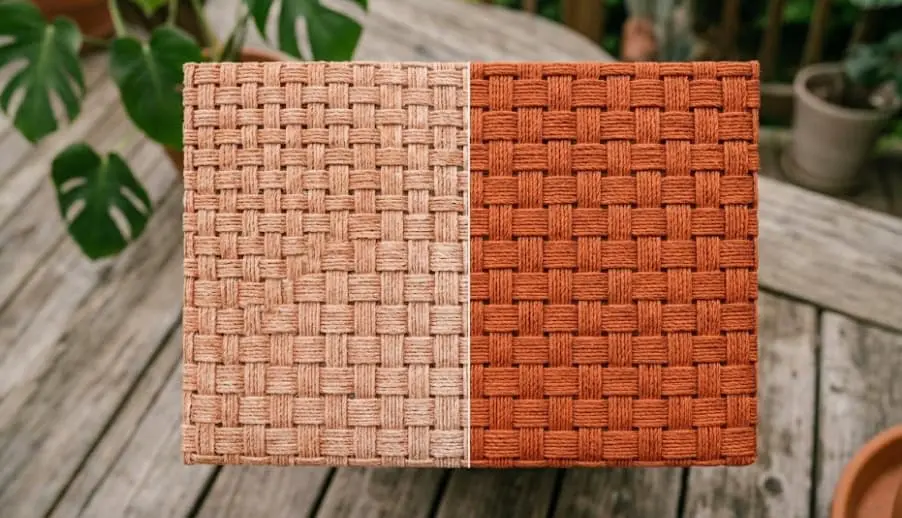
True UV Fading
Even, gradual color loss
What it looks like: Uniform lightening across the most exposed surfaces, usually the top and one side that gets the most sun. Color shifts toward pale or grey rather than disappearing patchily.
What's actually happening: Dye molecules in the fabric have been chemically broken down by UV exposure over months or years. This is permanent in the affected fibers — restoration means adding new pigment, not recovering the old.
Oxidation and Soil Film
Dull, hazy, slightly grey cast
What it looks like: An overall greyish or muddy cast over the whole cushion, sometimes worse in areas that don't get rinsed by rain — under awnings, against walls, in covered seating areas.
What's actually happening: Airborne particulates — pollen, vehicle exhaust residue, mildew spores, general grime — build up in the fabric weave and oxidize over time. This is removable with proper cleaning, and removing it often makes a cushion look dramatically better without any dye at all.
Chemical / Bleach Fading
Localized spots or streaks
What it looks like: Sharp-edged light spots or streaks, often where a cleaning product was applied unevenly, where pool or hot tub water splashed and dried, or where a sunscreen or bug spray was overspray contacted the fabric.
What's actually happening: A chemical reaction stripped dye from a specific area rather than gradual UV breakdown. These spots are often the hardest to blend with a dye restorer because the surrounding fabric hasn't faded the same amount — an even recolor across the whole cushion is usually needed to disguise a localized chemical fade spot.
Step One, Always: Deep Clean Before You Judge the Color
We've cleaned cushion sets in Bellevue and Kirkland that the owners were ready to throw out, convinced the fabric had faded to a uniform dull grey, only to find a saturated original color underneath a season or two of accumulated grime once we got through a proper extraction clean. This isn't true for every set — some really have faded that badly — but it's true often enough that skipping this step means some people buy dye restorer for a problem cleaning would have solved for free.
Brush Off Loose Debris and Vacuum
Start dry. A stiff-bristle brush followed by a vacuum with an upholstery attachment removes loose dust, pollen, and dried debris before you introduce water — wet debris turns into a paste that's harder to remove and can grind into the fabric weave during scrubbing.
Wash With a Mild Solution, Not Just a Hose Rinse
A solution of mild dish soap (about 1/4 cup per gallon of warm water) or a dedicated outdoor fabric cleaner, applied with a soft brush in the direction of the weave, lifts embedded grime that a hose alone won't touch. Work in sections, and don't let the soap dry on the fabric — rinse each section before moving to the next.
For Mildew or Grey Cast, Add Oxygen Bleach
If the dull cast has a slightly green or grey-green tint and the fabric smells musty when damp, you're dealing with mildew staining on top of soil. An oxygen bleach soak (1/4 cup per gallon of warm water, 15–20 minutes dwell) before the wash step addresses this. Oxygen bleach is safe on virtually all outdoor fabric dyes — chlorine bleach is not, and can accelerate fading on anything that isn't solution-dyed Sunbrella.
Rinse Thoroughly and Dry Standing on Edge
Residual soap left in the fabric attracts new dirt faster and can leave a slightly dulling film of its own. Rinse until the water runs clear, then stand cushions on edge so air moves across both faces. Full drying in Seattle's climate takes anywhere from 6 hours on a warm dry day to a full day or more if it's overcast — don't rush this, because applying dye restorer to a damp cushion produces uneven results.
Now Compare
Once the cushion is fully dry, look at it again next to an untreated one (or photograph it next to an old photo of the cushions when new, if you have one). If the color is close to what you remember, you're done — no dye needed. If it's still visibly lighter or greyed out compared to the original, that's the portion that's true UV fading, and that's what a dye restorer addresses.
Fabric Dye Restorers: What They Do and What They Don't
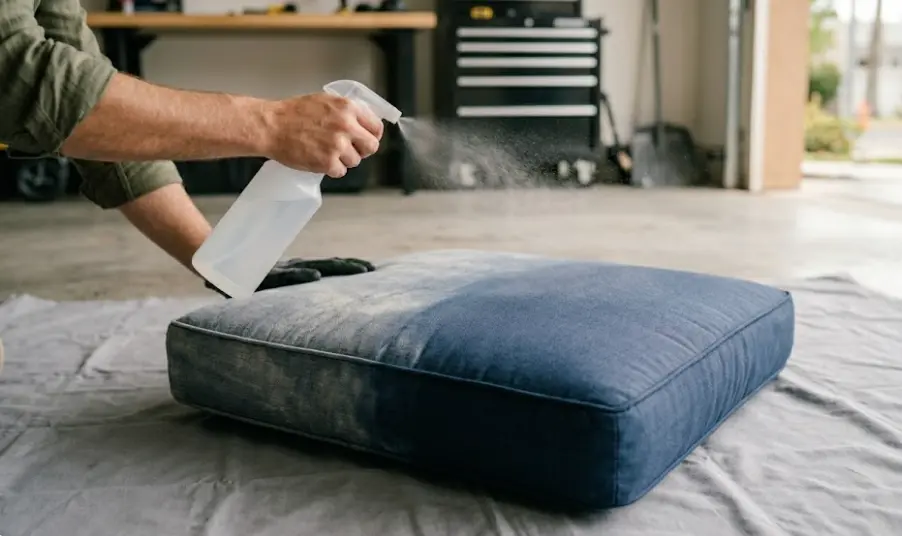
Once you've established that the remaining dullness is genuine UV fading, a fabric-safe dye restorer is the realistic option for bringing color back without replacing the cushions. These products — sold as fabric color restorers, fabric revivers, or outdoor fabric dye sprays — work by depositing a fine, even coat of pigment onto and into the surface fibers, which the weave absorbs. They are not the same as general spray paint for fabric, which sits on top of the fibers, stiffens the material, and tends to crack and flake under outdoor flexing and weather.
What These Products Do Well
Restore depth and richness to overall-faded color across large, evenly faded areas — a cushion that's gone from navy to washed-out grey-blue can come back close to navy. They penetrate the weave rather than sitting on top, so the fabric retains most of its flexibility and breathability. Most formulations are UV-resistant once cured, meaning the new pigment fades more slowly than the original dye did, since it's bonding to fiber that's already been through one fade cycle.
What They Don't Do
They will not produce an exact, lab-matched recreation of the original factory color — outdoor fabric is dyed in vats under controlled conditions with specific dye formulations per color, and a spray applied by hand outdoors is a different process entirely. They don't work on vinyl strapping, mesh sling chairs, or any fabric with a heavy waterproof laminate coating, because the pigment can't penetrate a sealed surface. And they don't fix structural fabric degradation — chalking, cracking, or loss of the water-repellent finish — because that's a breakdown of the fabric's coating, not its color.
Test on an Inconspicuous Area First
Spray a small section on the underside or a back corner and let it cure fully according to the product's instructions — usually 24 hours. Check the color match in daylight, not under garage lighting, since color temperature shifts how the result looks. This step matters because the same product can look noticeably different on different base fabrics depending on the fiber type and how faded it already is.
Apply in Light, Even Coats — Not One Heavy Pass
The most common mistake is treating this like spray painting a fence — holding the can close and saturating the fabric in one pass. This produces blotchy, uneven color and can leave the fabric stiff in spots. Hold the can 8–10 inches from the fabric, use a sweeping motion, and apply two to three light coats, allowing each to dry to the touch (usually 30–60 minutes) before the next.
Work in Full Sections, Edge to Edge
Stopping partway through a panel and resuming later — even an hour later — almost always leaves a visible line where the coats overlap unevenly. Plan to do one full cushion face per session, and lay the cushion flat on a clean drop sheet so overspray doesn't drift onto surfaces or other cushions.
Cure Fully Before Use or Rain Exposure
Most dye restorers need 24 hours minimum to cure, and some manufacturers recommend up to 72 hours before the cushion is sat on or exposed to rain. Curing indoors or under full cover in a garage is worth the wait — a cushion that gets rained on mid-cure can develop streaking that's much harder to fix than the original fading was.
Why Sunbrella Holds Color Differently Than Cheaper Outdoor Fabric
If you've noticed that some outdoor cushions seem to hold their color for five or six years while others from a big-box store look washed out after one summer, the difference usually comes down to how the fiber was dyed in the first place — and it's worth understanding if you're deciding whether restoration is worth the effort on a given cushion.
Solution-dyed acrylic — the process Sunbrella and similar premium outdoor fabrics use — adds pigment to the liquid acrylic solution before it's extruded into fiber. The color becomes part of the fiber itself, all the way through, not a coating applied afterward. When this fabric does eventually fade, it fades slowly and evenly, and because the pigment is integral to the fiber, a dye restorer applied to solution-dyed acrylic tends to bond very well and produce a longer-lasting result.
Piece-dyed polyester — common in less expensive outdoor cushion fabric — is dyed after the fabric is woven, which means the dye sits more on the surface of the fibers. This is faster and cheaper to produce, but the surface dye is more vulnerable to UV breakdown, abrasion, and washing, which is why these fabrics often show visible fading within one or two seasons. The upside, somewhat counterintuitively, is that dye restorers sometimes show a more dramatic before-and-after on piece-dyed polyester, simply because there was more room for visible improvement — but the restored color also tends to fade faster on this fabric type for the same underlying reason the original dye did.
When Fading Actually Means the Fabric Is Failing
This is the part that's less fun to write, but it's the honest answer for a meaningful number of cushions we see. Outdoor fabric isn't just dyed — it's also treated with a water-repellent finish, and in many cases, a UV-stabilizing topcoat. Over years of sun and weather, this finish breaks down independently of the dye, and once it has, color restoration doesn't address the underlying problem.
The signs to check for, beyond color: run your hand firmly across the fabric surface. If a chalky white residue transfers to your hand — this is called "chalking," and it's the breakdown of the fabric's UV-stabilizer coating becoming visible as a powder — the fabric finish has degraded structurally. Check whether water still beads up on the surface or immediately soaks in; loss of water repellency means the protective finish is gone. And look closely at fold lines and high-wear areas for fine cracking in the fabric surface itself, which indicates the fiber coating has become brittle.
Any one of these on its own doesn't necessarily mean the cushion is done — chalking can sometimes be cleaned off and the fabric can still take a dye restorer reasonably well. But if you're seeing two or more of these signs together, especially cracking, you're looking at a fabric that's reached the end of its practical life regardless of color, and a dye restorer applied to it will look temporarily better and then fail faster than it would on healthy fabric, because the restored pigment has nothing stable to bond to.
Slowing Down the Next Round of Fading
Whether you restore the color or decide to live with the current state, a few habits make a real difference to how fast the next round of fading happens — and they cost almost nothing compared to restoration or replacement.
Rotate and flip cushions periodically through the season. The face that gets the most sun fades fastest. Flipping cushions every few weeks, and rotating which end faces the strongest afternoon light, spreads UV exposure more evenly across the fabric instead of concentrating it on one face.
Cover or store cushions during extended periods of non-use. A breathable outdoor furniture cover during Seattle's long wet off-season — typically November through March for most patios — protects fabric from both UV (on the rare sunny winter day) and the moisture that contributes to mildew growth, which compounds the dull, dirty look over time.
Apply a UV-protectant fabric guard annually. Products like 303 Fabric Guard add a UV-blocking and water-repellent layer to outdoor fabric. Applied to fabric that's already in good condition, on a clean, dry surface, once a year — typically in spring before the season's heaviest sun exposure begins — this measurably slows the rate of future fading and helps maintain the water repellency that keeps soil from working its way deep into the weave.
Consider the orientation of new furniture purchases. If you're replacing a set anyway, positioning seating areas to avoid direct west-facing exposure during peak summer afternoons — or planning for shade from an umbrella, pergola, or awning — meaningfully extends how long the new fabric holds its color before this whole process repeats.
What Seattle Homeowners Have Found
"Our west-facing deck cushions went from a deep teal to almost grey over about three summers and I genuinely thought they were trash. Fresh Furnish came out for a deep clean first and honestly that alone brought back a lot of the color — there was way more grime built up than I realized. We did a dye restorer on top ourselves after that and it's not 100% the original teal, but it's close enough that you'd have to be looking for the difference. Cushions look better than they have in years."
"I was ready to buy new cushion covers for our sectional, about $400 for the set. The Fresh Furnish team looked at them and pointed out the fabric was chalking pretty badly on the armrests — said dye wouldn't hold on that and recommended covers instead, which is what I was already leaning toward but wasn't sure was actually necessary versus just trying a cheap fix first. Appreciated that they didn't just sell us a treatment that wouldn't have worked."
When to Get a Professional Assessment
If you're not sure whether your cushions are dealing with soil, true fading, or a failing fabric finish — or all three at once — a quick assessment before you spend money on cleaning supplies or dye restorer can save you from treating the wrong problem. We regularly walk Seattle, Bellevue, Kirkland, Redmond, Bothell, and Eastside homeowners through exactly this: what's cleanable, what's restorable with dye, and what's genuinely at the end of its life.
For cushions that just need the deep clean step done properly — which, as covered above, often does more for apparent color than people expect — our outdoor furniture cushion cleaning guide covers the full process in detail, including how to handle removable covers and foam inserts separately. Contact us for a no-obligation assessment and quote on outdoor cushion cleaning and restoration across the Seattle metro.
Frequently Asked Questions
It depends on the type and severity of the fading. Light to moderate UV fading on solution-dyed acrylic fabrics like Sunbrella can often be visually improved with a fabric-safe dye restorer spray, which redeposits pigment into the fibers. The original factory color is achieved through a precise dye-bath process that is very difficult to replicate exactly with a spray-on product, so the result is usually a close match rather than identical. Severe, multi-season fading where the fabric coating has also degraded — chalking, cracking, loss of water repellency — generally cannot be restored to a like-new appearance, because the fabric itself has broken down, not just the color.
UV radiation passes through cloud cover almost unimpeded. Seattle's UV index is lower than sunnier climates, but cushions are exposed for months at a time, and cumulative UV exposure is what breaks down fabric dyes — not just direct sunlight on clear days. West-facing decks get the strongest late-afternoon UV exposure, and surfaces near water or light-colored concrete reflect additional UV onto cushions from below and the sides, which is often why the underside and lower edges fade faster than expected.
A surprising number of cushions that look faded are actually coated in a thin film of oxidized dirt, pollen, airborne grease, and atmospheric grime that dulls the fabric's appearance without the dye itself being significantly degraded. This is especially common on cushions that haven't been deep-cleaned in a year or more. A proper deep clean often restores a large portion of the apparent color loss before any dye restorer is applied. The simple test is to clean a small section thoroughly and compare it to an uncleaned area — if the cleaned section looks noticeably brighter, you're dealing with soiling on top of fading.
The main category is fabric-safe dye restorer sprays, sometimes marketed as fabric revivers or color restorers, designed for outdoor textiles. These work by depositing a fine, even layer of pigment onto the fiber surface, which the fabric absorbs into its weave. Products formulated specifically for outdoor fabric are flexible after curing and don't significantly stiffen the material. They work best on solution-dyed acrylic and polyester. They don't work on vinyl strapping, mesh sling fabric, or fabrics with a heavy waterproof laminate, since the coating prevents absorption.
A properly applied dye restorer on outdoor fabric typically holds its color for one to two outdoor seasons before UV exposure begins to fade it again, similar to the original fabric dye. Cushions kept under a covered patio or rotated periodically to even out sun exposure tend to hold the restored color longer. Applying a UV-protectant fabric guard spray after the dye has fully cured — typically 24 hours — extends this further.
This comes down to the condition of the fabric itself, separate from the color. If the fabric is still structurally sound — no cracking, no chalky residue that rubs off on your hand, water still beads on the surface — restoration is usually worth attempting, since replacement cushions for a full sectional or dining set often cost several hundred dollars or more. If the fabric is chalking, cracking at fold lines, or has lost its water repellency entirely, the underlying fabric coating has broken down and color restoration won't address that. In that case, replacement cushion covers — if the foam inserts are still good — are usually a better investment than dye.
Related Outdoor Furniture Guides
Full Pre-Season Cushion Cleaning
The deep clean covered above is the first half of a complete seasonal refresh. Our outdoor furniture cushion cleaning guide covers fabric identification, the full DIY process, and how to handle removable covers and foam inserts.
Water Stains and Mineral Deposits
White rings, rust spots, and tea-colored staining can all add to a "faded" appearance on their own. Our guide on removing water stains from outdoor cushions covers identification and treatment for each type.
Restoring the Frame Too
If your furniture frame has faded or oxidized along with the cushions, our patio furniture restoration guide covers wrought iron, aluminum, and wood frame care for Seattle's climate.
Not Sure If Your Cushions Can Be Saved? We Can Tell You Honestly
Fresh Furnish Cleaners provides outdoor cushion assessment, deep cleaning, and color restoration guidance across Seattle, Bellevue, Kirkland, Redmond, Bothell, and the greater Eastside — same-day service available when you call before 2 PM.
Honest Assessment
We tell you what's cleanable, what's restorable, and what's genuinely worn out — no upsell on lost causes
Same-Day Service
Call before 2 PM for same-day outdoor furniture and cushion cleaning across the Seattle metro
Photo Quote
Send a photo of your faded cushions for a no-obligation assessment and quote within the hour
Serving Seattle, Bellevue, Kirkland, Redmond, Bothell, Woodinville, Lynnwood, Edmonds, Shoreline & surrounding areas
