Professional vs. DIY Upholstery Cleaning: What Actually Works
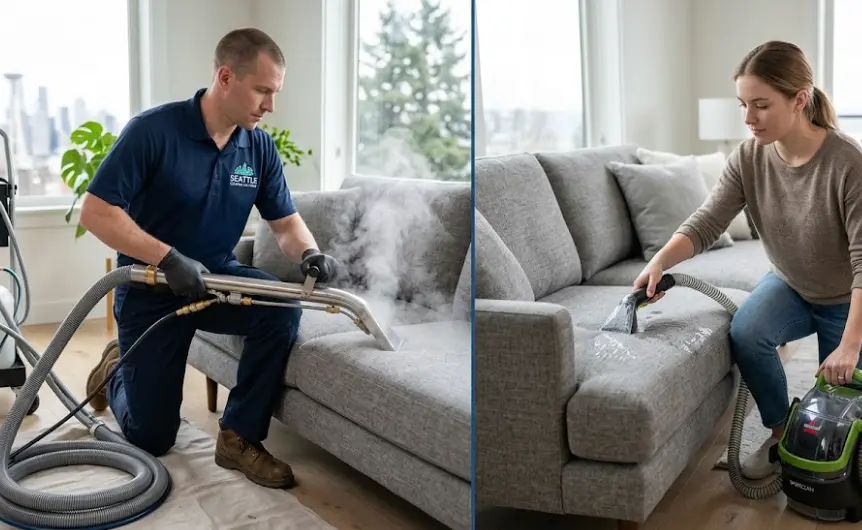
Most people try DIY couch cleaning at least once. The results range from "perfectly fine" to "permanently ruined a $1,400 sofa with a $35 rental machine." The difference usually comes down to three things: fabric type, equipment capability, and what the person expected the cleaning to actually do.
This isn't a piece arguing that you should always hire someone. For some situations, DIY upholstery cleaning is genuinely the right call — it's faster, cheaper, and produces adequate results. But the cases where it goes wrong go very wrong, and the pattern of mistakes is consistent enough that it's worth laying out exactly where the line is.
What follows is based on what we see on actual jobs: the fabric types that come to us after DIY attempts, the specific damage patterns, and the situations where the homeowner got a good result without us and probably didn't need us. Being honest about that last category matters — you should know when a professional visit actually adds value versus when you can handle it yourself.
What "Cleaning Code" Means and Why You Need to Check It First
Every upholstered piece made after about 1969 has a care tag, usually attached to the underside of a seat cushion or along the bottom frame edge. Four codes exist, and they determine everything about what cleaning approach is safe:
| Code | What It Means | DIY Safe? | Typical Fabrics |
|---|---|---|---|
| W | Water-based cleaners only | Yes — with low moisture | Polyester, nylon, most microfiber |
| S | Solvent-based cleaners only. No water. | No — water causes permanent damage | Cotton velvet, viscose, rayon blends, some antique fabrics |
| W/S | Either water-based or solvent cleaners are safe | Yes — with care | Polyester blends, performance fabrics, some linen blends |
| X | Vacuum only. No liquid of any kind. | Vacuum only | Some delicate woven fabrics, specialty textiles |
The first step before anything else — before buying a product, before renting a machine, before spraying anything — is finding this tag and reading it. If the tag is missing or unreadable, that alone is reason to call a professional rather than guess. Applying a water-based cleaner to an S-coded fabric is the most common cause of the "I made it worse" calls we receive.
Approximately 70–75% of upholstered furniture sold in the US over the last 20 years is W or W/S coded — polyester and polyester blends dominate the market because they're durable and relatively cleanable. But the 25% that isn't includes a lot of pieces people specifically bought for their appearance: cotton and linen sofas, velvet chairs, antique pieces reupholstered in natural fibers. These are the pieces that get damaged.
The Equipment Gap — This Is the Core Issue
The honest reason professional cleaning produces results DIY cannot match isn't technique — it's machinery. The gap between consumer and professional extraction equipment is large, and it explains most of the performance difference.
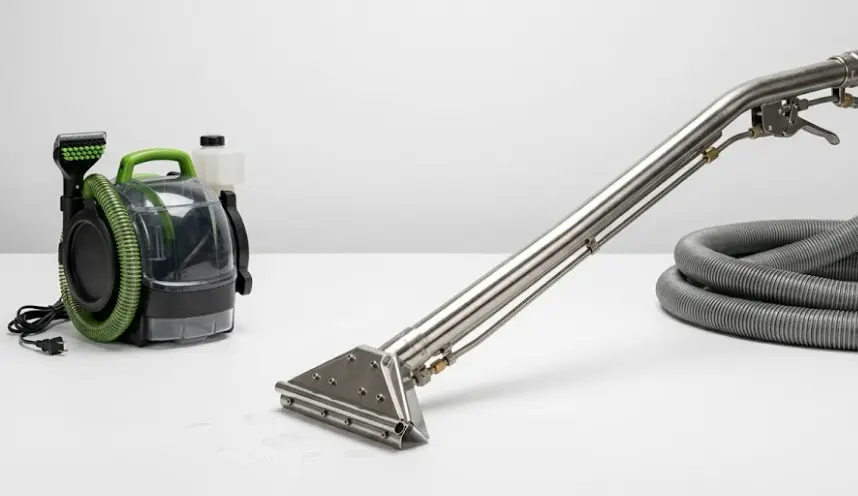
A truck-mounted professional extraction unit runs at 220–250°F water temperature and 500+ PSI injection pressure. That combination drives cleaning solution deep into fabric pile and through the foam fill beneath it, then extracts it — along with dissolved soiling, allergens, and biological matter — back out. The extraction suction on a truck-mounted unit is strong enough to pull moisture from deep in the cushion fill, not just the fabric surface.
A Bissell Little Green — one of the better consumer handheld units — runs cold or barely warm water at roughly 25 PSI. It cleans effectively to a depth of about 3–5mm into fabric pile. Below that, nothing happens. A Rug Doctor rental, which is the most powerful consumer-available option, operates at around 100–150°F and 100 PSI — meaningfully better than handheld units, but still operating at roughly 15–20% of a professional truck-mount's extraction power.
What this means practically: consumer equipment cleans what you can see. Professional equipment cleans what you can't see — the foam fill where pet dander accumulates, the mid-layers where mold spores can establish in a humid Pacific Northwest winter, the embedded particulates that cause the musty smell that returns within two weeks of a DIY clean. If the sofa just looks a bit dull and needs freshening, the Bissell does fine. If there's biological contamination, pet odor, or deep embedded soil, consumer extraction doesn't reach it.
Where DIY Actually Works — Being Honest About This
DIY upholstery cleaning is not universally a bad idea. There are specific situations where it's the right approach:
None of these are consolation prizes — they're genuinely appropriate applications of DIY methods. The problem is when these approaches get applied to situations that require something different.
Where DIY Makes Things Worse
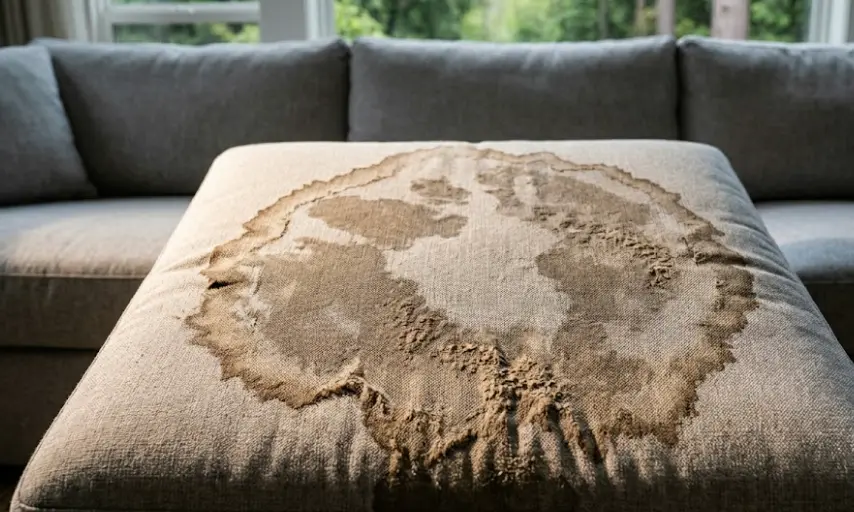
These are the specific failure modes we see consistently — not edge cases, but common patterns:
Over-wetting and what happens inside the foam
Consumer machines introduce more moisture than they extract. The foam fill beneath the fabric cover — typically open-cell polyurethane, 3–6 inches thick — absorbs water readily and releases it slowly. A professional truck-mount extracts aggressively enough to leave foam near-dry. A consumer unit leaves foam significantly wet — and in Seattle's ambient humidity, "significantly wet" foam doesn't dry in 4–6 hours. It dries in 12–36 hours, if airflow is good. If the cushion cover goes back on before the foam is dry, or if the room has normal indoor humidity levels, you've created the conditions for mold growth inside the foam where you can't see it.
The mold doesn't usually show up for 3–6 weeks. When it does, it shows up as a persistent musty smell that gets worse when the cushions are warm or compressed. By that point, the foam fill is contaminated, and professional cleaning can reduce it but not always eliminate it. The cleanable outcome of a DIY over-wetting is a worse problem than the original soiling.
Wrong products for the fabric type
Commercial upholstery sprays — Resolve Fabric Cleaner, Woolite Upholstery Foam, Folex, most supermarket options — are formulated for W-coded synthetic fabrics. The label doesn't warn you that they will permanently damage S-coded fabrics like cotton velvet, viscose, or fine linen. A water ring on a cream viscose velvet sofa from a single application of an upholstery spray is permanent. Professional cleaning can reduce its visibility; it cannot remove it.
This applies to enzyme cleaners for pet urine as well. Enzyme cleaners (Nature's Miracle, Rocco & Roxie) are water-based and effective on W-coded fabrics. On S-coded fabrics, they cause water damage before the enzyme chemistry has any chance to work. The correct approach for pet contamination on an S-coded fabric is professional solvent-based extraction — there is no consumer product that handles this correctly.
Residue buildup from incomplete rinsing
Consumer cleaning products leave surfactant residue in fabric unless they're rinsed out with clean water. Most DIY cleaning doesn't include a rinse pass — the product gets applied, scrubbed or blotted, and that's it. The surfactant residue left in the fabric is slightly sticky and attracts airborne particulates at an accelerated rate. The result: the sofa looks clean for two to three weeks, then gets dirty faster than it did before. This is such a consistent pattern that many homeowners assume professional cleaning "wore off" — when actually the issue is unrinsed DIY product accelerating re-soiling.
Rubbing stains instead of blotting
Rubbing pushes liquid deeper into fabric and foam rather than extracting it. It also spreads the stained area laterally and, on directional fabrics like velvet and corduroy, permanently disrupts the pile direction in the affected zone. The correct approach for any spill on any fabric is vertical blotting pressure — pressing straight down and releasing, without any lateral movement. This is the single technique change that would prevent the largest proportion of DIY upholstery damage.
The Real Cost Comparison
DIY upholstery cleaning looks cheap on paper. The actual cost comparison is more complicated:
| Scenario | DIY Cost | Professional Cost | Realistic Outcome |
|---|---|---|---|
| Surface freshening, polyester sofa | $15–25 (product) | $140–180 | DIY adequate for light surface soiling. Pro gives deeper clean. |
| Pet odor removal, standard fabric sofa | $25–50 (enzyme cleaner + machine) | $160–220 | DIY removes surface odor. Pro addresses foam contamination — smell stays gone. |
| Annual deep clean, 3-piece sectional | $50–80 (Rug Doctor rental) | $200–320 | DIY cleans to mid-layer. Pro extracts from full depth; furniture lasts longer. |
| Velvet or S-coded fabric, any soiling | $20–40 (product) + permanent damage | $180–260 | DIY causes irreversible water damage. Pro result: fully clean, pile intact. |
| DIY over-wetting + mold remediation | $50 (original clean) + $300–500 (remediation or replacement) | $160–220 (would have been preventive) | DIY attempt costs 5–10× the professional service that would have prevented it. |
The pattern: for light maintenance on budget polyester furniture, DIY has a reasonable cost-to-result ratio. For any situation involving pet contamination, S-coded fabrics, or furniture worth more than a few hundred dollars, the cost math favors professional cleaning even before accounting for the risk of DIY damage.
The furniture longevity angle compounds this further. Upholstery manufacturers — Ethan Allen, Pottery Barn, La-Z-Boy — specify professional cleaning every 12–18 months in their care documentation partly because professional cleaning maintains fiber integrity in ways consumer equipment doesn't. Deep extraction removes the abrasive fine particulates that work into fabric pile with daily use and gradually cut the fibers from the inside. A sofa that gets regular professional cleaning lasts 12–15 years. The same piece maintained with consumer cleaning typically shows measurable fabric degradation by year 7–8.
Specific Fabric Scenarios: What to Do
A Practical Decision Framework
Most situations fall clearly into one category or the other if you work through four questions:
1. What's the cleaning code? S-coded: stop, call a professional. X-coded: vacuum only. W or W/S: proceed to the next question.
2. What's the soiling type? Surface dust, light food spills caught quickly, general dullness: DIY is appropriate. Pet urine, mold smell, embedded odor, heavy soiling that's been sitting for weeks: professional cleaning.
3. What's the furniture worth? Sub-$300 piece, W-coded polyester: DIY cost-benefit makes sense. Above $500, or any piece with sentimental or design value: the risk-adjusted case for professional cleaning gets compelling quickly.
4. How long has it been? Regular annual professional cleaning means DIY maintenance in between is genuinely effective — you're maintaining a clean baseline. Furniture that hasn't been professionally cleaned in 3+ years has deep contamination that consumer equipment can't reach. Start with a professional clean; maintain DIY after that.
Frequently Asked Questions
Yes — for the right fabric type and the right soiling level. W-coded fabrics (polyester, most microfiber) handle DIY cleaning reasonably well for surface soiling. Check the cleaning code tag first; S-coded fabrics require professional solvent-based cleaning and will be permanently damaged by water-based DIY products. For deep embedded soiling, pet contamination, or furniture that hasn't been cleaned in 2+ years, professional extraction gets to areas consumer equipment cannot reach.
Professional truck-mounted extraction runs at 220–250°F and 500+ PSI — injecting solution deep into fabric pile and foam fill, then extracting it along with dissolved contamination. Consumer machines operate at 25–150 PSI and clean the upper layers of fabric effectively but can't penetrate to mid-fill where allergens and biological matter accumulate. Professional cleaning also includes fabric pre-treatment, pH-balanced rinse, and drying protocols — steps consumer cleaning typically skips.
The main risks are over-wetting (leading to mold in foam fill), wrong product for the fabric type (permanent water marks on S-coded fabrics), and rubbing rather than blotting (pile damage on velvet and directional fabrics). The higher the fabric value, the higher the DIY risk. For a $300 polyester sofa with surface soiling, DIY is low-risk. For a $1,500 cotton velvet piece with a stain, DIY is high-risk and professional assessment is the right starting point.
DIY costs $10–80 depending on whether you use products at home or rent a Rug Doctor. Professional upholstery cleaning for a standard sofa in Seattle runs $120–200; sectionals $180–280; individual chairs $60–100. The cost comparison shifts when you factor in that professional cleaning reaches areas DIY cannot, extends furniture lifespan measurably, and avoids the risk of DIY mistakes that can cost more than years of professional cleaning to address or replace.
No pets, no children: every 12–18 months. One pet: every 9–12 months. Multiple pets or young children: every 6–9 months. The interval matters because allergens and particulates work progressively deeper into fabric and foam fill over time — early professional cleaning extracts contamination before it bonds deeply. Furniture cleaned on a consistent schedule produces better results than furniture cleaned infrequently with more aggressive treatment required each time.
For one specific purpose: absorbing and neutralizing mild surface odors on dry fabric. Sprinkled on, left 15–20 minutes, and vacuumed off, it genuinely reduces ambient fabric odor. It doesn't remove stains, doesn't clean soiling, and has no effect on odors embedded in foam fill. It's a useful maintenance tool with clearly limited scope — not a cleaning substitute, but not a myth either. Use it for what it does: light surface odor between professional visits.
Professional Upholstery Cleaning in Seattle and the Puget Sound Area
We serve Bothell, Woodinville, Kirkland, Redmond, Bellevue, Seattle, Everett, Edmonds, Lynnwood, Shoreline, Sammamish, and surrounding King and Snohomish County communities. Free fabric assessment included — we'll tell you what your specific piece needs before we start.
See our full range of furniture and upholstery cleaning services • No hidden fees • Satisfaction guaranteed
Related Guides
Velvet Sofa Cleaning: Why DIY Can Ruin It
The specific ways DIY cleaning damages velvet — water rings, pile crushing, and why they're permanent on viscose and cotton velvet.
Read Velvet GuideHow to Identify Your Upholstery Fabric
How to read the cleaning code tag, understand W/S/X codes, and identify fabric fiber content before any cleaning attempt.
Read Fabric ID GuideUpholstery Cleaning Cost in Seattle
What professional upholstery cleaning actually costs in Seattle and the Puget Sound area — by furniture type and soiling level.
See Pricing Guide