Velvet Sofa Cleaning: Why DIY Can Ruin It
Velvet Is the Most Damage-Prone Upholstery Fabric to Clean
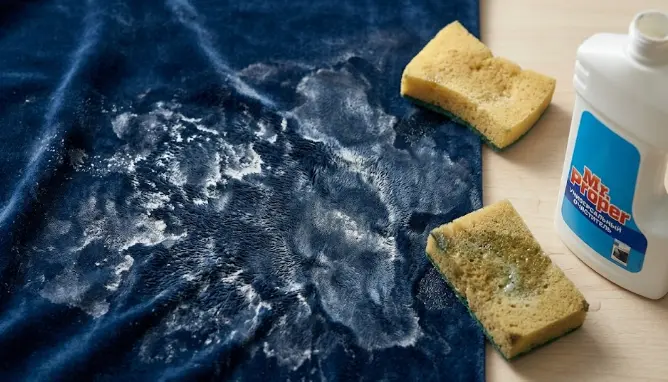
Of all the upholstery fabrics found in homes, velvet is the one that generates the most calls from customers who tried to clean it themselves and made the problem significantly worse. A water ring on a cream velvet sofa. A matted, flattened armrest where someone rubbed a wet cloth. A patch of dull, lifeless pile where a spray cleaner was applied and dried unevenly. These are not small cosmetic issues — on most velvet couch cleaning damage cases, the result is permanent.
The reason velvet is so unforgiving is structural. The fabric is defined entirely by its pile — thousands of cut or looped fibers standing upright, creating the characteristic sheen, softness, and color depth that makes velvet so visually striking. That pile is also what makes velvet extraordinarily reactive to moisture, pressure, and friction. The same properties that make it beautiful make it fragile under amateur cleaning.
This guide explains exactly what DIY cleaning does to velvet, why it goes wrong, what the professional approach looks like, and how to maintain your velvet sofa safely between professional appointments.
Velvet by Fiber Type: Risk Level Before Cleaning
Not all velvet is the same fabric. The fiber content — printed on the care tag alongside the cleaning code — determines how water-sensitive the pile is and what methods are even theoretically safe.
| Velvet Type | Cleaning Code | DIY Water Risk | Professional Method |
|---|---|---|---|
| Polyester velvet | W or W/S | Moderate — over-wetting or rubbing causes pile matting | Low-moisture hot water extraction |
| Cotton velvet | S | Extreme — water causes permanent water rings and color change | Dry solvent extraction only |
| Viscose / rayon velvet | S | Extreme — any moisture permanently alters fiber structure | Dry solvent extraction only |
| Acetate / silk velvet | S or X | Do not attempt — extreme sensitivity; professional assessment required | Specialist dry cleaning only |
| Performance velvet (Crypton, Sunbrella) | W or W/S | Lower risk — engineered to resist moisture; still requires correct technique | Low-moisture hot water extraction |
Note: using wet velvet before it is 100% dry — even sitting on it while damp — increases the risk of permanent pile distortion significantly. Always let cleaned velvet dry fully (minimum 4–6 hours) before any contact.
Why Velvet Reacts So Badly to DIY Cleaning
To understand why delicate fabric upholstery like velvet is so difficult to clean correctly, you need to understand what the pile actually is and what happens to it under moisture and friction.
The Pile Structure
Velvet pile consists of thousands of very short fibers — typically 1 to 3 mm long — woven into a backing fabric and then cut to create a uniform standing surface. These fibers are anchored at the base but free at the tip. When undisturbed, they stand upright in a consistent direction, and it is this directional uniformity that creates velvet's characteristic light-catching sheen.
Pressing the pile in different directions changes the apparent color — this is the "two-tone" effect you see when you stroke velvet against the nap. The pile is simultaneously velvet's most valuable visual property and its most vulnerable structural feature.
What Moisture Does to the Pile
When water or a water-based cleaner contacts velvet pile, each fiber absorbs moisture and swells. As the fibers swell, they lose their upright posture and begin to lean or mat together. If the fabric dries with the pile in this matted state — which happens when there is no active pile restoration during drying — the fibers bond in the flattened position.
On polyester velvet, this effect is moderate and partially reversible with steaming. On viscose (rayon) and cotton velvet, the fiber structure changes more permanently when wet — the pile does not recover on its own, and the water mark left at the drying perimeter is typically irreversible without professional intervention.
The Water Ring Problem
When any liquid is applied to velvet and begins to dry, the moisture does not evaporate uniformly. It migrates outward toward the drying edge, carrying dissolved soiling, minerals, and fiber lubricants with it. At the perimeter of the wet area, these dissolved materials concentrate as the last moisture evaporates — leaving a visible ring that is usually darker, shinier, or different in texture from the surrounding pile.
On viscose velvet, this ring is permanent because the fibers at the perimeter have been physically altered by uneven moisture exposure. The ring cannot be removed by applying more water — that just creates a larger ring. Professional solvent-based cleaning is the only effective treatment, and even then, old water rings that have been repeatedly re-wetted may be too set to fully remove.
The tragic pattern: A homeowner gets a small stain on their velvet sofa. They apply water to remove it. A water ring forms around where the water was applied. They apply more water to remove the ring. The ring gets larger each time. By the time we receive the call, the original stain area is 8 cm across and surrounded by a 30 cm water ring.
Friction and Rubbing Damage
Rubbing a velvet surface — whether with a cloth, sponge, or brush — disrupts the pile direction and can permanently tangle or break the fibers at the tips. This creates patches that appear matted, dull, or visually distinct from the surrounding undisturbed pile. On high-pile velvet, rubbing can also pull fibers from their weave anchors, creating bald patches.
This is why the advice to "blot, never rub" is particularly critical on velvet — more critical than on any other upholstery fabric. A gentle blotting motion applies pressure without lateral movement, which means it can absorb surface liquid without disrupting the pile direction.
Professional cleaning tools are specifically designed to clean velvet without friction — the extraction wand moves in one consistent direction aligned with the pile, never against it, and never with a scrubbing motion.
The Four Types of Velvet: Different Fibers, Different Risks
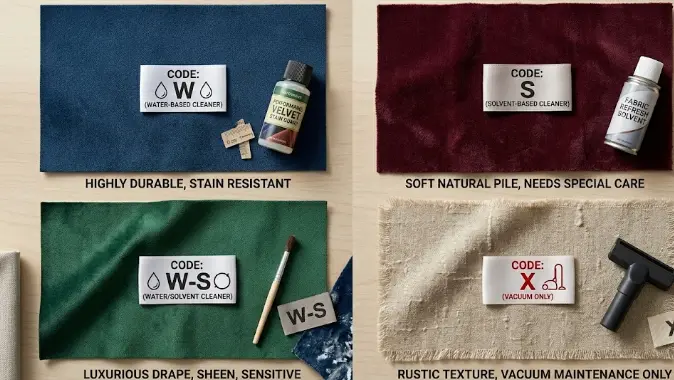
Not all velvet is equally fragile. The velvet couch cleaning approach — and the risk level of any DIY attempt — depends entirely on what the pile fibers are made of. Check the care tag on your sofa for the fiber content percentage.
Polyester Velvet — Most Forgiving
Care code: Usually W or W/S
Fiber behavior with water: Polyester fibers do not absorb water — they repel it at the fiber surface. Moisture sits on the fiber rather than penetrating it, which means water rings are less severe and pile recovery after drying is much better than with natural fibers.
DIY risk level: Moderate. Water-based cleaning is technically possible with low moisture and no rubbing. However, even polyester velvet will show pile distortion if over-wetted or dried unevenly. The most common DIY damage on polyester velvet is not water rings but crushed pile from rubbing or incorrect tool pressure.
Professional method: Low-moisture hot water extraction in one consistent direction aligned with the pile nap, followed by pile restoration with a velvet brush while slightly damp.
Cotton Velvet — High Risk
Care code: Usually S (solvent only)
Fiber behavior with water: Cotton fibers are highly absorbent. Water penetrates immediately and deeply, saturating the pile and the backing fabric. As cotton dries, it shrinks slightly — this can cause visible puckering or distortion of the weave structure. Pile recovery after wet cleaning is poor without active professional pile restoration during drying.
DIY risk level: Very high. Any water application risks permanent water rings and pile matting. Commercial upholstery spray cleaners are water-based and will damage cotton velvet. Do not attempt wet cleaning.
Professional method: Dry solvent extraction only. Solvent dissolves soiling without introducing water to the fiber structure. Pile restoration is required post-cleaning regardless of method.
Viscose / Rayon Velvet — Extreme Risk
Care code: S (solvent only) — non-negotiable
Fiber behavior with water: Viscose is the most water-sensitive upholstery fiber in common use. It is a semi-synthetic fiber made from cellulose — when wet, viscose fibers swell dramatically, lose tensile strength, and change their surface texture at a fiber level. This causes permanent sheen changes and pile damage that is visually distinct and irreversible. Even distilled water causes permanent marks on high-viscose velvet.
DIY risk level: Extreme. A single application of any water-based product — including most commercial spot removers, fabric refresher sprays, and even plain water — will permanently damage the pile. The resulting water ring and pile mat are not treatable by professional cleaning once set.
Professional method: Dry solvent extraction only, applied with minimal contact pressure. Pile restoration is essential and requires specialist technique on viscose pile.
Performance Velvet — Lowest Risk
Care code: W or W/S
Fiber behavior with water: Performance velvet fabrics (branded as Crypton, Sunbrella upholstery pile, or similar) are engineered with a moisture barrier built into the fiber structure. Liquids bead on the surface rather than penetrating the pile. This makes performance velvet dramatically more resistant to staining and water damage than natural-fiber velvet.
DIY risk level: Low to moderate. Blotting fresh spills on performance velvet is generally safe. For general soiling and deep cleaning, professional extraction still gives far better results than DIY methods, but accidental water contact is unlikely to cause permanent damage.
Professional method: Low-moisture hot water extraction. Often the easiest velvet type to clean with the most consistent results.
Common DIY Mistakes That Permanently Damage Velvet
These are the specific actions that cause the majority of irreversible velvet couch cleaning damage we see in our work across Seattle, Bothell, Bellevue, and the surrounding area:
Using a Spray Bottle of Water
Spraying water directly onto a velvet surface distributes moisture in an irregular pattern. Some areas get more water than others. The uneven drying creates multiple water rings at the edges of each differently saturated zone. On viscose velvet, each spray application permanently changes the fiber surface — the result is a mottled, uneven sheen that looks like a pattern of overlapping discoloration.
Never spray water onto velvet — not even to pre-wet before applying a cleaning product.
Commercial Upholstery Spray Cleaners
Products like Resolve, Woolite Upholstery, and most supermarket upholstery foam cleaners are water-based. The "foam" format gives the impression that they are dry, but the foam is water carrying surfactants — it penetrates the pile exactly as liquid water does. The foam dries and leaves a residue that attracts new soiling, and the moisture it carries can permanently damage viscose or cotton velvet pile.
These products are tested and approved for synthetic fabrics like polyester and nylon — they are not safe for delicate fabric upholstery including velvet with natural fiber content.
Steam Cleaning at Home
Handheld steam cleaners are marketed broadly for upholstery, but direct steam application to velvet pile is one of the fastest ways to create permanent damage. Steam combines high moisture and high heat — the heat relaxes the fiber bonds while the moisture causes them to re-set in whatever distorted position they are in when they cool. On viscose velvet, the combined effect is fiber-level structural change that cannot be reversed.
Steam has a specific professional use case for velvet pile restoration — steaming from a controlled distance to relax crushed pile before brushing — but this requires technique and distance control that handheld consumer steam cleaners do not allow.
Rubbing with a Cloth or Sponge
Rubbing velvet — even gently — creates friction across the pile surface. This pushes fibers in inconsistent directions, tangles pile tips, and can permanently alter the nap direction in the treated area. The result is a patch of velvet that looks visually different from the surrounding fabric — the light catches it differently, and it appears matted, dull, or worn even if the original stain has been removed.
The correct motion when anything contacts velvet is a straight, firm blot — vertical pressure applied and released without any lateral movement. No circular rubbing, no back-and-forth wiping.
Using a Hairdryer to Speed Drying
Applying direct heat to damp velvet sets the pile in whatever distorted position it is in when the heat reaches it. A hairdryer pointed at a wet patch of velvet will permanently lock the pile in a matted, distorted state. The heat also strips moisture from the fiber faster than it can naturally re-align, preventing any chance of natural pile recovery.
Drying velvet correctly means ambient air movement without heat — open windows, a low-speed fan at distance, or professional air movers positioned away from the surface. Never direct heat, never direct airflow onto wet velvet pile.
Renting a Carpet Cleaner
Consumer rental carpet extractors (Rug Doctor and similar) are calibrated for carpet cleaning — they apply significantly more water than upholstery requires and the suction is not strong enough to extract all of that moisture from upholstery fabric and foam. Using one on a velvet sofa saturates the pile and backing completely. On cotton or viscose velvet this causes severe, permanent pile damage and often results in structural wetting of the foam that takes days to dry and frequently leads to mildew growth inside the cushions.
Even on polyester velvet, the over-saturation from a carpet extractor causes problems that professional upholstery cleaning equipment — with its controlled low-moisture delivery — avoids entirely.
What Professional Velvet Sofa Cleaning Actually Involves
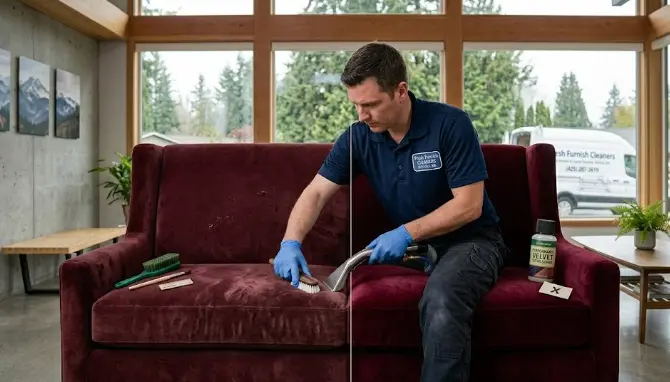
Professional delicate fabric upholstery cleaning for velvet is different in every significant way from the DIY approaches above. Here is what the process looks like when done correctly:
Fiber Identification First
Every professional velvet cleaning job starts with reading the care tag — fiber content percentage and cleaning code. The cleaning method selection is entirely determined by this: polyester velvet gets low-moisture water-based extraction; cotton or viscose velvet gets dry solvent extraction; performance velvet gets standard low-moisture extraction.
This step takes two minutes and is non-negotiable. Skipping fiber identification and applying a "standard" cleaning method is the single most common cause of professional cleaning errors on velvet — and professional errors on velvet are expensive.
Dry Pre-Vacuuming
Before any liquid contact, the entire velvet surface is vacuumed with a low-suction upholstery attachment — specifically the soft brush attachment, never a hard-bristle or rubber tool. The direction of vacuuming follows the pile nap to avoid disrupting it. This removes surface debris, pet hair, and dry dust that would be pushed deeper by subsequent wet cleaning.
The vacuum suction setting matters on velvet — too strong and the pile is pulled toward the attachment and compressed. Professional upholstery vacuums have adjustable suction; consumer vacuums on full power often over-suction on velvet pile.
Targeted Pre-Treatment
Pre-treatment solutions are applied sparingly to stained areas only — not broadcast across the whole surface. For S-coded velvet, only solvent-based pre-treatments are used. The pre-treatment is applied by misting or with a soft cloth placed flat (not rubbed) and allowed to dwell for the appropriate time before extraction.
Dwell time is the pre-treatment working chemically before any mechanical action — this is how soiling is loosened without mechanical friction that would damage the pile.
Directional Extraction — No Scrubbing
The extraction pass on velvet always moves in one direction — with the pile nap, never against it, never in circles. The wand is moved slowly and with consistent pressure, allowing thorough extraction with minimal moisture input. On W-coded velvet, a low-moisture hot water extraction machine is used at reduced pressure. On S-coded velvet, the solvent is applied and extracted without any water.
Multiple slow passes extract more effectively than one fast pass — speed reduces suction contact time per area and leaves more residue in the fabric.
Safe Velvet Maintenance Between Professional Cleanings
Between professional appointments, there is a safe maintenance routine that keeps velvet couch cleaning needs to a minimum and preserves the pile condition:
| Task | How Often | How to Do It Safely |
|---|---|---|
| Vacuuming | Weekly | Soft brush attachment, low suction, follow pile direction. Never use hard-bristle or rubber tools. |
| Pile brushing | Weekly or as needed | Velvet pile brush (widely-spaced soft bristles), brush in the direction of the nap. Restores sheen and lifts light compression from sitting. |
| Cushion rotation | Every 2–4 weeks | Flip and rotate cushions to distribute wear. Reduces pile compression in high-contact areas like seat centers and armrests. |
| Fresh spill response | Immediately | Blot firmly with a dry white cloth — vertical pressure only, no rubbing. Remove as much surface liquid as possible. Do not apply water. Contact professional if stain remains. |
| Pet hair removal | As needed | Velvet lint roller or damp rubber glove stroked in pile direction. Never a sticky tape roller (it disturbs pile direction). Never a stiff brush. |
| Sunlight management | Ongoing | Position velvet sofas away from direct sunlight — UV fades velvet pile unevenly, creating lighter patches on sun-exposed sections. UV window film is highly effective. |
When DIY Has Already Caused Damage — What Can Be Fixed
If velvet damage has already occurred from a DIY cleaning attempt, the severity and whether it is reversible depends on the specific type of damage:
Often Reversible
- Pile compression from sitting — steam at controlled distance + professional pile brushing restores most compression.
- Light water rings on polyester velvet — professional low-moisture extraction over the whole affected section, with feathering at the edges, eliminates most rings.
- General dullness from light soiling buildup — professional cleaning and pile restoration brings back the sheen in most cases.
- Detergent residue buildup — professional rinse extraction removes product residue left by repeated DIY cleaning attempts.
- Fresh spray-cleaner application (treated quickly) — if treated professionally within a few days before the product dries fully, most damage from spray cleaners on polyester velvet is reversible.
Usually Permanent
- Old water rings on viscose velvet — the fiber structure change is permanent. Professional cleaning can reduce visibility but rarely eliminates fully.
- Pile crushed by steam or hairdryer while wet — heat-set pile flattening is irreversible. The fibers have bonded in the distorted position.
- Rubbing damage — physically disrupted and tangled pile tips cannot be untangled. The patch appears permanently matted or worn.
- Multiple overlapping water rings on viscose — repeated re-wetting compounds the fiber damage; each application increases the irreversibility.
- Bleach or strong oxidizer contact — dye removal from velvet pile is irreversible and creates permanent discoloration.
If you are not sure whether damage to your velvet sofa is reversible, the answer is to have a professional assess it before attempting any further treatment. Every additional DIY attempt after initial damage narrows the window for professional recovery. The sooner a professional sees it, the better the realistic outcome.
Frequently Asked Questions: Velvet Couch Cleaning
Dry maintenance — vacuuming with a soft attachment and weekly pile brushing — is safe to do yourself. Wet cleaning is not recommended for home attempts. Any water or liquid cleaner applied without professional technique to velvet, especially cotton or viscose velvet, risks permanent pile crushing and water rings. For soiling that requires liquid treatment, professional cleaning is the right call.
On viscose and cotton velvet, water causes the pile fibers to absorb moisture and mat together. As the water dries unevenly, it leaves a permanent ring at the perimeter — often darker or shinier than the surrounding pile. On polyester velvet the effect is less severe and partially reversible, but pile distortion from uneven drying still occurs. Never apply water directly to velvet without professional technique controlling the moisture level and drying process.
It depends on the fiber content. Polyester velvet is usually W or W/S — water-based cleaning is safe with low-moisture technique. Cotton velvet is usually S — solvent only, no water. Viscose/rayon velvet is S — water causes permanent damage. Performance velvet (Crypton, Sunbrella) is W or W/S and the most tolerant. Check the care tag on your sofa — both the letter code and the fiber percentage are listed there.
Professional velvet cleaning identifies the fiber type first, then uses low-moisture extraction for polyester velvet or dry solvent extraction for cotton and viscose velvet. The extraction wand moves in one direction aligned with the pile — never against it, never in circles. After cleaning, while the fabric is still slightly damp, a specialist velvet pile brush is used to restore the nap to its upright directional position. This pile restoration step is what prevents the dull, flat result that amateur cleaning produces.
Light compression from normal use can often be lifted by steaming from 10–15 cm distance (never direct contact) and gently brushing the pile back in its natural direction with a soft-bristle velvet brush while still warm. This works for sitting compression. It does not work for pile crushed by DIY wet cleaning — once moisture-set and dried flat, steaming alone cannot restore the pile bond. Prevention and professional cleaning are more effective than repair once pile is set.
Yes — typically 20 to 35% more than standard polyester or microfiber cleaning. The higher cost reflects the additional skill required: fiber identification, correct method selection, slower directional extraction passes, and the pile restoration step after cleaning. For a quality velvet sofa, this premium is well justified — incorrect cleaning can permanently damage a piece worth thousands of dollars.
Professional Velvet Sofa Cleaning in Seattle
We identify your velvet fiber type, use the correct method, and restore the pile after every clean. No water on S-coded fabrics. No shortcuts. Serving Seattle, Bellevue, Kirkland, Redmond, Bothell, Everett, Edmonds, Lynnwood, Sammamish, and the greater Puget Sound area.
Free fabric assessment before we start • No damage guarantee • Satisfaction guaranteed
Related Guides
How to Identify Your Upholstery Fabric
Read your cleaning code tag — W, S, W/S, or X — and understand exactly what each one means before any cleaning attempt.
Read Fabric ID GuideLeather vs Fabric Upholstery Cleaning
How the cleaning approach, products, and technique differ completely between leather sofas and fabric upholstery.
Read Comparison GuideBefore & After: Real Upholstery Cleaning Results
Honest results from real professional cleaning jobs — what was achieved on velvet, microfiber, leather, and linen sofas.
See Real Results