Before & After: Real Upholstery Cleaning Results
What Professional Upholstery Cleaning Actually Achieves
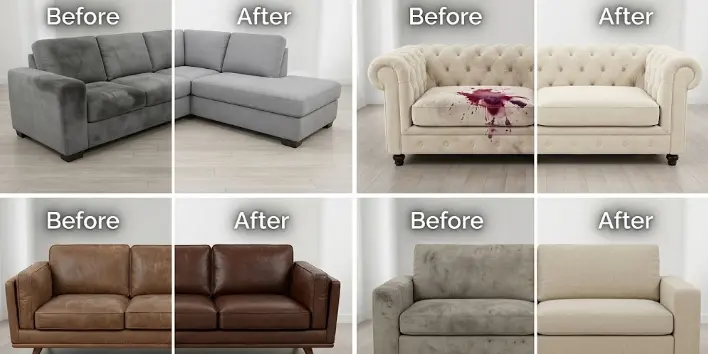
There is a lot of uncertainty around what professional sofa cleaning can and cannot do. Some people expect a miracle on a 15-year-old white sofa with a decade of pet stains. Others assume cleaning only makes a marginal difference and put off booking until the furniture is nearly unwearable. The truth sits between these extremes — and it is generally much more positive than most people expect.
This guide documents real sofa cleaning results from professional upholstery cleaning jobs across Seattle and the greater Puget Sound area: what was cleaned, what method was used, what the outcome was, and what factors determined the result. If you are trying to decide whether professional cleaning is worth it for your specific sofa, these real-world examples will give you a reliable answer.
Results by Sofa Type
Different fabrics respond differently to professional cleaning. Here is what to expect from the most common sofa types:
Microfiber Sofas
Typical condition before: Flattened, dull pile with dark patches from body oils and skin cells. Armrests and seat cushions significantly darker than the rest of the sofa. May have water marks from previous DIY attempts.
Method used: Hot water extraction with enzyme pre-treatment on soiled areas. Low-moisture technique to avoid water marks on W/S-coded microfiber.
Typical result: Microfiber consistently delivers the most dramatic visual transformation of any fabric type. The pile is restored, color evens out across the whole sofa, and the characteristic soft texture returns. Most microfiber sofas look close to new after professional cleaning regardless of age.
Realistic expectation: Excellent. Deep-set old stains on very light microfiber may lighten rather than disappear completely — but overall appearance improvement is dramatic in nearly every case.
Polyester & Fabric Blend Sofas
Typical condition before: General grime and body oil buildup concentrated at armrests and center seat cushions. May have food stains, beverage rings, or pet hair embedded in the weave.
Method used: Hot water extraction with appropriate pre-treatment for stain types present. High-temperature rinse for sanitization where needed.
Typical result: Very good. Polyester and synthetic blends respond well to extraction cleaning — the fibers release embedded soiling effectively. Color and texture are restored. Fresh stains come out completely; older stains come out in the majority of cases.
Realistic expectation: Very good to excellent. Among the easiest fabric types to clean professionally with consistently strong results.
Velvet & Velour Sofas
Typical condition before: Pile crushed flat at seat areas. Color appears uneven — lighter where pile is compressed. May have water marks from previous cleaning attempts or spills.
Method used: Low-moisture cleaning with careful pile restoration. Velvet cannot be over-saturated — technique is critical to avoid permanent pile distortion or watermarking.
Typical result: Good to very good when done correctly. Pile is restored, color evens out, and the sofa regains its characteristic sheen and depth. The transformation on flattened velvet is often striking.
Realistic expectation: Good — with an important caveat. Previous DIY cleaning attempts that left water marks on velvet can create permanent marks that professional cleaning cannot fully reverse. If velvet has been incorrectly cleaned before, set expectations accordingly.
Linen & Natural Fiber Sofas
Typical condition before: Soiling on linen shows distinctly — natural fibers show body oil buildup as darkening and a loss of the fabric's characteristic crisp texture.
Method used: Low-moisture dry-cleaning solvent method (S-code fabrics) or very controlled low-moisture water-based treatment (W/S-code). Over-wetting linen causes shrinkage and distortion.
Typical result: Good — cleaning restores color and removes soiling effectively. The natural texture is refreshed. Linen requires the most careful moisture management of any fabric type.
Realistic expectation: Good, with careful technique. Results are excellent when the fabric is W/S or W coded and handled by an experienced technician. S-coded linen requires solvent-based cleaning only.
Leather & Faux Leather Sofas
Typical condition before: Dull, sticky surface from body oil accumulation. Fading or darkening on high-contact areas. Possible cracking on genuine leather due to lack of conditioning.
Method used: pH-balanced leather cleaning solution, gentle agitation, conditioning treatment to restore moisture and suppleness. UV protectant for sun-exposed pieces.
Typical result: Excellent on genuine leather — color is restored and evened out, suppleness returns, and surface feels clean rather than sticky. Conditioning noticeably improves the look and feel of dried-out leather.
Realistic expectation: Very good for genuine leather. Bonded leather and faux leather show good surface cleaning results but conditioning is less effective — and heavily peeling bonded leather cannot be restored by cleaning.
Large Sectional Sofas
Typical condition before: Heavy use sections (corner seat, chaise end) dramatically darker than less-used sections. Uneven soiling makes the sofa look patchy and worn.
Method used: Full sectional treatment ensuring consistent cleaning across all sections — treating the whole piece rather than spot-treating heavy areas prevents cleaned sections from looking odd against uncleaned ones.
Typical result: Dramatic. The evening-out of color across the whole sectional is one of the most visually impressive sofa cleaning results we achieve. A patchy, worn-looking sectional becomes a cohesive, fresh-looking piece.
Realistic expectation: Very good. Full-sectional treatment delivers more consistent results than spot-treating individual sections — we always recommend treating the complete piece for best visual outcome.
Results by Stain Type
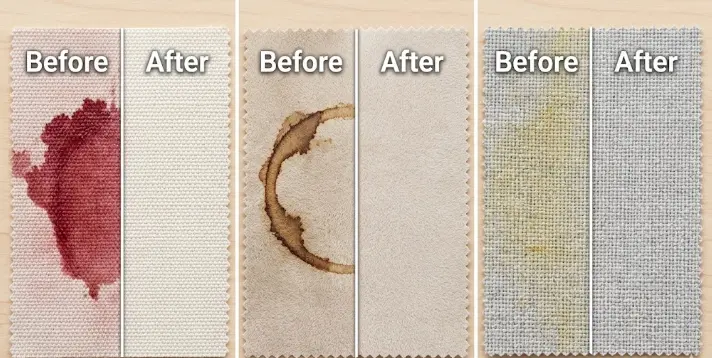
The type of stain — and crucially how long it has been there — is the primary factor determining what professional cleaning can achieve. Here is an honest breakdown:
| Stain Type | Fresh (under 3 months) | Old (over 12 months) | Heat-Set or DIY-Treated |
|---|---|---|---|
| General body oils & grime | Fully removed in almost all cases | Fully removed in most cases | Significantly reduced; may not fully restore color |
| Coffee & tea | Fully removed in most cases | Significantly reduced; old tannin stains may lighten | Difficult; heat-set tannins resist removal |
| Red wine | Removed completely in most cases with oxidizing pre-treatment | Significantly reduced; old red wine may leave a faint ghost | Partial improvement; set wine pigment is very resistant |
| Pet urine (odor) | Permanently eliminated with enzyme treatment | Eliminated with extended enzyme pre-soak | Steam-treated urine is harder; may need repeat sessions |
| Pet urine (stain) | Fully removed in most cases | Significantly reduced; old urochrome pigment may lighten | Heat-set urine stain may persist on light fabrics |
| Food & grease | Fully removed with enzyme or degreaser pre-treatment | Good result; old grease oxidizes and becomes more stubborn | Variable; depends on fabric type and grease composition |
| Ink & dye stains | Variable — ballpoint usually responds well; permanent marker resists | Difficult; dye-based stains bond strongly to fibers | Often permanent — especially on light or natural fabrics |
| Mold & mildew | Removed and sanitized with antimicrobial treatment | Mold removed; staining may remain on white or light fabric | Deep mold growth may have caused permanent fiber damage |
Real Job Examples: What We Cleaned and What Happened
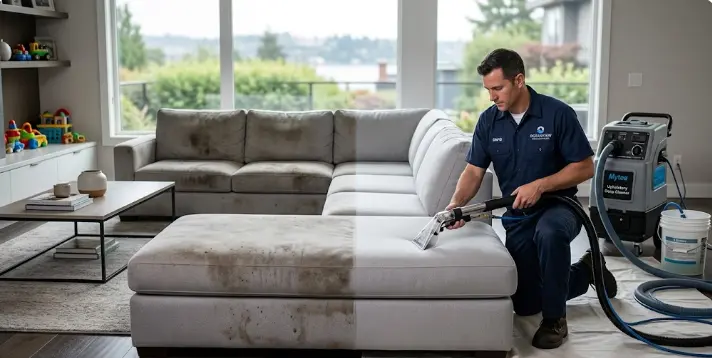
Grey Microfiber Sectional — 4 Years of Use, Two Dogs
Location: Ballard, Seattle
Fabric: Microfiber (W-coded)
Condition: Armrests and center seat nearly black from body oils and dog contact. Visible pet hair embedded in the weave. Faint urine smell from one cushion. Owner had tried vinegar spray and a rental carpet cleaner.
Method: Hot water extraction with enzyme pre-treatment on all surfaces. Extended enzyme soak on the urine-affected cushion with UV identification of all contaminated areas.
Result: Full color restoration across the entire sectional. Urine odor completely eliminated — confirmed by UV re-scan. Pet hair removed. Owner described the result as "looks like a different sofa." Extended furniture life estimated 3 to 5 years.
Cream Velvet Sofa — Red Wine & General Soiling
Location: Queen Anne, Seattle
Fabric: Velvet (W/S-coded)
Condition: Two red wine stains, approximately 8 months old. General soiling and pile compression across seat cushions. Owner had rubbed the wine stains with a wet cloth immediately after the spill and applied baking soda.
Method: Low-moisture cleaning with oxidizing pre-treatment on the wine stains. Careful pile restoration technique throughout.
Result: General soiling fully removed; pile restored to its original depth and sheen. Wine stains reduced by approximately 85% — a faint shadow visible only in direct light. The rubbing motion used immediately after the spill had spread and partially set the wine, limiting full removal.
Dark Brown Leather Sofa — 10 Years Old, Heavily Used
Location: Bellevue
Fabric: Genuine full-grain leather
Condition: Seat cushions faded significantly lighter than the back and arms. Sticky, tacky surface from a decade of body oil accumulation. Cracking beginning on the seat cushion fold lines.
Method: Professional leather cleaning with pH-balanced solution, full conditioning treatment, and UV protectant application on the sun-facing sections.
Result: Color significantly evened across all sections — the fading contrast reduced by roughly 70%. Surface tackiness completely gone. Leather supple and smooth after conditioning. Cracking halted — conditioning restored moisture to the dried areas. Owner said it looked better than it had in five years.
White Linen Sofa — Toddler Household
Location: Kirkland
Fabric: Linen blend (W/S-coded)
Condition: Multiple food stains, juice marks, and general grime across all seat cushions. One cushion had a dried chocolate stain approximately 3 months old. Owner had used a commercial stain remover spray on most spots.
Method: Low-moisture controlled water-based treatment. Careful enzyme pre-treatment on food stains with adequate dwell time.
Result: All food stains and juice marks fully removed. Chocolate stain removed completely. The commercial stain spray previously applied had not set any stains — full extraction was successful. The sofa returned to a consistent bright white across all cushions.
Beige Microfiber Sofa — Mold from Flood Damage
Location: Shoreline
Fabric: Microfiber (W-coded)
Condition: The home had experienced a water leak three weeks prior. The sofa had dried but showed visible mold spotting on one arm and part of the seat cushion. A musty odor was present throughout the piece.
Method: Full antimicrobial pre-treatment, hot water extraction, and antimicrobial protector application post-cleaning.
Result: Mold growth eliminated and antimicrobial tested negative post-treatment. Musty odor completely gone. Minor residual shadow marks from the mold spotting remained on the arm — visible only in strong side-lighting. Sofa safe for use and structurally sound.
Light Grey Polyester Sofa — Multiple Steam Cleaning Attempts
Location: Edmonds
Fabric: Polyester blend (W-coded)
Condition: Multiple food and beverage stains from a year of use. Owner had rented a home steam cleaner and used it three times on the stained areas. Several stains appeared unchanged; one coffee stain appeared worse after steaming.
Method: Hot water extraction with enzyme and oxidizing pre-treatments. Extended dwell times given the heat-setting history.
Result: General soiling and most stains fully removed. The repeatedly steam-treated coffee stain reduced by approximately 60% but not fully eliminated — the heat had permanently bonded the tannins to a portion of the fibers. This is an honest result: professional cleaning recovered a great deal, but the steam treatment had created permanent damage in one area.
What Determines Your Sofa Cleaning Results
Six factors have the greatest influence on what professional cleaning achieves on any given sofa:
1. Age of the Soiling
Fresh soiling is dramatically easier to remove than old soiling. Most stains treated within weeks come out completely. The same stains after 12+ months have oxidized, bound to fabric fibers, and may have been rehydrated and re-dried multiple times — each cycle making removal harder.
Impact: The single biggest variable in sofa cleaning results. Treat soiling early when possible.
2. Fabric Type & Care Code
Microfiber and synthetic blends consistently deliver the best results — durable fibers release soiling well. Natural fibers (linen, cotton) require careful moisture management. Velvet needs specialist technique. S-coded fabrics can only use solvent-based cleaning.
Impact: High — determines which methods are available and how aggressively soiling can be treated.
3. Previous DIY Treatment
The most common cause of limited results is prior DIY treatment. Rubbing instead of blotting spreads stains and pushes them deeper. Steam or hot water heat-sets proteins and tannins. Incorrect products can chemically alter the stain. The sooner professional cleaning happens — before DIY attempts — the better the outcome.
Impact: High — some DIY treatments create permanent limitations for professional cleaning.
4. Type of Stain
Protein-based stains (food, pet accidents, body oils) respond very well to enzyme treatment. Tannin stains (coffee, tea, wine) respond well when fresh, become more resistant with age. Dye-based stains (ink, some food dyes) are the most resistant. Odors respond to enzyme and antimicrobial treatment reliably.
Impact: Moderate — enzyme treatment handles most organic stains well; dye stains are the exception.
5. Fabric Color
Dark and mid-tone fabrics are more forgiving — any residual trace of a stain is far less visible. Light and white fabrics show everything and require complete removal for the result to look clean. Results on white or cream sofas are excellent when treatment happens early; older stains on very light fabric may leave a faint shadow.
Impact: Moderate — affects how visible any residual trace is rather than how much is removed.
6. Fabric Protector History
Sofas that have previously had professional fabric protector applied are significantly easier to clean. The protector prevents spills from soaking into the fiber — they bead on the surface and can be blotted up rather than saturating the weave. Unprotected fabric absorbs spills immediately, allowing deeper penetration and faster staining.
Impact: Significant — protector application after cleaning is one of the most cost-effective steps to preserve sofa cleaning results.
When Professional Cleaning Cannot Fully Restore a Sofa
Honest assessment means acknowledging what professional cleaning cannot fix. There are situations where results will be limited — and knowing them in advance helps set realistic expectations:
Permanent Limitations
- Bleach damage — bleach permanently removes dye from fabric. No cleaning process can restore color that has been chemically destroyed.
- Severe sun fading — UV degradation of fabric dye is irreversible. Cleaning can remove soiling but cannot restore faded color.
- Physical damage — pulls, tears, pilling, and worn-through areas are structural issues, not cleaning issues.
- Bonded leather peeling — delamination of bonded leather or PU coating cannot be reversed by cleaning.
- Deeply heat-set stains — protein and tannin stains that have been repeatedly steam-treated may be permanently bonded to fibers.
When to Replace vs. Clean
We always inspect and advise honestly before accepting a job. If cleaning cannot meaningfully improve a piece, we say so rather than take payment for disappointing results.
Replacement makes more sense than cleaning when:
- The fabric is physically degraded beyond what cleaning can address
- Structural damage (frame, springs, foam) makes the sofa uncomfortable regardless of appearance
- Mold has penetrated the full depth of the foam padding — a health risk that cleaning cannot resolve
- The piece has significant bleach or irreversible dye damage that would leave it looking patchy
How to Get the Best Results from Your Sofa Cleaning
Before the Appointment
- Remove cushion covers if they are removable and machine washable — we clean the foam cushions in place and the covers can be laundered separately
- Remove loose items from and around the sofa (remotes, blankets, decorative pillows)
- Tell us about any DIY treatments that have been applied — knowing what products were used helps us select compatible cleaning agents
- Point out all known stains and problem areas, including ones you are not sure about — we will UV-scan for hidden contamination
- Book as soon as possible after a stain occurs — results improve significantly with early treatment
After the Appointment
- Allow the full drying time before sitting on the sofa — typically 2 to 4 hours with low-moisture methods, up to 6 hours for fully saturated extraction cleaning
- Keep windows open or run a fan to speed drying and prevent any moisture from resettling in the foam
- Some stains may appear to shadow slightly when damp and then disappear fully as the fabric dries — give it 24 hours before assessing the final result
- Apply fabric protector if you have not already — this is the single best step to preserve your sofa cleaning results and prevent future staining
- Vacuum weekly to prevent dry soil buildup, which acts as an abrasive and degrades the fabric between professional cleanings
What Seattle Customers Say About Their Sofa Cleaning Results
"I genuinely thought our sofa was done. Seven years old, two kids, one dog — it was dark grey in the seat areas where it had started out light. After cleaning it was unrecognizable in the best way. My husband asked if we'd bought a new couch. Worth every penny and I'll never wait this long again."
"They were upfront that the ink stain on our linen sofa might not come out fully given how old it was — it had been there about two years. They got 90% of it out and the rest is only visible if you look for it. The honest assessment before they started meant there were no disappointments. Really professional service."
"Called them the day after a red wine accident on our cream velvet sofa. Managed to get a next-day appointment. The stain came out completely — I cannot find any trace of it. The technician told me that calling quickly was the key. I believed him after seeing the result."
"Our leather sofa had been looking dull and almost sticky for years. After cleaning and conditioning it looks like a completely different piece of furniture — the color is deep and even, the surface is smooth, and it smells clean. I had no idea leather responded so well to proper professional cleaning."
2026 Job Results: South King County and Pierce County
Since expanding service to Tacoma, Renton, Kent, Federal Way, and Auburn in 2026, here are representative outcomes from recent jobs in these areas:
Tacoma — Grey Sectional, Pet Household
Fabric: Polyester blend, 5 years old. Two large dogs, daily use.
Issues: Heavy body oil buildup on armrests and headrest zones, embedded pet hair throughout, general darkening of seat areas.
Method: Hot water extraction with enzyme pre-treatment across all cushion surfaces and crevices. Air mover for accelerated drying given Tacoma humidity.
Result: Full removal of body oil discoloration. Pet hair extracted from fibers. Seat area color restored to original grey. Dry in 4 hours.
Renton — Microfiber Sofa, Cat Urine
Fabric: Microfiber (W-code), 3 years old. Cat urine — approximately 6 months old, multiple incidents.
Issues: Strong urine odor reactivating in warm weather, visible staining at two cushion sites. Owner had used enzyme spray from pet store with no lasting result.
Method: UV scan to locate all affected areas (found a third spot not visible). Professional enzyme pre-soak with 20-minute dwell time. Hot water extraction, repeat on worst cushion.
Result: Odor fully eliminated on follow-up check 2 weeks later. Visible staining removed. Customer confirmed no odor return after first warm-weather week.
Frequently Asked Questions: Sofa Cleaning Results
Most sofas show dramatic improvement: general soiling and body oils are fully removed in almost all cases. Fresh stains are removed completely in the majority of jobs. Old stains are significantly reduced but may not disappear entirely. Pet urine odor is permanently eliminated with enzyme treatment. The biggest factors in results are fabric type and how long the soiling has been present.
Yes — heavily soiled sofas often show the most dramatic before and after results. Years of body oil buildup, pet hair embedding, and general grime accumulation respond very well to hot water extraction and enzyme pre-treatment. We regularly clean sofas that owners believe are beyond saving, achieving results that extend the furniture lifespan by several years.
With normal household use, professional sofa cleaning results typically last 12 to 18 months before the furniture benefits from another professional cleaning. Applying fabric protector after cleaning extends this significantly — treated sofas resist resoiling and are much easier to spot-clean between professional visits. Homes with pets or children may benefit from cleaning every 6 to 12 months.
It depends on the stain type, age, and whether heat has been applied. Fresh stains are removed completely in most cases. Old stains (over 12 months) are significantly reduced and often fully removed. Stains that have been heat-set by steam cleaning, a hair dryer, or years of sun exposure are the most difficult and may not fully disappear. We assess and advise honestly before starting any treatment.
When done correctly, professional cleaning restores fabric to its original texture and color — removing the dull, flattened appearance that soiling causes over time. It does not alter the fabric itself. The exception is if incorrect methods are used (such as over-wetting natural fibers or steam on certain fabrics), which is why professional fabric assessment and correct technique before cleaning is essential.
Stains that have been permanently set by heat (steam, sun, iron) are the most resistant. Some dye-based stains (certain ink types, some food dyes) may not fully lift from lighter fabrics. Bleach damage, fabric fading, and physical fiber damage cannot be reversed by cleaning. A professional inspection will identify what is achievable before any treatment begins — we do not start work without giving you realistic expectations first.
See What Professional Cleaning Can Do for Your Sofa
Free inspection and honest assessment before any work begins. Serving Seattle, Bellevue, Kirkland, Redmond, Bothell, Everett, Lynnwood, Edmonds, Sammamish, and the greater Puget Sound area.
Free quote before we start • No hidden fees • Satisfaction guaranteed
Related Upholstery Cleaning Guides
How Often Should You Clean Your Sofa?
A practical guide to professional sofa cleaning frequency based on household type, number of occupants, pets, and fabric.
Read Cleaning Frequency GuideRemove Wine Stains from a Couch
What to do immediately after a red wine spill on fabric upholstery — and when to call a professional for complete stain removal.
Read Wine Stain Removal GuideHow to Maintain Upholstery Between Cleanings
Practical tips to preserve your sofa cleaning results and keep furniture looking its best between professional appointments.
Read Maintenance Guide