Why Cheap Upholstery Cleaning Can Damage Your Furniture
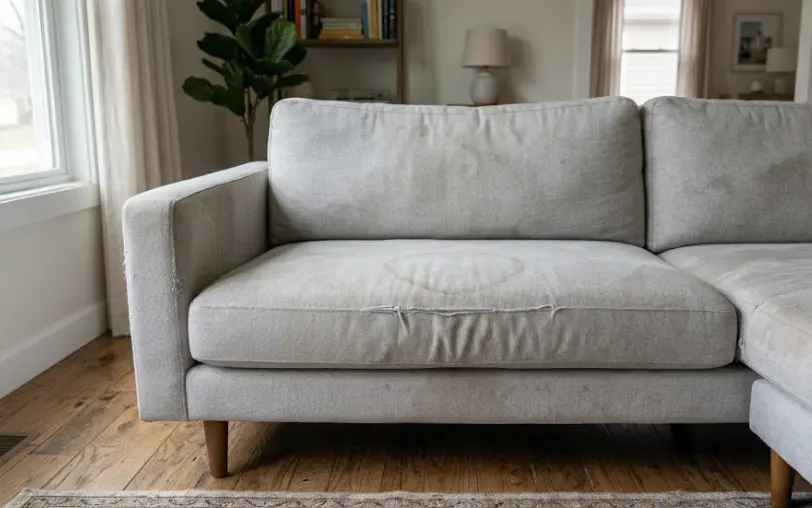
The $49 couch cleaning flyer lands in the mailbox, or the ad surfaces in a local Facebook group, and it looks reasonable — a sofa is a sofa, how complicated can it be. The answer, unfortunately, is more complicated than a $49 job allows for. The damage that follows cheap upholstery cleaning is rarely immediate. It shows up days later as a persistent damp smell, weeks later as accelerated re-soiling, or months later as mold inside foam you can't see until the odor becomes impossible to ignore.
This is not about brand loyalty or upselling. These are the specific technical reasons why cutting too far on price for this particular service tends to cost more in the end than it saves upfront.
The Equipment Problem: Suction Is the Whole Game
Hot-water extraction — the method behind effective upholstery and carpet cleaning — works because it injects a small amount of water and immediately vacuums it back out along with the loosened soil. The ratio of water injected to water extracted matters enormously. A professional truck-mounted system maintains consistent pressure and suction throughout the job. A cheap portable unit, especially one that has been on multiple jobs already that day, loses efficiency as the dirty water tank fills and the motor heats up.
When extraction suction is insufficient, more water stays in the fabric and foam than was put in. A 3-seat sofa has roughly 8–12 kg of foam fill in the cushions and body. That foam absorbs water readily and releases it slowly. In a Pacific Northwest home where baseline indoor humidity runs 60–75% for much of the year, foam that has been over-wetted and under-extracted can stay damp internally for 48–72 hours even when the surface feels dry to the touch.
Truck-mounted systems used by properly equipped companies draw from a vehicle-mounted water heater and waste tank. They do not lose suction or water temperature over the course of a job. Portable units suitable for professional use do exist, but they come at a cost that does not align with a $49 service price point.
The Chemical Problem: Dilution and Wrong Product for Fabric Type
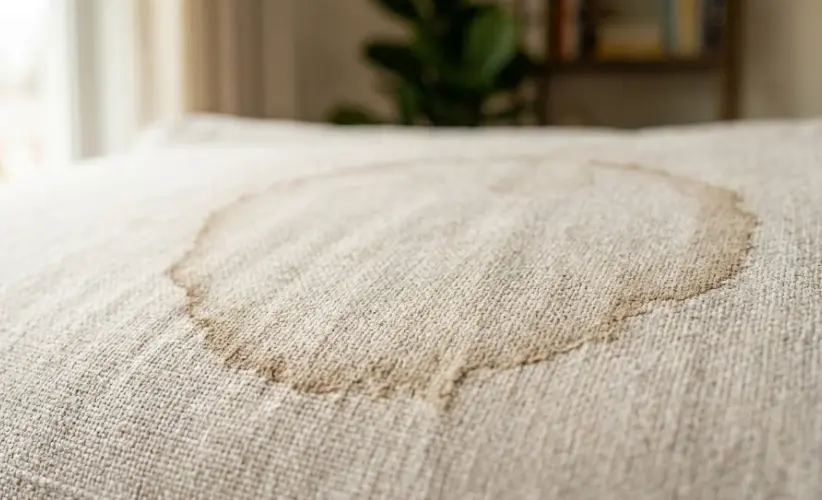
Professional upholstery cleaning uses different chemistry for different fabric types — not because this is a technicality, but because the wrong product causes permanent damage to specific materials. The four cleaning codes (W, S, W/S, X) exist because cotton, viscose, and rayon fabrics that carry an S code will water-mark, shrink, or ring permanently if cleaned with water-based solutions. Cheap operators frequently apply the same product to everything.
Water-Based Cleaner on S-Code Fabric
What it looks like when done: Surface appears clean and wet normally.
What appears as it dries: A distinct tide mark forms at the edge of the cleaned area as water migrates outward and evaporates unevenly, leaving a concentrated ring of dissolved mineral salts and surfactant.
Can it be reversed: Often not fully. Professional solvent treatment can reduce it, but the original water mark usually remains visible in raking light.
High-pH Cleaner on Cotton or Linen
What it looks like when done: Fabric appears clean or slightly brightened.
What appears as it dries: Color shift — typically a bleached or faded appearance in the treated area. In some dyes, a pink or orange undertone emerges as the dye oxidizes under alkaline conditions.
Can it be reversed: No. Dye oxidation from alkaline cleaners is permanent. The only resolution is reupholstering.
Beyond fabric compatibility, cheap operators frequently use heavily diluted solutions — the product costs money, and diluting it stretches the supply further. Under-concentrated cleaner does not break down soil effectively, which means more agitation and more water are applied to compensate. Both increase damage risk.
The Residue Problem: Why the Sofa Re-Soils Faster After Cheap Cleaning
This is one of the less obvious consequences of a cheap clean, and one that many people attribute to just "bad luck" or their own habits. A properly cleaned sofa with fully extracted solution dries neutral — there is no residual chemistry in the fabric. A sofa cleaned with insufficiently diluted or poorly rinsed surfactant retains a thin layer of cleaning agent in the weave after drying.
Surfactants — the active cleaning ingredient in most upholstery products — are designed to attract and suspend soil particles. When residue remains in the fabric, it continues attracting airborne dust, skin oil, and particulates at an accelerated rate. A sofa that was dirty over two or three years of normal use can reach the same visible soil level within six to eight weeks of a residue-leaving clean.
Customers who experience this often assume the cleaning failed or that their household is unusually dirty. The root cause is that the cleaning company did not perform a rinse pass with clean water after the main extraction, or used a product with a high residual surfactant load that was not designed for upholstery. Fresh Furnish Cleaners uses low-residue upholstery solutions and always performs a final rinse pass — it adds time to the job but is not optional for a result that actually lasts.
The Pet Odor Problem: Spray vs. Enzyme
Pet odor treatment is where the gap between cheap and proper service is widest, and where the consequences of cutting corners are most frustrating.
Cat and dog urine odor comes from uric acid crystals that form as urine dries inside fabric and foam. These crystals are stable at room temperature and relatively odorless when dry. When they are wetted — including by cleaning — the uric acid reactivates and releases ammonia, which is why a sofa that smelled faintly of pet odor before cleaning can smell dramatically worse immediately after a cheap clean.
Proper treatment requires enzyme solution applied with sufficient dwell time — typically 8–12 minutes — before extraction. Enzymes break down the uric acid at the molecular level, converting it into compounds that do not produce odor. This approach, done correctly, produces a genuine reduction or elimination of the odor source.
Ask directly: "Do you use enzyme solution for pet odor, and how long do you let it dwell?" A company that uses enzyme treatment properly will answer this question specifically. A company that does not will give a vague answer about "special pet treatment" or will not distinguish between enzyme and deodorant.
What Prices Actually Mean in the Seattle–Tacoma Market
A realistic cost breakdown for a 3-seat sofa clean as of 2026: professional-grade truck-mounted equipment amortized over its lifespan, $8–12 in solution per job at proper concentration, $18–25 in labor at a minimum, fuel, insurance, and the time for a proper pre-inspection and rinse pass. This does not reach profitable territory below $100–110 for a sofa in the Seattle metro area, and most reputable companies price at $120–185 to account for variability in condition and fabric type.
| Quote Range (3-seat sofa) | What It Usually Means | Risk Level |
|---|---|---|
| Under $65 | Portable equipment with weak suction, diluted solution, spray-and-wipe method, or a bait-and-switch lead | High — over-wetting and residue damage likely |
| $65–$100 | Variable — some legitimate budget operators, some with equipment or skill gaps. Ask specific questions before booking. | Medium — outcome depends heavily on technician |
| $120–$185 | Standard professional range — covers proper equipment, correct solutions, pre-inspection, and rinse pass | Low — consistent results when company is reputable |
| Over $220 | Premium or specialty services — leather conditioning, Crypton/performance fabric treatment, heavily soiled sectionals | Low — typically justified for complex jobs |
The replacement cost of a mid-range sofa in 2026 runs $600–$2,000. Saving $70 on cleaning and permanently damaging the fabric or growing mold in the foam is not a trade that works out mathematically. The calculus only looks different when the existing sofa is near end of life anyway — in which case, the honest advice is that cleaning may not be worth doing at all.
Specific Damage Patterns to Watch For After Cheap Cleaning
Tide Marks and Ring Stains
Appears: 2–6 hours after cleaning, as the fabric dries.
Cause: Water migrated beyond the cleaned area and evaporated unevenly, depositing dissolved minerals and surfactant at the boundary.
Fix: Professional solvent treatment or re-extraction of the entire panel with feathered edges. Not always fully reversible.
Fabric Shrinkage or Puckering
Appears: As fabric dries, usually within 12–24 hours.
Cause: Water-based cleaning applied to S-code cotton or viscose fabric that should have been cleaned with solvent method only.
Fix: None. Shrinkage in natural fiber upholstery is irreversible without professional reupholstering.
Persistent or Worsening Odor
Appears: Within 24–72 hours after cleaning, once residual fragrance from deodorant spray fades.
Cause: Uric acid reactivated by moisture during cleaning, redistributed through foam without enzyme treatment.
Fix: Enzyme treatment with proper dwell time, then re-extraction. May require foam replacement for severe cases.
How to Vet a Cleaning Company Before Booking
These four questions separate operators who know what they're doing from those who don't, and most people never ask any of them.
- What equipment do you use — truck-mounted or portable? Truck-mounted is preferable for upholstery for the suction and temperature consistency reasons described above. A portable unit is not automatically bad, but it requires a more skilled operator to compensate for its limitations. A company that cannot answer this question does not know their own equipment.
- Do you check the fabric cleaning code before applying any product? Yes or no. The correct answer is yes, every time. If the answer involves any hedging — "we use products safe for all fabrics" — treat it as a no.
- What do you use for pet odor — enzyme solution or deodorant? The correct answer is enzyme solution with a specific dwell time. "We have a special pet treatment" is not the same thing. Press for whether it is enzyme-based.
- What is your process if fabric is damaged during cleaning? Any reputable company has a clear answer to this — insurance, a claims process, or at minimum a direct conversation with ownership. A company that becomes vague or defensive about this question is one that has no process for it.
Fresh Furnish Cleaners answers all four of these questions before starting any job, and provides written confirmation of the cleaning method and product used for each fabric type treated. If a company is unwilling to have this conversation before accepting your booking, find a different company.
Questions About Your Sofa Before Booking?
Call or text (206) 212-1234. We'll tell you upfront what method your fabric needs, what the job will cost, and whether cleaning makes sense for your specific piece.
