Couch Cleaning Puyallup WA — Professional Sofa Cleaning Service
Puyallup Homes Have Their Own Upholstery Challenges
Puyallup sits about 12 miles east of Tacoma, in the Puyallup River Valley rather than on the Sound. That geography matters for furniture cleaning in ways most homeowners don't consider. The valley gets similar annual rainfall to coastal Pierce County — around 37–40 inches — but the temperature swings are wider. Valley winters include more freeze-thaw cycles, and valley summers bring periods of real heat. Upholstery in homes without consistent HVAC cycles between slightly damp and slightly dried out, which breaks down fabric fibers over time and creates the right conditions for dust mite populations to grow unchecked.
The city's housing stock is a genuine mix. Downtown Puyallup and the surrounding older residential streets have Craftsman bungalows and mid-century ranches from the 1940s through the 1970s — often with fabric sofas that have lived through multiple owners and accumulated years of embedded soil. South Hill and the Sunrise area are largely newer construction from the 1990s to present, full of families with kids, pets, and furniture from big-box stores built from polyester blends and performance fabrics. Bradley Lake Park and East Puyallup are quieter streets with larger lots and longer-term residents who may have had the same sectional for a decade.
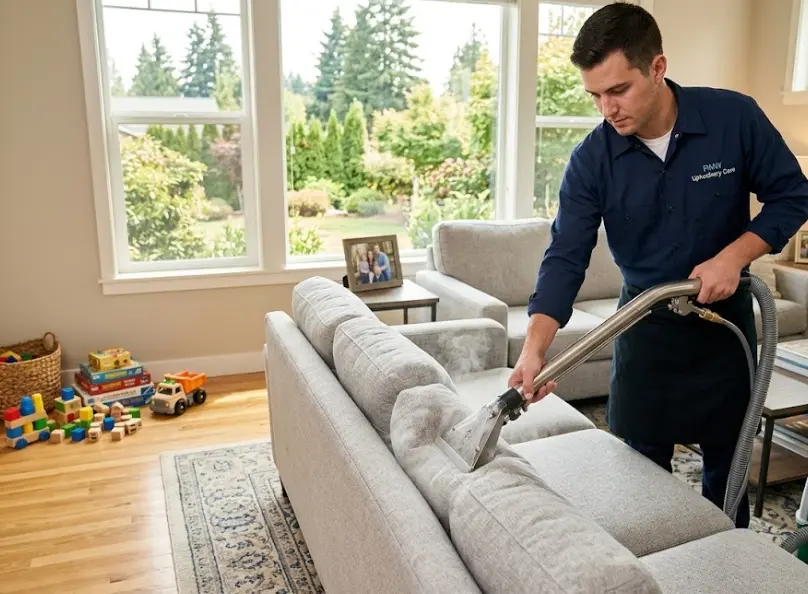
Fresh Furnish Cleaners serves all of Puyallup and the surrounding South Hill area. We work across this whole range — a straightforward extraction job in a well-maintained South Hill living room and a heavily pet-damaged sectional in an East Puyallup rental are both jobs we handle regularly. What we don't do is treat every situation identically and then hand you a surprise number at the end.
What Couch Cleaning Costs in Puyallup, WA
| Furniture Type | Price Range | Typical On-Site Time |
|---|---|---|
| Sofa / Couch (2–3 seat) | $120–$185 | 45–75 min |
| Sectional (4–6 piece) | $195–$310 | 90–150 min |
| Loveseat | $80–$120 | 35–55 min |
| Armchair / Accent Chair | $60–$90 | 20–40 min |
| Pet odor enzyme treatment (add-on) | +$40–$65 | Included in visit |
| Stain guard protector (add-on) | +$30–$50 | Included in visit |
We give you a firm price before we start. If we assess the sofa and find the condition warrants extra treatment — significant pet saturation, mold pre-treatment, or a second pass on a problem area — we tell you before doing anything additional, not after. You decide whether to proceed. If we're cleaning multiple pieces in the same visit, a bundled rate applies — call with what you have and we'll give you a combined quote.
Puyallup Neighborhoods and Surrounding Areas We Serve
| Area | Typical Upholstery Situations | Our Usual Approach |
|---|---|---|
| Downtown Puyallup / Meeker Historic District | Craftsman bungalows and mid-century homes, long-term residents, quality furniture that's seen 10–20 years of daily use | Fabric-code inspection first; dry solvent for S-code pieces; hot-water extraction for W-code; honest assessment if cleaning vs. replacement is the right call on very worn pieces |
| South Hill (Pierce County unincorporated) | Newer large-lot family homes, multiple pets and children, high-use living room furniture; polyester blends and performance fabrics from big-box retailers are common | Enzyme pre-spray on pet-affected areas, full extraction, stain guard recommended on light-colored fabric with young kids present |
| Sunrise Village / North Puyallup | Mid-range suburban homes, mix of older and newer residents, rental properties in some blocks | Standard extraction for most jobs; moisture check inside older foam cushions before proceeding with wet methods |
| Bradley Lake Park | Quiet owner-occupied neighborhood, furniture tends to be well-maintained; occasional guest room pieces that haven't been used in years | Full dry-vacuum pass first; stored furniture gets a moisture probe before any wet method is applied |
| East Puyallup / Foothills | Semi-rural properties, agricultural dust, some homes with livestock nearby, heavy pet households | Extended pre-vacuum pass — rural dust compacts differently than urban particulate; enzyme treatment on any pet-involved job; thorough extraction |
| Sumner / Bonney Lake | Suburban commuter neighborhoods, growing newer developments, similar character to South Hill | Same approach as South Hill; covered under our standard service area with no travel surcharge |
Situations That Bring Puyallup Customers to Us
A few recurring scenarios come up specifically in Puyallup at higher frequency than in more urban parts of our coverage area. None of them are unusual problems — just situations that the city's particular character produces regularly.
Large family homes with high-use furniture. South Hill and comparable Puyallup suburban areas have more square footage per household than Seattle or Tacoma's urban core. More square footage means more sofas, more chairs, more fabric accumulating dog hair, kid spills, and daily body oils. Families who'd never think about cleaning upholstery in a smaller apartment call us when the cumulative dirt on a three-year-old gray sectional becomes visually obvious. We do these jobs constantly — a full sectional extraction takes 90–150 minutes on-site, and the before-and-after difference on a poly-blend sofa in this kind of household is usually significant.
Pre-Fair preparation. The Washington State Fair in Puyallup runs through September and draws well over 1.2 million visitors across its run. Many Puyallup households have relatives and friends visiting during Fair week, and there's a consistent uptick in cleaning calls from late July into mid-September. If you're planning a pre-Fair clean, book several weeks ahead. August in Pierce County fills up faster than people expect.
JBLM move-outs. Joint Base Lewis-McChord is about 15 miles west of downtown Puyallup, and the South Hill corridor has a large military family population. Rotation schedules mean regular move-outs, and upholstery cleaning is part of that process. We provide documentation of the clean on request for security deposit purposes and work with military families' schedule constraints — often tighter timelines than a standard residential booking.
Garage-stored furniture coming back inside. Puyallup homes tend to have larger garages and outbuildings than most of the Seattle metro. A sofa stored in an unheated garage through a PNW winter accumulates real moisture — valley garages without climate control can stay cold and damp for four to five months. Surface mildew responds well to treatment and comes off cleanly. Foam that has developed internal mold is a different situation that wet cleaning can make worse; we probe suspect pieces before starting and explain what we find.
What the Cleaning Visit Actually Involves
There's enough vague language in the cleaning industry that it's worth spelling out exactly what we do from arrival to departure.
- Fabric identification and pre-inspection. We find the care tag — W (water-based extraction), S (solvent only), W/S (either method), or X (vacuum only). On older furniture where the tag has been removed or worn off, we run a test on a hidden area before committing to any method. We map existing stains, note pet-affected zones, and check foam cushions for moisture that may already be present. In PNW homes that went through a damp winter with limited heating, this step sometimes changes the approach before we've applied anything.
- Dry vacuum pass. Before any liquid touches the sofa, we run a HEPA vacuum over every surface — body panels, cushion faces and backs, arms, and underneath the removable cushions where pet hair and debris compact over months. Skipping this step pushes loose material deeper into the fabric during wet extraction. We don't skip it.
- Pre-treatment of problem areas. Pet urine, grease spots, food staining, and areas of heavy soiling get a targeted pre-spray before the main extraction. For pet odor we use enzyme solution with a 5–10 minute dwell time. Enzyme chemistry breaks down the organic compounds causing the odor at their source — this is not the same as applying a deodorizing spray. Deodorizers mask; enzymes eliminate.
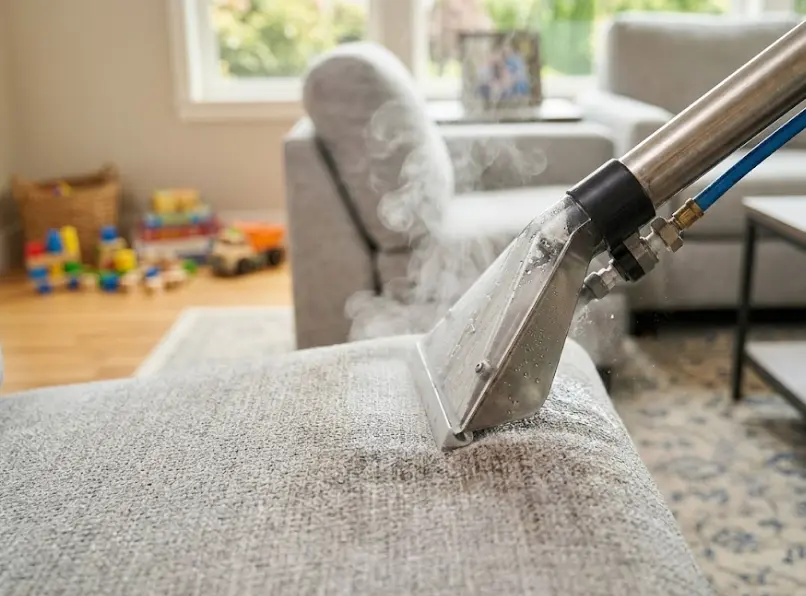
- Hot-water extraction (or solvent method for S-code). For W-code and W/S fabrics, the primary method is heated extraction — a wand injects hot water and immediately vacuums it back out, pulling dissolved soil, allergens, and pre-treatment residue with it. For S-code fabrics, we use dry solvent with a different set of application and dwell procedures. We don't mix methods on a single piece without knowing the complete fabric composition first.
- Air mover drying. We run an air mover during the final stages and leave it running for 20–30 minutes after finishing. In Puyallup's summer conditions, most sofas reach usable dryness in 3–4 hours. In winter or with heavier fabrics — velvet, thick chenille, densely upholstered arms — plan on 4–6 hours. We give you a realistic number based on what we see, not a default marketing figure. For evening appointments where you need the sofa accessible by bedtime, we can adjust extraction volume and maximize airflow to push drying time down.
- Final walkthrough. Before leaving, we look at everything. A stubborn stain that needs a second application gets it at no additional charge. We don't call a job done until it looks right.
Fabric Types We Work With in Puyallup Homes
Synthetic and Performance Fabrics
- Microfiber — W-code (hot-water extraction) and S-code (solvent only — water leaves permanent ring marks on S-code)
- Polyester and polyester blends — the most common type in Puyallup big-box sofas from the last decade
- Performance fabrics: Crypton, Revolution, Sunbrella indoor
- Velvet and velour — extractable but requires controlled moisture and directional brushing during drying
- Chenille and textured weaves
- Olefin / polypropylene (common in budget-tier furniture)
Natural Fibers and Leather
- Genuine leather — full clean plus conditioning; PNW homes with forced-air heating in winter dry leather out faster than homeowners expect
- Bonded leather (common in 2010s-era mid-price sofas) — requires careful handling; already-peeling bonded leather cannot be restored by cleaning
- Cotton and linen upholstery — controlled moisture, careful drying to prevent ring marks and shrinkage
- Wool and wool blends — lower temperature extraction, deliberate drying approach
- Silk and silk-blend decorative fabrics — spot treatment only; no full wet clean
A note on performance fabrics: Crypton, Revolution, and similar stain-resistant materials are genuinely better at repelling surface spills, but they still accumulate body oils, pet dander, and embedded particulate through long-term contact. The stain resistance operates at the surface level — it doesn't stop slow absorption over months of daily use. Performance fabric sofas still benefit from annual professional cleaning to remove what the surface barrier can't prevent.
Dogs, Cats, and Upholstered Furniture in Puyallup
Pet households make up a large portion of what we see from South Hill and the broader Puyallup area. Most situations are solvable. Here's an honest breakdown of what to expect.
Dog hair and dander accumulation
Hair compacted into the weave from months of daily dog contact doesn't vacuum out conventionally — it needs to be loosened by extraction before it can be removed. We start with a dedicated HEPA vacuum pass, then run extraction. Dander and allergen residue comes out in the water. Most customers notice an immediate difference in how the room smells after this type of job, even before the sofa fully dries.
Cat or dog urine
Surface-level incidents and moderate saturation — a few accidents over a period of months — respond well to enzyme treatment and extraction in a single visit. Urine that has soaked through fabric into the frame wood and dried there repeatedly over years is a different situation. We can dramatically reduce the smell but full elimination at that level of saturation may need a follow-up visit or foam replacement. We assess the degree of penetration and tell you the realistic expectation before we start.
General pet odor (not urine-specific)
Dog body oil, the baseline "dog smell" that builds up in fabric over months of use as sleeping furniture, and general pet household odor — this clears well with extraction alone in most cases. We add enzyme pre-treatment as a precaution on any pet household job regardless. The odor reduction after cleaning a heavily dog-used sofa is usually immediate and dramatic, even from inside the room during the drying period.
A pattern we see often in Puyallup's multi-pet South Hill homes: a household has two dogs and a cat, the sectional doubles as sleeping furniture for all of them, and the owners have adapted to the smell without registering it as unusual anymore. These jobs almost always show significant improvement in a single visit. The enzyme pre-treatment handles the uric acid; extraction handles dander, oils, and embedded hair; and the household smell change is apparent when the customer comes home after the drying period.
Book Couch Cleaning in Puyallup
Call or text (425) 287-3619. We cover all of Puyallup, South Hill, Sumner, Bonney Lake, and surrounding Pierce County. Weekday and Saturday appointments available.
Questions Puyallup Customers Ask
How much does sofa cleaning cost in Puyallup?
A 2–3 seat sofa is $120–$185 with Fresh Furnish Cleaners. A sectional runs $195–$310. Pet enzyme treatment adds $40–$65; stain guard protection adds $30–$50. You get a firm price before we start — no line items added at the end. These are working rates as of July 2026 for Puyallup and South Hill customers.
How long until the sofa is dry?
In summer Puyallup conditions — the inland valley humidity that's noticeably lower than Tacoma's waterfront — most sofas reach usable dryness in 3–4 hours with air mover running during and after the job. In winter, or with heavier fabrics like velvet or thick chenille, count on 4–6 hours. For evening appointments where you need the sofa accessible by bedtime, tell us when booking and we'll structure the visit to maximize drying speed — sometimes that means adjusting extraction volume and keeping the air mover running longer after we finish.
Can I book before the Puyallup Fair?
Yes, but book early. Pre-Fair demand throughout Pierce County is real — August and early September fill up faster than most customers expect. Three to four weeks ahead is safe; last-minute late-August booking is harder to accommodate. Text (425) 287-3619 to check current availability.
I have a microfiber sofa. Does the cleaning process differ?
Yes, and the difference is important. Microfiber falls into two types: W-code (water-extractable) and S-code (solvent only). Using water on S-code microfiber leaves permanent ring marks and damages the texture — we've done remediation work after DIY cleaning attempts on S-code pieces, and the damage from using the wrong method isn't reversible. We check the care tag before touching anything. If it's missing, we test on a concealed area first. W-code microfiber, by contrast, cleans very well with hot-water extraction and typically looks close to new afterward.
Do you serve Bonney Lake, Sumner, and Auburn?
Bonney Lake and Sumner are within our standard Puyallup service zone — no travel surcharge. Auburn is also reachable. Enumclaw and Orting: call to confirm based on your specific location. We don't charge travel fees within our established service area.
My sofa was in the garage all winter. Can you clean it?
We can, but we check it carefully before starting. An unheated garage in Puyallup over a PNW winter means genuine moisture exposure for four to five months. Surface mildew — visible on fabric or cushion surfaces — responds to treatment and comes off cleanly. Foam with internal mold growth is a health risk; pushing wet extraction through already-compromised foam can spread contamination. We probe cushions in suspect cases and explain what we find before committing to a cleaning method. Sometimes the honest answer is that a stored piece needs foam replacement, not cleaning.
We have someone with severe dust allergies at home. Does cleaning actually help?
In most cases, meaningfully. Dust mites — the actual source of the most common upholstery allergen — aren't removed by regular vacuuming; they're embedded in the fabric layer along with their fecal matter, which is the allergenic compound. Hot-water extraction at operating temperature kills mites on contact and physically removes the allergen load from the fabric. For a household with a diagnosed dust allergy sufferer, annual professional cleaning of upholstered furniture is one of the higher-impact interventions available, and it's specifically recommended by the American Lung Association as part of indoor allergen management.
Dust Mites and Allergens in Puyallup Homes
Dust mites are present in virtually every upholstered piece of furniture in Pierce County homes. They're not an indicator of cleanliness — they're a consequence of fabric, warmth, and the skin cells humans shed continuously wherever they sit. In PNW valley climates like Puyallup's, where winters keep indoor humidity elevated for four to five months, mite populations stay active and reproduce at higher rates than in drier continental climates.
The allergen isn't the mites themselves — it's their fecal matter, which compacts into the fabric layer in quantities that surface vacuuming doesn't reach. Hot-water extraction removes this mechanically: the extraction vacuum pulls material out of the weave that a household vacuum can't access by suction alone. For a household with asthma sufferers, rhinitis, or young children who sit directly on cushion surfaces for extended periods, this is a meaningful health intervention, not just an aesthetic service.
A sofa that hasn't been professionally cleaned in three or four years in a Puyallup home has accumulated a significant allergen load regardless of surface appearance. The fabric may look fine — the issue is invisible and embedded. Annual professional cleaning addresses this in a way no surface cleaning method can replicate.
