How Long Does It Take for a Couch to Dry After Cleaning?
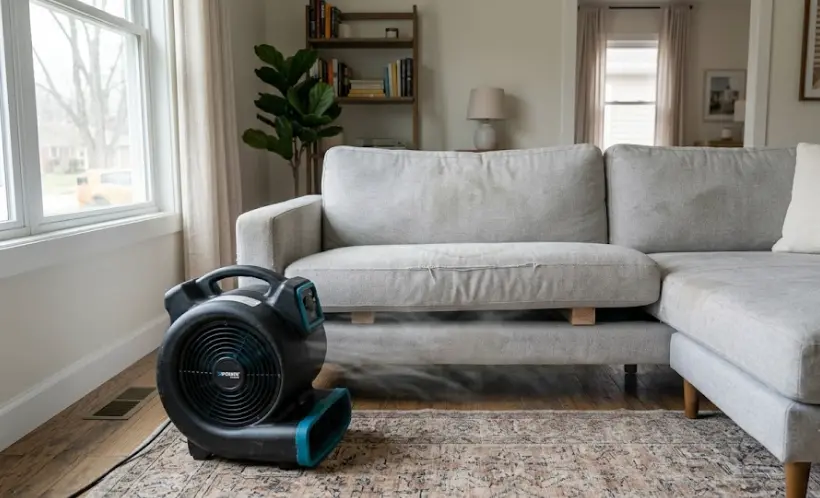
That gap between "surface dry" and "foam dry" is the thing most people don't know about — and it's the reason couches develop mold or a persistent smell even after what seemed like a successful clean. The fabric dries from the outside inward. You can press your palm on the armrest three hours after cleaning, feel nothing damp, and still have the seat cushion foam holding significant moisture at its center.
This article gives you exact times for each combination of cleaning method, fabric type, and room conditions — plus a simple physical test you can do with your hand to know whether the foam is actually dry, not just the surface.
Couch Drying Time by Cleaning Method
Different cleaning methods leave different amounts of water in the fabric and foam. Here are realistic drying windows for each, assuming normal indoor conditions (18–22°C, 50–60% RH) with fans running.
| Cleaning Method | Surface Dry | Foam Fully Dry | Notes |
|---|---|---|---|
| Hot water extraction (professional truck-mount) | 2–4 hours | 4–6 hours | Highest suction (200–500 CFM). Leaves least moisture behind. Air movers used on-site. |
| Steam cleaning | 3–6 hours | 6–10 hours | Steam introduces less volume of water but penetrates deeply. Similar result to HWE with professional equipment. |
| Foam / carbonation cleaning | 2–3 hours | 4–8 hours | Less water used overall. Faster surface drying. Foam residue must be fully vacuumed out. |
| Solvent (dry) cleaning | 1–2 hours | 2–4 hours | Minimal water. Required for S-code fabrics. Fastest overall drying. Professional only. |
| DIY rental machine | 6–12 hours | 12–36 hours | Weakest suction (40–100 CFM). Leaves 55–70% of applied water behind. |
Add 2–4 hours to all figures for Pacific Northwest homes October–April, when indoor RH typically runs 65–80% without active dehumidification.
The Two-Stage Drying Process: Surface vs. Foam
A sofa is not a single material — it is a layered structure. From outside in: the upholstery fabric, an optional batting or fiber layer, open-cell polyurethane foam (typically 10–15 cm thick in seat cushions), and in some cases a second inner fabric liner. Water introduced during cleaning travels inward through all of these layers under gravity and compression. It dries outward, in reverse — the outer fabric first, the foam core last.
This layered structure creates two distinct drying stages that matter practically:
Stage 1 — Surface Dry (Safe to Use)
The outer fabric feels dry to the touch and shows no cool sensation. The couch is safe to sit on without re-soiling or compressing moisture back up through the weave.
Professional clean with fans: 2–4 hours
Professional clean without fans: 4–7 hours
DIY clean: 6–12 hours
Stage 2 — Foam Dry (Fully Complete)
The foam core inside the cushion has released its residual moisture. At this point there is no risk of mold development or odor from the cleaning moisture.
Professional clean with fans: 4–6 hours
Professional clean without fans: 8–14 hours
DIY clean: 12–36 hours
Drying Times by Fabric Type
Fabric type is the second biggest variable after cleaning method. Different materials absorb and release moisture at different rates, and the foam beneath is not the only consideration — the weave structure and fiber content of the outer fabric determine how quickly moisture passes through it in both directions.
| Fabric Type | Surface Dry (professional + fans) |
Surface Dry (DIY, no fans) |
Notes |
|---|---|---|---|
| Microfiber (W-code) | 1–2 hrs | 4–7 hrs | Fast-drying weave, releases moisture readily. One of the best fabrics for post-cleaning recovery. |
| Polyester / Polyester blend | 2–3 hrs | 5–8 hrs | Synthetic fibers hold minimal moisture. Dries evenly across the surface. |
| Performance fabrics (Crypton, Sunbrella indoor) | 1–2 hrs | 3–6 hrs | Engineered for moisture resistance. Surface dries fastest of all fabric types. |
| Velvet / Velour | 3–5 hrs | 8–14 hrs | Dense pile traps moisture between fibers. Requires careful directional brushing while drying to prevent pile matting. |
| Cotton / Cotton blend | 4–6 hrs | 10–18 hrs | Natural fiber absorbs significantly more moisture than synthetic. High humidity slows drying dramatically. |
| Linen | 3–5 hrs | 8–16 hrs | Releases moisture faster than cotton but still slower than synthetic. Can wrinkle during drying — light brushing helps. |
| Wool / Wool blend | 5–8 hrs | 12–24 hrs | Slowest-drying upholstery fabric. Wool retains moisture at a fiber level. Requires low-heat air movement — no direct heat sources. |
| Genuine leather | 1–3 hrs | 3–6 hrs | Surface dries fast but conditioning applied after cleaning needs 2–4 hours to fully absorb. Do not use until conditioning is dry. |
All times assume normal indoor temperature of 18–22°C and relative humidity of 50–60%. Foam drying adds 2–4 hours to surface drying times in all cases.
How Room Humidity Changes Everything
This is the variable that most online drying guides underweight, and for Pacific Northwest homeowners it matters more than anywhere else in the country. Evaporation requires a moisture gradient between the wet object and the surrounding air. When indoor humidity is already high — which in Tacoma, Seattle, Everett, and surrounding areas runs 75–85% relative humidity from October through April — that gradient narrows and evaporation slows significantly.
| Indoor Humidity Level | Effect on Drying Time | What to Do |
|---|---|---|
| Below 50% RH | Baseline — times in tables above apply directly | Fans alone are effective. Optimal drying conditions. |
| 50–65% RH | Add 1–2 hours to all estimates | Fans plus open windows if outdoor humidity is lower. Adequate. |
| 65–75% RH | Add 2–4 hours. DIY foam drying can reach 36–48 hours. | Dehumidifier in the room is strongly recommended. Fans alone insufficient. |
| Above 75% RH | Add 4–6+ hours. Mold risk for DIY cleaning becomes significant. | Dehumidifier required. Consider scheduling professional cleaning for a drier-weather day if using DIY methods. |
The Physical Test: How to Actually Know If the Foam Is Dry
The surface-touch test is unreliable for foam dryness. Here are two tests that work.
The Palm Press Test
- Press your open palm firmly into the center of a seat cushion.
- Hold firm pressure for 10 seconds.
- Remove your hand and check the palm — and the temperature sensation immediately before removing it.
If dry: Your palm feels the same temperature before and after. No damp sensation, no moisture visible on skin.
If wet: Your palm feels distinctly cooler during or after contact. You may see slight moisture on skin.
The Cushion-Lift Test
- Remove a seat cushion from the couch and hold it vertically by one edge.
- Press both palms against the flat faces of the cushion and squeeze firmly.
- Watch for any moisture expression at the seams or through the fabric.
If dry: No moisture appears at seams. Fabric surface feels consistently dry across both faces.
If wet: Moisture beads at seam lines or you can feel a cool wet sensation on the palm despite dry-looking surface.
What Happens If You Use the Couch Too Soon
Sitting on a still-damp couch is not just uncomfortable — it creates a specific mechanical problem. When you sit, you compress the foam by 30–50% of its height. That compression squeezes the moisture held inside the open-cell foam structure upward and outward. Some of that moisture travels back up through the batting and fabric layers to the surface — effectively re-wetting the fabric you just dried.
On light-colored fabrics, this can produce body-outline marks on the cushion surface that appear as it dries again. On fabric that had soil extracted during cleaning, the moisture can carry dissolved residue back to the surface layer, partially reversing the cleaning result. On velvet and velour specifically, sitting too early while the pile is still slightly damp compresses the fibers in the direction of the body weight, which can cause permanent pile flattening that no subsequent brushing fully corrects.
The practical rule: wait until Stage 1 (surface dry, palm-press test passes) before sitting. This is typically 2–4 hours for professional cleaning with fans. Two hours of patience prevents results that cost a re-clean to fix.
How to Speed Up Couch Drying: What Actually Works
| Method | Time Saved vs No Action | How to Use It |
|---|---|---|
| Air mover fan (professional) | 40–55% reduction in drying time | Position 30–45 cm from the sofa face, aimed across the cushion surface at a low angle. Move to each sofa section every 30–45 minutes. This is what Fresh Furnish Cleaners uses during and after every job. |
| Standard box fan or tower fan | 20–35% reduction | Position facing the sofa at 60–90 cm distance. Effective but weaker than an air mover. Open a window on the opposite wall to create cross-ventilation — this doubles the effectiveness of a standard fan. |
| Room dehumidifier | 30–50% reduction (higher in humid conditions) | Run in the same room as the sofa. Most effective in high-humidity conditions (above 65% RH). Combines well with fan use — together, fan + dehumidifier approaches air mover performance. |
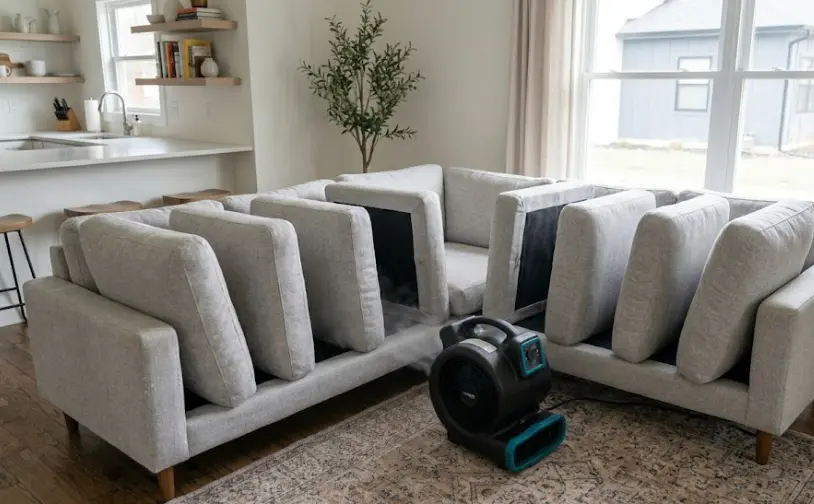
| Removing cushion covers | 25–40% reduction for foam drying | If covers are removable and washable, take them off after the main surface is dry. Stand foam inserts vertically with air circulating around all sides. This dramatically accelerates foam drying. |
| Central heating (not forced hot air) | 15–25% reduction | Raising room temperature to 22–24°C helps but is the weakest standalone option. Avoid pointing forced-air heating vents directly at wool or cotton fabric — uneven heat can cause differential drying that leaves tide marks. |
| Opening windows | 10–30% reduction (weather-dependent) | Only effective when outdoor humidity is lower than indoor humidity — check a weather app. On a 75% outdoor humidity day in November, opening windows in a 68% RH home makes things worse, not better. |
Professional vs. DIY Drying Times: The Equipment Gap
The drying time difference between professional cleaning and DIY is almost entirely about suction, not the cleaning solution or technique. A truck-mounted professional extraction system operates at 200–500 CFM (cubic feet per minute) of vacuum suction. A rental carpet cleaner or portable upholstery machine operates at 40–100 CFM. That 3–5× gap in suction means significantly more water remains in the fabric and foam after a DIY clean — and that water drives the extended drying window.
Professional Truck-Mounted
Suction: 200–500 CFM
Water remaining after extraction: ~15–25% of applied
Surface dry (with fans): 2–4 hours
Foam dry (with fans): 4–6 hours
Professional Portable Unit
Suction: 100–180 CFM
Water remaining after extraction: ~30–45% of applied
Surface dry (with fans): 3–6 hours
Foam dry (with fans): 6–10 hours
DIY Rental Machine
Suction: 40–100 CFM
Water remaining after extraction: ~55–70% of applied
Surface dry (no professional fans): 6–12 hours
Foam dry: 12–36 hours
Warning Signs That Drying Has Gone Wrong
Most drying problems are recoverable if caught within the first 24–36 hours. After 48–72 hours of sustained moisture in foam, mold becomes established and surface cleaning cannot reverse it.
Booking Professional Cleaning in the Seattle–Tacoma Area?
Fresh Furnish Cleaners uses truck-mounted extraction and leaves an air mover running at every job. Most customers have a surface-dry, usable couch within 3 hours. Call or text (425) 287-3619.
