Steam Cleaning vs Hot Water Extraction for Upholstery
The Confusion That Costs People Clean Furniture
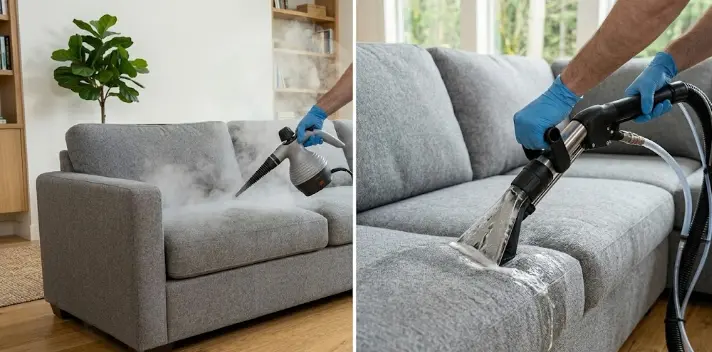
Walk into any home goods store and you will find machines labelled "steam cleaner" that are actually hot water extractors. Browse cleaning forums and you will find people arguing passionately about a distinction they have not quite got right. Call most cleaning companies and ask if they use steam cleaning — the answer often describes hot water extraction.
The terms get used interchangeably, but they describe genuinely different processes with different strengths, different limitations, and different outcomes for your upholstery. Choosing the wrong method — or hiring a company using the wrong method for your fabric — can leave your sofa less clean than expected, or worse, damage it.
This guide explains exactly what steam upholstery cleaning and hot water extraction sofa cleaning are, how they differ, and which method is right for each situation. We also explain what professional cleaning services actually use and why.
What True Steam Cleaning Actually Is
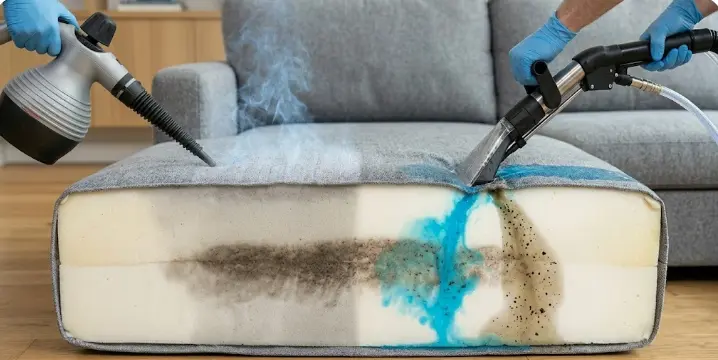
True steam cleaning uses dry vapor steam — water heated well above 212°F (100°C) until it converts to pressurized vapor. At this temperature the vapor contains very little actual moisture (typically 5–6% water content). When applied to a surface, the heat and vapor do the work:
How Steam Cleaning Works
- High-temperature vapor (212–320°F) penetrates fabric fibers
- Heat kills bacteria, dust mites, and mold spores on contact
- Steam loosens surface soiling and oils from fabric
- Very low moisture output — fabric dries quickly (30–60 minutes)
- No cleaning chemicals required — heat alone does the sanitizing
- Does not extract loosened dirt — it remains in the fabric
Where Steam Cleaning Is Effective
- Surface sanitizing — killing germs and dust mites on hard surfaces
- Grout lines, tile, and hard flooring
- Mattresses — killing surface dust mites without over-wetting
- Spot treatment on robust fabric surfaces
- Pet bedding and removable cushion covers (washed separately)
- Refreshing lightly soiled upholstery between deep cleans
What Hot Water Extraction Actually Is
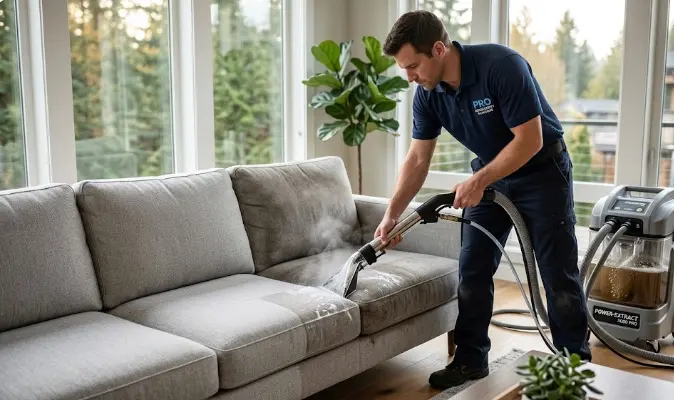
Hot water extraction (HWE) — also called warm water extraction or, incorrectly, "steam cleaning" by most companies and consumers — is the professional standard for deep upholstery and carpet cleaning. The process is fundamentally different from steam cleaning:
Step 1: Injection
Heated water (typically 150–200°F) mixed with a cleaning solution is injected under pressure directly into the fabric fibers and foam padding. The solution is formulated to dissolve and suspend dirt, oils, allergens, and stain compounds at their actual location in the material — not just on the surface.
Step 2: Agitation
The cleaning solution dwells in the fabric for a short time, during which the chemical action loosens embedded soiling. For upholstery, the technician works the solution through the fabric with the cleaning wand to ensure full penetration and contact with soiled areas, seams, and high-contact zones.
Step 3: Extraction
Powerful suction simultaneously extracts the water, dissolved dirt, suspended allergens, cleaning solution residue, and broken-down stain compounds — physically removing them from the fabric. This extraction step is what distinguishes HWE from steam: contaminants are physically removed, not just loosened.
Steam Cleaning vs Hot Water Extraction: Direct Comparison
| Factor | True Steam Cleaning | Hot Water Extraction |
|---|---|---|
| Moisture in fabric | Very low (5–6% water content) | Moderate — extracted by suction during process |
| Drying time | 30–60 minutes | 2–4 hours (professional), 6–12 hours (consumer machines) |
| Dirt removal | Loosens surface soiling — does not extract it | Dissolves and physically extracts dirt from fabric and padding |
| Stain removal | Limited — heat can set protein stains permanently | Effective — pre-treatment + extraction removes most stains |
| Allergen removal | Kills allergens in place — they remain in the fabric | Physically extracts allergens — removes them from the material |
| Sanitizing ability | Excellent — heat kills bacteria, mites, mold on contact | Good — cleaning agents and heat together kill most pathogens |
| Pet odor removal | Poor — heat can lock odor compounds into fabric | Excellent — with enzyme pre-treatment, removes odor source |
| Fabric risk | Higher — heat can damage velvet, delicate weaves, leather | Lower — temperature and moisture controlled precisely per fabric |
| Cleaning agents | None — heat only | Targeted solutions matched to fabric type and soiling |
| Professional standard for upholstery | Not standard — limited use cases | Industry standard for deep upholstery cleaning |
Which Method Is Right for Each Upholstery Type
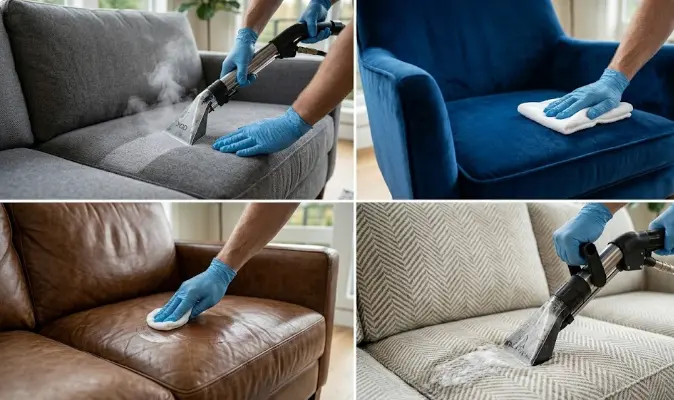
Recommended method: Low-moisture hot water extraction
Microfiber is the most popular upholstery material and one of the trickiest to clean correctly. Its fine fiber structure absorbs liquid rapidly — which means both cleaning solution and dirty water need careful management.
- Steam cleaning risk: High heat can cause permanent watermarks if any surface moisture is present; can also cause pile matting that does not recover
- HWE advantage: Low-moisture extraction reaches deep into the fiber without over-wetting; nap is brushed back to position during drying
- Key consideration: Microfiber has two care codes — "W" (water-based cleaning allowed) and "S" (solvent only). Professional technicians verify the code before selecting any method
- Result: Uniform clean color, restored nap, no watermarks when done correctly
See also: How to Clean a Microfiber Couch — Professional Guide
Recommended method: Full hot water extraction
Woven fabric sofas — polyester, cotton-polyester blends, performance fabrics — respond best to full hot water extraction. The open weave structure allows solution to penetrate effectively and extraction to remove it cleanly.
- Steam cleaning limitation: Loosens soiling but does not remove it; cotton content can shrink under high heat
- HWE advantage: Deepest possible clean; most effective stain removal; excellent allergen extraction
- Drying time: 2–4 hours with professional equipment; good air circulation speeds recovery
- Fabric protection: Scotchgard or similar protector applied after extraction significantly extends cleanliness
Recommended method: Specialist leather cleaning (neither steam nor standard HWE)
Leather requires its own dedicated cleaning approach. Both steam and standard hot water extraction can permanently damage leather upholstery if applied incorrectly.
- Steam cleaning risk: High heat dries out natural oils, causing cracking, blistering, and finish damage — often immediate and irreversible
- Standard HWE risk: Excessive moisture causes leather to dry unevenly, leading to stiffening, discoloration, and finish damage
- Correct approach: pH-balanced leather cleaners applied with controlled moisture, followed by thorough conditioning to restore suppleness
- Seam treatment: Seams and perforations require separate careful treatment — these are the primary moisture entry points
See also: Professional Leather Furniture Cleaning in Seattle
Recommended method: Dry-cleaning solvents or low-moisture extraction — never steam
Velvet is among the most cleaning-sensitive upholstery materials. The pile structure that gives velvet its distinctive appearance is highly vulnerable to both heat and excess moisture.
- Steam cleaning risk: Crushes pile permanently; can cause irreversible marking, sheen changes, and pile direction damage
- Standard HWE risk: Over-wetting causes pile crushing and watermark rings that are extremely difficult to reverse
- Correct approach: Dry solvent cleaning for traditional velvet; low-moisture specialist extraction for performance velvet (Crypton, Sunbrella)
- Mandatory: Professional assessment before any treatment — velvet type determines the safe cleaning range entirely
Recommended method: Hot water extraction — most tolerant upholstery type
Performance fabrics are engineered specifically to resist staining, moisture, and cleaning chemicals. They are the most forgiving upholstery type for cleaning and respond well to hot water extraction.
- Designed to resist liquid penetration — spills and cleaning solutions stay on the surface longer
- Hot water extraction with standard upholstery solutions is safe and effective
- Steam cleaning is technically safe for most performance fabrics but provides less thorough cleaning
- Fastest drying of any upholstery type — often 1–2 hours after professional extraction
Why Professional Hot Water Extraction Outperforms Home Machines
Consumer hot water extraction machines — including well-known brands like Bissell and Hoover — use the same basic process as professional equipment. The results are substantially different. Here is why:
Consumer Machines
- Water temperature: 120–140°F — insufficient to effectively break down body oils and deeply embedded soiling
- Extraction power: 50–100 CFM suction — leaves significant moisture in fabric, leading to 6–12 hour drying times and mold risk
- Cleaning solution: General-purpose formulas — not matched to specific fabric types or soiling
- Reach: Surface to 10–15mm into fabric — rarely reaches foam padding where most odors and allergens concentrate
- Residue: Often leaves detergent residue in fabric that attracts resoiling within weeks
Professional Equipment
- Water temperature: 150–200°F — sufficient to dissolve body oils, break down stain compounds, and sanitize at depth
- Extraction power: 200–300+ CFM — extracts most injected moisture immediately, reducing drying to 2–4 hours
- Cleaning solution: Matched to specific fabric type, care code, and soiling — enzyme-based for organics, solvent-based for oils
- Reach: Injection wand delivers solution through fabric into foam padding — treats the full depth of contamination
- Residue: pH-neutral rinse removes cleaning agent residue, preventing resoiling acceleration
When Steam Cleaning Does Have a Role in Upholstery Care
Despite its limitations for deep sofa cleaning, true steam cleaning has legitimate uses in upholstery maintenance:
Allergen Spot Reduction
Between professional deep cleans, a steam pass over sofa surfaces kills dust mites and surface bacteria without introducing moisture. Useful for allergy sufferers maintaining clean furniture between annual professional services.
Removable Cover Freshening
Removable cushion covers and slipcovers can be effectively refreshed and sanitized with steam between wash cycles — quickly eliminating surface odors and killing surface microbes without laundering.
Wrinkle Removal on Fixed Covers
Tight-fitting sofa covers and fabric-covered chair arms can develop wrinkles. Careful steam application removes wrinkles effectively without the moisture risk of wetted cleaning, useful for maintaining professional appearance between cleans.
Common Cleaning Scenarios: Which Method We Use
| Cleaning Scenario | Our Method | Why |
|---|---|---|
| Annual sofa deep clean | Hot water extraction | Full-depth clean; allergen and dust mite extraction; stain treatment |
| Cat or dog urine on sofa | Enzyme pre-treatment + hot water extraction | Enzymes break down uric acid; extraction removes it from foam padding. See: Cat Urine Sofa Cleaning Guide |
| Red wine or coffee stains | Oxidizing pre-treatment + hot water extraction | Oxidizing agent breaks tannin compounds; extraction removes residue |
| Recliner chair cleaning | Low-moisture hot water extraction | Controlled moisture protects recliner mechanism; reaches fold zones. See: Recliner Chair Cleaning Guide |
| Leather sofa maintenance | Leather cleaner + conditioner | Neither steam nor HWE is appropriate; specialist leather protocol required |
| Velvet armchair | Dry solvent cleaning | Steam would crush pile; moisture would cause permanent marking |
| Post-illness sanitizing | Hot water extraction + antimicrobial treatment | Extraction removes pathogens physically; antimicrobial prevents regrowth |
| Pre-move-out cleaning | Hot water extraction, all pieces | Most thorough clean possible; removes all evidence of use for deposit recovery |
What Customers Say About Professional Extraction Cleaning
"I rented a Bissell steam cleaner twice and the sofa looked clean for about three weeks each time before the dirt came back. One professional cleaning later and it's been six months — still looks like it did the day after they cleaned it. The difference is remarkable."
"My daughter has severe dust mite allergies. I was using a steam cleaner thinking it was the right tool — it kills mites, so I figured it was effective. The technician explained that killing them in place doesn't help much; you need to extract them. After professional extraction cleaning, her symptoms noticeably improved."
"I nearly steam-cleaned my velvet sofa before a friend stopped me. Called for professional advice and they immediately said not to use steam on velvet — came out the same day with the right equipment. I had no idea the fabric type mattered so much for cleaning method."
"We have three dogs. I tried steam cleaning monthly — the smell never really went away, just changed. With professional extraction and enzyme treatment, the smell was gone after one visit. They explained that steam doesn't remove the odor compounds, it just temporarily masks them with heat."
Frequently Asked Questions
No — they are genuinely different processes. True steam cleaning uses dry vapor (212°F+, very low moisture) to sanitize surfaces. Hot water extraction injects heated water and solution into fabric, then extracts it with powerful suction. Most consumer machines sold as "steam cleaners" are actually hot water extractors without the extraction step. Professional cleaning companies almost universally use hot water extraction for upholstery, not true steam.
Professional hot water extraction should not cause shrinkage when done correctly. Pre-testing fabric colorfastness and shrink response is standard practice before any treatment. Natural fiber fabrics (cotton, linen, wool) are more shrink-sensitive and require lower temperatures and less moisture. Synthetic fabrics (polyester, nylon, acrylic) are very shrink-resistant and clean well with standard hot water extraction.
For a regularly used sofa in an average household (no pets, no children), professional hot water extraction every 12 to 18 months maintains hygiene and appearance. Households with pets, young children, or allergy sufferers benefit from professional cleaning every 6 to 12 months. Regular vacuuming between professional visits significantly extends the period between necessary deep cleans.
Mold risk with professional hot water extraction is very low because professional equipment extracts most moisture immediately. Consumer machines leave significantly more moisture and do pose more mold risk if furniture does not dry within 6–8 hours. After professional extraction, ensure good air circulation, open windows if weather allows, and avoid replacing cushions until fully dry. In the Pacific Northwest, a dehumidifier can help accelerate drying in cooler months.
Our Professional Upholstery Cleaning Services in Washington State
In-Home Service — We Come to You
Fresh Furnish Cleaners uses professional-grade hot water extraction equipment for all upholstery cleaning throughout the greater Seattle and Puget Sound region. We match the cleaning method precisely to your fabric type and bring all equipment to your home — no need to transport furniture.
- Seattle and all neighborhoods
- Bellevue and the Eastside
- Kirkland and Redmond
- Bothell and Mill Creek
- Everett and Lynnwood
- Edmonds and Shoreline
- Sammamish and Issaquah
- Woodinville and Snohomish
Related Upholstery Cleaning Guides
Cat Urine Sofa Cleaning
Why enzyme pre-treatment combined with hot water extraction is the only method that fully eliminates cat urine odor from a sofa.
Cat Urine Removal GuideRecliner Chair Cleaning
How professional low-moisture extraction reaches the hidden zones inside a recliner that surface cleaning misses entirely.
Recliner Cleaning GuideUpholstery Cleaning Seattle
Full-service professional upholstery cleaning for all furniture types across Seattle and the Puget Sound region.
Upholstery Cleaning Seattle
Professional Upholstery Cleaning Pricing in Seattle
| Piece | Price Range | Notes |
|---|---|---|
| Loveseat | $85 – $120 | 2-seat sofa or loveseat |
| Standard sofa (3-seat) | $115 – $175 | Fabric; most common |
| Sectional | $195 – $350 | Depends on configuration |
| Leather sofa | $120 – $190 | Includes conditioning |
| Upholstered chair | $55 – $95 | Armchair or accent chair |
| Pet odor / enzyme treatment | +$35 – $65 | Add-on to any piece |
Prices as of September 2026. Call (425) 287-3619 for a free quote — most visits scheduled within the same week.
Ready for a Genuinely Deep Sofa Clean?
Professional hot water extraction — not surface steam — removes what has actually built up inside your upholstery. We bring professional-grade equipment to your home and clean every fabric type correctly.
Serving Seattle, Bellevue, Kirkland, Redmond, Bothell, Everett & surrounding Washington communities
