How Long Does Carpet Take to Dry After Cleaning? What Seattle Homeowners Need to Know
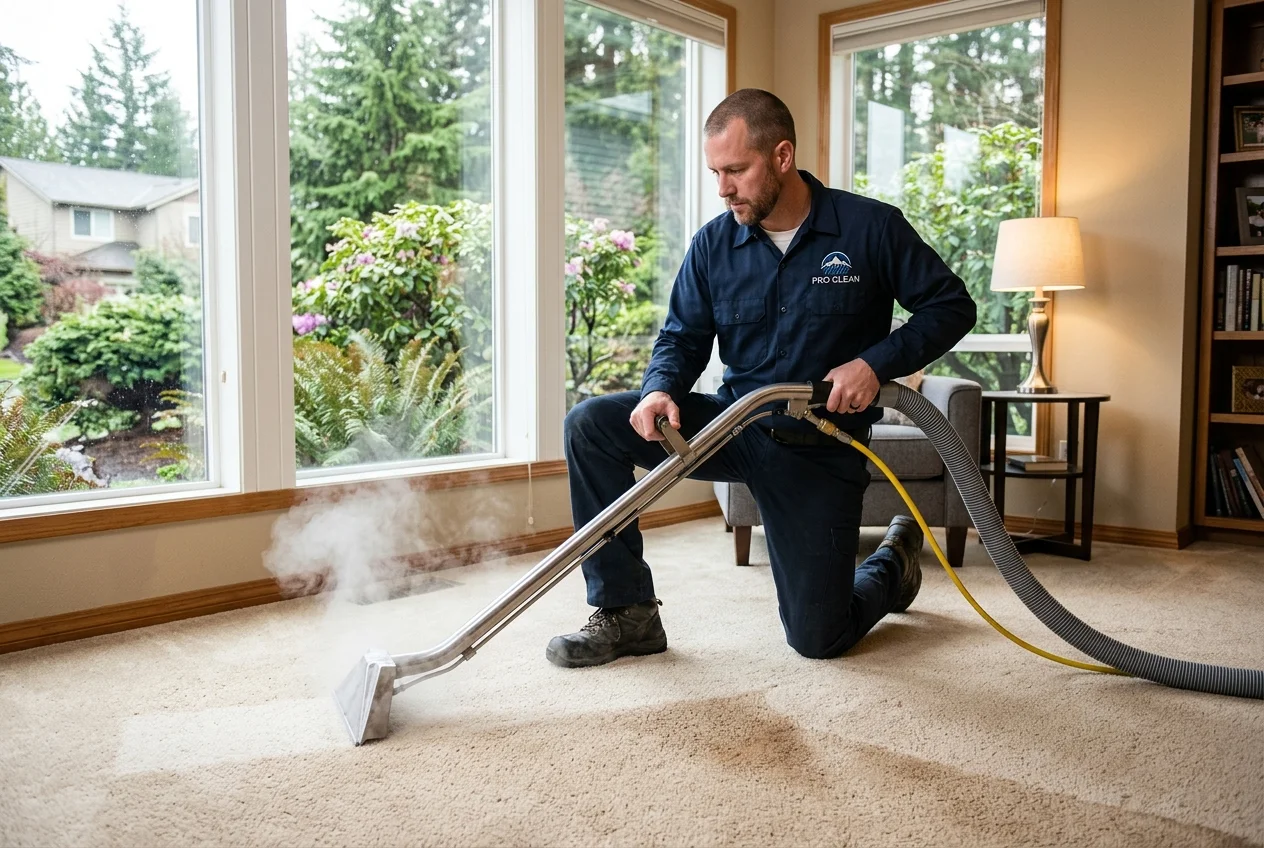
Seattle gets 37 inches of rain a year, and indoor relative humidity runs 75–85% from October through April. That changes carpet drying time more than most homeowners expect — and more than most carpet cleaning companies tell you upfront.
The national average drying time of "6–12 hours" is measured in climates with 40–55% indoor humidity. In a Seattle home in November with the windows closed, the same cleaning job on the same equipment can take 14–18 hours. This guide covers what actually determines drying time, what Seattle's climate adds to the equation, and what you can do to dry faster without opening windows into the rain.
Carpet Drying Time by Cleaning Method — Seattle Climate
The cleaning method is the single biggest variable. Here's what to expect in Seattle conditions:
| Cleaning Method | June–Aug (RH ~55–65%) |
Sept–Oct (RH ~65–75%) |
Nov–Mar (RH ~75–85%) |
Notes |
|---|---|---|---|---|
| Truck-mount HWE (professional) | 4–6 hrs | 6–10 hrs | 8–14 hrs | Strongest extraction vacuum — removes 90%+ of water before drying begins |
| Portable HWE (some pro companies) | 8–12 hrs | 12–18 hrs | 18–30 hrs | Weaker vacuum leaves 2–3x more moisture in carpet |
| Dry / VLM cleaning | 1–2 hrs | 1–2 hrs | 1–2 hrs | Minimal water used — humidity largely irrelevant; lower soil removal depth |
| Encapsulation cleaning | 2–4 hrs | 3–5 hrs | 4–6 hrs | Common in commercial buildings; less thorough on residential deep soil |
| DIY rental (Rug Doctor, etc.) | 12–18 hrs | 18–30 hrs | 24–48 hrs | Portable with low vacuum power; more solution applied than extracted |
Times assume adequate airflow (fans running) and a single-layer residential carpet. Thick pile, old pad, and concrete slab subfloors extend drying time further.
What Seattle's Humidity Actually Does to Your Carpet
Carpet drying is an evaporation process. When ambient air is already holding 80% of its maximum moisture, it can only absorb the remaining 20% from your wet carpet — and it absorbs that slowly. Compare this to a Denver home at 30% humidity after a summer cleaning, where the same air can absorb 70% of its capacity from the carpet. Your carpet dries more than twice as fast in Denver.
This matters for Seattle homeowners in three specific ways:
- Mold window is shorter. Mold growth can begin within 24–48 hours on wet organic material (carpet backing, natural-fiber pad). In a humid Seattle fall, your margin is at the lower end of that range — not the higher end. A carpet that's still wet 20 hours after cleaning in October is approaching the mold risk window.
- Opening windows often makes it worse. In summer (June–August), opening windows helps. From September onward, outdoor air in Seattle is frequently more humid than indoor air — bringing it in slows evaporation rather than speeding it.
- Portable machines are much riskier here. A portable extraction machine that performs adequately in Phoenix or Denver leaves significantly more residual moisture in Seattle, where that moisture has nowhere to go quickly.
Factors That Change Drying Time Beyond the Method
| Factor | Faster Drying | Slower Drying |
|---|---|---|
| Carpet pile height | Short / loop pile (Berber) | Plush, frieze, high-pile (shag) |
| Carpet fiber | Nylon, polyester | Wool, cotton, natural blends |
| Pad age and condition | New or recently replaced pad | Old compressed pad holds water like a sponge |
| Subfloor type | Wood subfloor (allows some airflow) | Concrete slab — cold surface slows evaporation |
| Room airflow | Fans + HVAC on continuous | Closed, still room |
| Level of soiling | Lightly soiled carpet | Heavily soiled — technician uses more solution |
| Pre-treatment products | Dry pre-spray, enzyme pre-treat | Heavy foam pre-treatment adds moisture |
How to Speed Up Carpet Drying in Seattle — What Actually Works
The right approach depends on the season:
June–August (lower humidity)
- Open windows on opposite sides of the home to create cross-ventilation
- Ceiling fans on medium — circulate air across carpet surface
- HVAC fan to "On" (not Auto) — keeps air moving through ducts even when heating/cooling isn't running
September–March (high humidity)
- Keep windows closed — outdoor air is more humid than indoor, importing it slows drying
- Run a dehumidifier in the cleaned room — this is the most effective single action in wet months. A standard 50-pint dehumidifier drops room humidity 15–20 percentage points within two hours
- Box fans on the floor — move air laterally across carpet surface at low height where evaporation happens
- Turn heat up 3–5°F — warmer air holds more moisture capacity, accelerating evaporation
- Avoid running AC — at low fall temperatures, AC reduces temperature without meaningfully reducing humidity and slows drying
When Carpet Is Still Wet: Warning Signs and What to Do
Most carpet should be dry within the ranges in the table above. If yours isn't, here's how to read what's happening:
| Symptom | Likely Cause | Action |
|---|---|---|
| Damp to touch after 12+ hours (summer) | Portable machine used, or poor pad condition | Add dehumidifier + fans; contact cleaner if not improving |
| Cold and squishy after 24 hours | Pad is saturated — moisture trapped under carpet | Carpet may need to be pulled back to dry pad separately; call immediately |
| Musty smell within 24–48 hours | Mold / bacteria growth has begun | Treat urgently — do not wait; contact cleaner or restoration service |
| Brown wicking stains after drying | Old stains in pad wicked up through carpet fiber as it dried | Professional re-cleaning targeting the pad layer; enzyme treatment for organics |
| Dried stiff / crunchy texture | Residue from DIY cleaning product not fully rinsed | Professional extraction — dry residue attracts soil rapidly and reappears as dark spot |
How Long to Stay Off Carpet After Professional Cleaning
Specific guidance that most companies don't give clearly:
- Bare feet or clean socks only: 30–60 minutes after cleaning (truck-mount HWE)
- Normal foot traffic in shoes: Wait until carpet is fully dry — shoes track soil into damp fibers and the dirt bonds as the carpet dries
- Children and pets: Keep off until fully dry — not for chemical safety reasons (professional cleaning products are inert when dry), but because wet carpet fibers pick up and hold new contamination immediately
- Furniture: Full dry time before replacing; use foam blocks or plastic furniture tabs under legs if you must replace before dry — bare metal or wood feet leave rust or tannin stains on wet carpet
Truck-Mount vs. Portable: Why It Matters More in Seattle Than Elsewhere
Truck-mount extraction equipment has a vacuum rated at 200+ inches of water lift. Portable machines typically run 80–130 inches. In a dry climate, the difference is meaningful. In Seattle's wet climate — particularly September through March — it's the difference between 8 hours and 24 hours of drying time.
When you're booking carpet cleaning in the Seattle area, the question to ask is: "Is your equipment truck-mounted or portable?" It's a reasonable question that legitimate companies answer directly. If the price seems unusually low, portable equipment is one of the reasons.
Fresh Furnish Cleaners operates truck-mount HWE exclusively across Bothell, Kirkland, Edmonds, Shoreline, and South King County. Our equipment achieves the extraction rate that minimizes drying time in Pacific Northwest conditions. Call (425) 287-3619 or get a quote online — we confirm scheduling and equipment type in writing before your appointment.
Frequently Asked Questions
Related Guides
Why Is Carpet Still Wet After Cleaning?
What causes carpets to stay wet longer than expected — and when to call for help.
How Long Does a Couch Take to Dry?
Upholstery drying times by fabric and cleaning method — with Seattle climate notes.
Professional Carpet Cleaning That Dries in Hours, Not Days
Fresh Furnish Cleaners uses truck-mount hot water extraction on every job — the equipment that achieves 4–8 hour drying times even in Seattle's wet climate. We serve Bothell, Kirkland, Edmonds, Shoreline, Kenmore, and South King County.
Get a Free Quote (425) 287-3619