Couch Cleaning Kent WA — Professional Sofa Cleaning Service
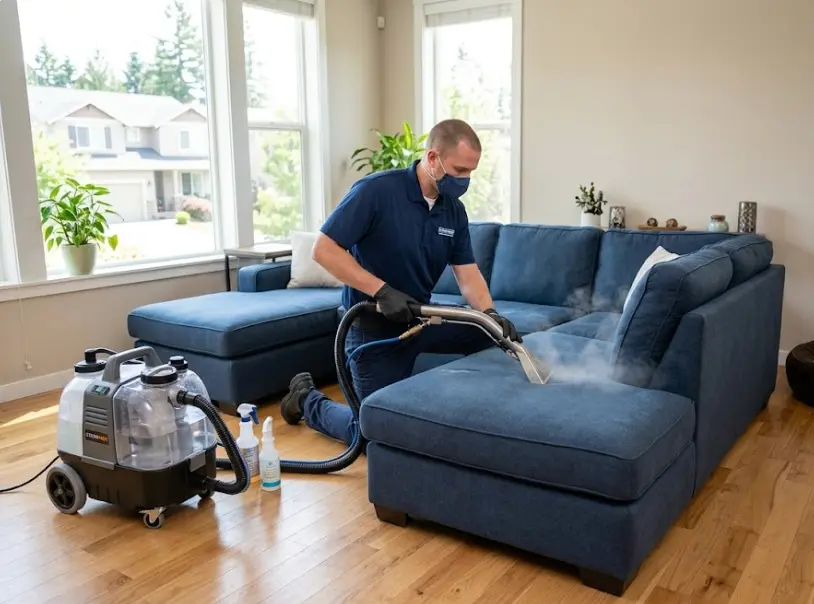
Kent Is a Different Kind of City — and That Shows Up in Upholstery
Kent isn't a bedroom suburb of Seattle in the way Kirkland or Redmond are. It's a working city — home to one of the largest industrial valleys in the Pacific Northwest, a genuinely diverse population, and a housing stock that ranges from 1950s ranches near Downtown to dense East Hill subdivisions built in the 1990s and 2000s. That mix matters for furniture cleaning more than people expect.
The Kent Valley floor sits at a lower elevation than the surrounding neighborhoods, which means it collects morning fog, holds ambient moisture longer, and — in the industrial corridor running south from Renton — carries measurably higher levels of fine particulate from warehouse and manufacturing activity. Homes within a mile or two of that corridor accumulate airborne dust in their upholstery faster than comparable homes on East Hill or West Hill above the valley. It's not a dramatic difference you'd notice day to day, but over a year or two it adds up to significantly more embedded soil than a household's vacuuming routine removes.
East Hill, where much of Kent's residential population actually lives, is its own environment: large suburban lots, family homes with multiple bedrooms, heavy furniture use from kids and pets, and a lot of the polyester and performance fabric sofas that were popular from big-box retailers in the 2000s and 2010s. West Hill and Scenic Hill have older homes with longer-term residents and furniture that's been in place for years. Downtown Kent is going through genuine revitalization, with newer residents in renovated properties alongside longtime households.
Fresh Furnish Cleaners covers all of Kent — East Hill out to Panther Lake, West Hill, Downtown, and the valley-floor residential streets. We work with the actual conditions in each part of the city rather than applying the same approach everywhere.
What Sofa Cleaning Costs in Kent, WA
| Furniture Type | Price Range | Typical On-Site Time |
|---|---|---|
| Sofa / Couch (2–3 seat) | $120–$185 | 45–75 min |
| Sectional (4–6 piece) | $195–$310 | 90–150 min |
| Loveseat | $80–$120 | 35–55 min |
| Armchair / Accent Chair | $60–$90 | 20–40 min |
| Pet odor enzyme treatment (add-on) | +$40–$65 | Included in visit |
| Stain guard protector (add-on) | +$30–$50 | Included in visit |
We give you a fixed price before we touch anything. If the condition turns out to warrant extra treatment — heavier pet saturation than expected, a mold pre-treatment, or a second extraction pass — we explain what we found and what we'd charge before doing it. You decide. For multi-piece jobs in the same visit, a bundled rate applies — give us the full list when you call and we'll quote the whole job at once.
Kent Neighborhoods We Cover
| Neighborhood / Area | Typical Upholstery Situations | Our Usual Approach |
|---|---|---|
| East Hill | Large family homes, heavy daily use, multiple pets, kids' staining on light-colored sofas; polyester and performance fabrics from 2000s–2010s big-box purchases | Enzyme pre-spray on pet areas, full extraction, stain guard recommended on light fabrics in active-use family rooms |
| Panther Lake | Newer East Hill subdivision with young families; performance fabrics common, high pet ownership, sectionals in large living rooms | Full extraction on all cushions and body panels; second pass on arm sections that accumulate body oils; fan drying |
| West Hill / Scenic Hill | Older homes with longer-term residents; furniture may have been in place for 10+ years; wool blends and natural fibers more common than in newer neighborhoods | Careful fabric identification first; controlled moisture for natural fibers; honest assessment if a very worn piece is worth the investment |
| Downtown Kent / Meeker District | Mix of long-term households and newer residents in revitalized properties; rental properties with move-out cleaning needs; smaller apartments with loveseats and accent chairs | Standard extraction; move-out documentation available on request; efficiency-focused visits for smaller pieces |
| Valley Floor / Midway | Proximity to industrial corridor means higher airborne particulate load; some rental housing; families with tight budgets needing honest value assessment | Extended pre-vacuum pass; check foam moisture before wet method; honest conversation about what cleaning can and can't achieve on heavily soiled pieces |
| Auburn / Renton (adjacent) | Same service zone as Kent, similar suburban character | Covered without travel surcharge; same day availability dependent on route |
Why Kent Customers Call Us
Kent has a few specific patterns we see consistently, shaped by the city's character.
East Hill family homes with pets. East Hill is one of the denser residential concentrations in south King County, and the household profile there tends toward larger families with multiple pets — dogs especially. A 2,000-square-foot home with two dogs and three kids generates a particular kind of sofa wear: compacted hair in the weave, body oils on arm sections, enzyme-level pet odor in the cushions, and spill staining on the seat panels. We handle this combination constantly. Hot-water extraction after enzyme pre-treatment addresses all of these in a single visit, and the results on a polyester or performance fabric sofa in this condition are typically dramatic.
Move-outs in Kent rentals. Kent has a substantial rental population, and move-out cleaning — including upholstery — is a regular part of our work here. We provide a written confirmation of the clean on request, which tenants use for security deposit documentation. Landlords in Kent are generally familiar with professional cleaning as a standard move-out expectation, and a $145–$185 sofa clean is almost always cheaper than the deposit deduction a dirty couch would cost.
Industrial workers and particulate accumulation. This one is specific to Kent. A household where one or more adults work in the Kent Valley warehouse and manufacturing corridor brings fine industrial particulate home on clothing. It's not visible individually — it accumulates in upholstery fabric over months and years. Standard vacuuming gets surface material; embedded particulate requires extraction. For Kent Valley-area households, we often recommend annual cleaning on this basis alone, separate from any visible soiling or odor.
Diverse household fabrics. Kent is one of the most ethnically diverse cities in Washington, and that diversity extends to furniture — we see a wider range of fabric types in Kent than in more homogeneous suburban cities. Silk-blend decorative pieces from Southeast Asian households, traditional textile-covered chairs, sofas recovered in imported fabrics without English-language care tags. We approach unknown fabrics carefully: test spot first, confirm the result, then proceed. We don't apply a single method universally when the fabric is unfamiliar.
How the Cleaning Visit Works
The process is consistent across all Kent neighborhoods, though some details change based on what we find on arrival.
- Fabric identification and pre-inspection. We locate the care tag: W (water-based extraction), S (solvent only), W/S (either method), or X (vacuum only). Missing tags — common on furniture over 10 years old, recovered pieces, or imported items without English labeling — get a test on a hidden area before any method is applied. We map stains, document pet-affected zones, and probe foam cushions for pre-existing moisture. Homes near the valley floor sometimes have elevated foam humidity that changes the drying plan before we've done anything.
- HEPA dry vacuum pass. Every surface gets a thorough dry vacuum before any liquid is applied — body panels, cushion faces and backs, arms, and underneath removable cushions. In Kent homes near the industrial corridor, this step removes more fine particulate than equivalent homes further from industrial activity. Skipping it would push that material deeper into the fabric during wet extraction. We don't skip it.
- Enzyme pre-treatment on problem areas. Pet urine zones, heavy food staining, grease, and concentrated odor areas get a targeted pre-spray with 5–10 minutes dwell time before the main extraction pass. Enzyme solution breaks uric acid down at the molecular level — the only method that eliminates pet odor rather than covering it temporarily. We use it on every pet household job regardless of odor severity, as a precaution.
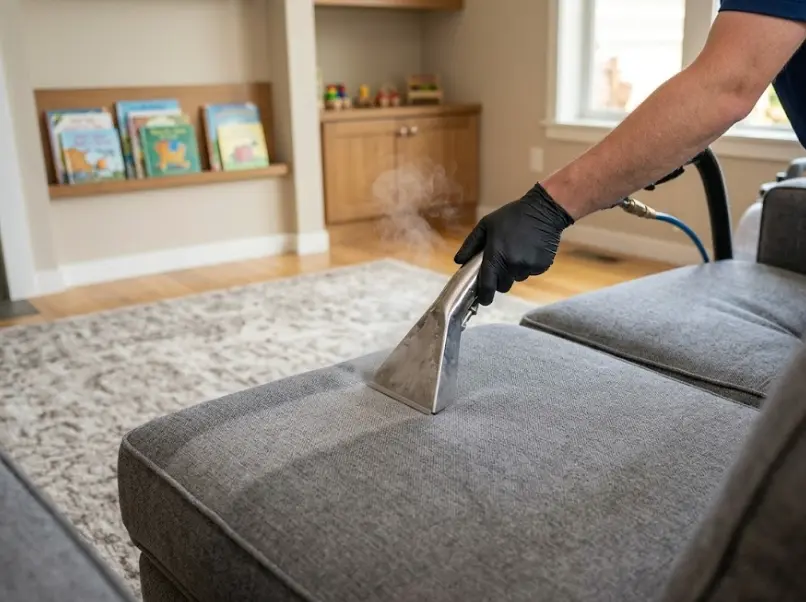
- Hot-water extraction (or solvent for S-code fabrics). For W-code and W/S fabrics, a heated extraction wand injects hot water and immediately vacuums it back out, removing dissolved soil, allergens, pre-treatment residue, and embedded particulate. For S-code fabrics — common on certain microfiber sofas — we use dry solvent. Using water on S-code microfiber causes permanent ring marks; we've done remediation work after DIY cleaning mistakes on S-code pieces and the damage is irreversible. Fabric identification first is non-negotiable.
- Air mover drying. We run an air mover through the final extraction stage and for at least 20–30 minutes after finishing. For East Hill and West Hill homes above the valley floor, expect usable dryness in 3–4 hours in warm months. Valley-floor homes, and any Kent home during the cooler, foggier months of October through March, typically run 4–5 hours. We give you the honest estimate based on the room conditions we observe, not a blanket marketing number.
- Final inspection and second pass if needed. We look at the whole piece before leaving. Any area that needs another pass gets it at no additional charge. We don't call a job done until it looks right.
Fabric Types We Handle in Kent Homes
Synthetic and Performance Fabrics
- Microfiber — W-code (hot-water extraction) and S-code (dry solvent only)
- Polyester and polyester blends — the dominant type in East Hill family room sofas
- Performance fabrics: Crypton, Revolution, Sunbrella indoor
- Velvet and velour — extractable with controlled moisture and directional brushing
- Chenille and textured weaves
- Olefin / polypropylene (common in budget-tier sofas and outdoor-indoor pieces)
Natural Fibers and Leather
- Genuine leather — full clean plus conditioning; forced-air heating in Kent winters dries leather faster than most owners expect
- Bonded leather (2010s mid-price sofas) — handle carefully; already-peeling bonded leather cannot be restored by cleaning
- Cotton and linen upholstery — controlled moisture to prevent ring marks and shrinkage
- Wool and wool blends — lower-temperature extraction, careful drying to prevent felting
- Imported decorative fabrics without English care tags — test-spot protocol before any method
On bonded leather specifically: this material was widely used in sofas priced at $400–$900 from 2008 through about 2018 and is common in Kent homes where that furniture is now 8–15 years old. Bonded leather peels from the edges inward as the polyurethane coating separates from the fabric backing. Cleaning won't reverse this — and we'll tell you so during the inspection rather than take your money for a result that can't satisfy. If it's not yet peeling, conditioning treatment during the cleaning visit can slow the degradation process.
Pet Households in Kent: Realistic Expectations
East Hill in particular has a high rate of pet-owning households, and pet-related upholstery jobs make up a significant portion of what we do in Kent. Here's what's realistic at different levels of severity.
Hair and dander accumulation
Dog hair compacted into the weave from daily use as sleeping furniture doesn't come out with standard vacuuming — extraction physically dislodges and removes it. We follow with a HEPA vacuum pass, then full extraction. Dander — the actual allergen, not the visible hair — comes out in the water. Most pet-household customers notice an immediate odor difference in the room even before the sofa is fully dry.
Cat or dog urine (moderate)
A few incidents over several months, not saturated through to the frame. Enzyme treatment with adequate dwell time followed by full extraction addresses this well in a single visit. Some faint odor may return if the foam retains moisture during drying — we advise fast drying with windows open and a follow-up if needed. Most moderate cases don't need a follow-up.
Heavy or long-term saturation
Years of accumulated urine soaked into foam, backing, and frame wood. Surface cleaning can significantly reduce but not fully eliminate odor at this saturation level — the source is deeper than wet extraction reaches. We tell you this before starting, give you the realistic outcome range, and let you decide. In some cases the right answer is foam replacement after cleaning, not cleaning alone.
Book Couch Cleaning in Kent
Call or text (206) 212-1234. We cover all of Kent — East Hill, West Hill, Panther Lake, Downtown Kent, and adjacent Auburn and Renton. Weekday and Saturday appointments available.
Questions Kent Customers Ask
How much does couch cleaning cost in Kent?
A standard 2–3 seat sofa is $120–$185 with Fresh Furnish Cleaners. A sectional runs $195–$310. Pet enzyme treatment is an additional $40–$65; stain guard adds $30–$50. You get a firm quote before we start — the number doesn't change when we arrive and assess. For Kent and East Hill customers, these are working rates as of August 2026.
How long until the sofa is usable after cleaning?
East Hill and West Hill homes above the valley floor: typically 3–4 hours in summer with air mover running during and after the job. Valley-floor homes and any Kent home in the October–March fog season: count on 4–5 hours. We run the air mover for a minimum of 20–30 minutes after finishing and give you a realistic estimate before we leave, not a generic answer. If you have an evening commitment and need the sofa available by a specific time, tell us when booking — we can structure the visit around it.
Does industrial dust really affect my indoor sofa?
It does, and it's not a dramatic problem — just a chronic one. Fine particulate from warehouse and manufacturing activity near the Kent Valley corridor settles on everything in homes nearby, including upholstery. It compacts into fabric weave at a depth standard vacuuming doesn't reach. The difference between a Kent valley-adjacent home and a home further from industrial activity isn't visible on a single cleaning — it accumulates over a year or two into meaningfully more embedded soil. For households within a mile or two of the valley industrial corridor, annual professional cleaning makes more difference than it would in a comparable suburban home further away.
Can you provide documentation for a security deposit dispute?
Yes. We can provide a written confirmation of the cleaning service, date, items cleaned, and method used. This is useful for rental move-out situations where a landlord has assessed a cleaning charge. Kent has a large rental population and we do move-out work regularly — it's a straightforward request we accommodate on all commercial and residential jobs.
Do you serve Auburn and Renton from Kent?
Yes. Auburn is in our standard service area with no travel surcharge — it's immediately south of Kent and we work there regularly. Renton is north of Kent and also covered. Federal Way is to the southwest and within range. Call to confirm for specific addresses outside Kent proper.
My sofa fabric has no English care tag. Can you still clean it?
We can, and this comes up more in Kent than in most cities we serve given the diversity of furniture backgrounds here. When there's no English care tag — imported pieces, recovered furniture, items brought from overseas — we identify the fabric visually and by texture, then run a test spot on a hidden area before committing to any method. We won't apply water to a fabric that shows S-code behavior on a test, and we won't proceed without confirming the test result first. This takes a few extra minutes but it's the only responsible approach on unknown fabric.
Allergens and Air Quality in Kent Homes
Kent's combination of valley-floor humidity and proximity to industrial activity creates an indoor air quality situation that's more challenging than a comparable home in a purely residential city. Dust mites — the primary upholstery allergen — thrive in fabric that stays even slightly damp, which is the baseline condition in valley-floor Kent homes for much of the year. Industrial particulate adds a secondary layer: fine airborne particles that settle into fabric and aren't removed by household vacuuming.
Hot-water extraction addresses both. The extraction process physically removes embedded particulate along with dust mite bodies and their fecal matter — the actual allergenic compound — from the fabric layer. For a Kent household with an asthma sufferer, a child with documented dust sensitivity, or anyone with rhinitis that's worse indoors than out, professional upholstery cleaning is a meaningful intervention. It's not a permanent fix — dust mites re-establish, particulate re-accumulates — but the reset after a professional clean is substantial and typically lasts 12–18 months with normal household conditions.
The American Lung Association specifically recommends deep-cleaning upholstered furniture annually as part of an indoor allergen management plan. For Kent homes near the industrial corridor, the case for that annual cadence is stronger than it is in less particulate-heavy environments.
