Couch Cleaning Auburn WA — Professional Sofa Cleaning Service
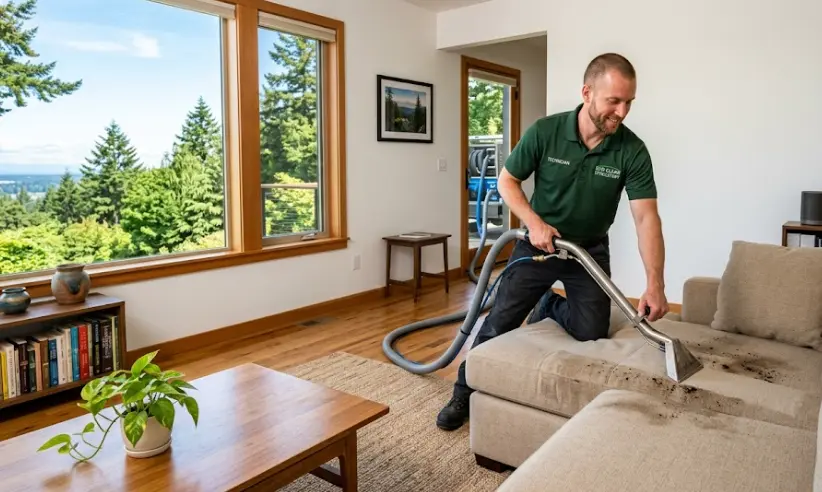
Auburn Is a Valley City — and That Changes How Upholstery Gets Dirty
Auburn sits in the Green River Valley at the confluence of the Green and White Rivers, hemmed in by hills on all sides. The valley geography matters for upholstery cleaning in ways that rarely come up in the generic industry copy you find online. Valley floors trap moisture. The Green River corridor generates morning fog through most of the year — persistent, low-level humidity that settles into homes near the valley bottom before midday clears it. In the fall and early winter months, that fog can linger into the afternoon. Upholstered furniture in homes on the valley floor — Terminal Park, West Auburn, the older residential blocks around Downtown Auburn — accumulates ambient moisture in its foam fill over time, sustaining dust mite populations at higher density than elevation-sitting homes would.
The upper neighborhoods — Lea Hill to the east and Lakeland Hills to the southeast — sit above the fog line and drain better. Sofas in those homes behave differently: drying after professional cleaning is faster, ambient allergen loads are lower, and the conditions more closely match what you'd find in drier King County cities like Bellevue or Issaquah. Auburn is not one uniform environment, and we treat it accordingly.
Auburn also has a more industrial character than neighboring Kent or Federal Way. The SR-18 and SR-167 corridors bring heavy truck traffic through the city, and the logistics and warehouse facilities clustered near the freeways generate fine particulate that settles on the residential streets closest to those routes. Homes within a half-mile of the main warehouse district — particularly West Auburn — tend to show higher fabric surface loading than similar homes further from the corridor.
What Sofa Cleaning Costs in Auburn, WA
| Furniture Type | Price Range | Typical On-Site Time |
|---|---|---|
| Sofa / Couch (2–3 seat) | $120–$185 | 45–75 min |
| Sectional (4–6 piece) | $195–$310 | 90–150 min |
| Loveseat | $80–$120 | 35–55 min |
| Armchair / Accent Chair | $60–$90 | 20–40 min |
| Pet odor enzyme treatment (add-on) | +$40–$65 | Included in visit |
| Stain guard protector (add-on) | +$30–$50 | Included in visit |
We quote before we start, and the number is fixed. For multi-piece jobs, give us the full list when you call — we quote the whole visit at once. If the inspection reveals something that would change the scope (heavy pet saturation into the frame, mold pre-treatment needed), we explain it and you decide before we proceed.
Auburn Neighborhoods We Serve
| Neighborhood | Typical Upholstery Situations | Notes |
|---|---|---|
| Lea Hill | Eastern hillside neighborhood, above the valley fog line; mix of newer single-family homes and established neighborhoods; growing families, good-quality furniture; faster drying than valley floor | 3–4 hr dry time; standard extraction on most synthetics and fabric sofas; fabric code check on any piece over 10 years old |
| Lakeland Hills | Southeast Auburn, planned community with townhomes and single-family homes, younger families, higher proportion of newer furniture; sits above valley floor with good drainage | 3–4 hr dry time; performance fabrics common (Crypton, Revolution blends); stain guard add-on popular here after cleaning |
| Downtown Auburn / Valley Floor | Older residential areas near the Green River, historic homes, longer-term residents, furniture that may not have been professionally cleaned in years; valley fog increases ambient humidity through fall/winter | 4–5 hr dry time planned; HEPA pre-vacuum especially important on older pieces; foam moisture check on arrival |
| Terminal Park | Established neighborhood on the valley floor, working families, mix of rental and owner-occupied; diverse household composition; high proportion of pet households | 4–5 hr dry time; enzyme pre-treatment standard on pet households; move-out documentation available for rentals |
| West Auburn | Near SR-167 and the industrial corridor; fine particulate from truck traffic settles on upholstery surfaces; Boeing Fabrication proximity means shift-worker households | 4–5 hr dry time; fabric surface loading often higher from particulate; early morning and Saturday appointments available for shift workers |
| Algona / Pacific (adjacent) | Small cities immediately south of Auburn, similar valley geography; often on the same Auburn service route | No travel surcharge; same service standards as Auburn proper |
Green River Valley Humidity: What It Does to Upholstery Over Time
Auburn's position in the Green River Valley produces a specific seasonal pattern that affects every home in the valley bottom. From October through March, morning fog from the river and low-lying terrain persists into midmorning or early afternoon multiple days per week. Relative humidity in valley-floor Auburn neighborhoods during these months regularly runs 85–95% in the morning hours — higher than hilltop areas by 15–20 percentage points. Even well-sealed homes absorb this ambient moisture through ventilation and temperature cycling.
For upholstered furniture, the effect accumulates over time. Foam cushion fill that cycles through high-humidity mornings repeatedly through the wet season absorbs and holds moisture at levels that support accelerated dust mite reproduction. Dust mites require approximately 70% relative humidity to thrive; in valley-floor Auburn homes during the rainy season, they have that condition for hours each morning. A sofa in a Downtown Auburn or Terminal Park home that hasn't been professionally cleaned in two or three years has been through two or three full wet seasons of this cycling — the allergen accumulation in that foam is typically significantly higher than an equivalent sofa in a drier climate or a hilltop location.
Hot-water extraction physically removes the accumulated allergen material — dust mite waste, skin cells, and particulate — from within the fabric and foam surface. Surface vacuuming alone can't reach it. For Auburn valley-floor homes with allergy sufferers, asthma, or young children who spend time on cushions, there's a real practical benefit to annual professional cleaning beyond aesthetics. It's the same reason the American Lung Association includes upholstered furniture in annual allergen management recommendations — and in Auburn's valley climate, that guidance is especially relevant.
Industrial Particulate in West Auburn: What Truck Traffic Does to Upholstery
Auburn's warehouse and logistics corridor along SR-167 and SR-18 is one of the largest in South King County. Amazon, USPS, and other major logistics operators have distribution facilities in the area, and the associated truck traffic is constant throughout the day. Fine particulate from diesel engines, brake dust, and road surface material disperses from the corridor into adjacent residential areas.
For homes within a few blocks of the main logistics routes — particularly in West Auburn — this creates measurable upholstery surface loading over time. It's not visible in the way pet hair or spilled coffee is; it settles as a fine film that accumulates in the fabric weave and appears as a gradual graying of light-colored upholstery, or as a persistent background smell in darker pieces. The pre-vacuum step in our cleaning process is particularly important for West Auburn homes for this reason — we extract the surface particulate before applying any moisture, because pushing dry particulate into wet fabric drives it deeper into the weave.
Imported Fabrics and Multi-Language Households in Auburn
Auburn's population is genuinely diverse — the city's Latino community represents roughly 25% of residents, and there are established Southeast Asian, East African, and other immigrant communities throughout the city, particularly in Terminal Park and the older Downtown-adjacent neighborhoods. Many households in these areas have furniture purchased in other countries, brought from home, or bought through community import networks — upholstery that often has no English-language care tag, or carries only Spanish, Korean, Somali, or other language labels.
The care tag problem matters. Upholstery care codes (W, S, W/S, X) exist to prevent cleaning damage — specifically, to prevent water-based cleaning from permanently marking S-code microfiber or shrinking certain natural fibers. When a tag is missing, worn, or in a language that doesn't use the standard ASTM codes, we can't rely on it. Our protocol for any fabric without a readable English-language care code is the same: visual and tactile identification, followed by a test spot in a hidden area with dwell time and assessment before any cleaning solution is applied to the main surface. The test takes a few minutes. It's not optional. We'd rather take the time than irreparably mark someone's sofa.
What the Cleaning Visit Involves
- Fabric identification and pre-inspection. We locate the care tag — W (water-extractable), S (solvent only), W/S (either method), X (vacuum only). On pieces without a readable English tag, we run a test spot before committing to any method. We map visible stains, identify pet-affected zones, and check foam cushion moisture — a critical step for valley-floor Auburn homes where foam can hold ambient humidity from the wet season. We tell you what we find before starting.
- HEPA dry vacuum pass. Every surface gets a thorough pre-vacuum before any moisture is applied — body panels, cushion faces and backs, arms, crevices, and underneath removable cushions. For West Auburn homes near the logistics corridor, this step removes the fine particulate layer that builds up from truck traffic. Skipping it pushes dry particulate deeper into the fabric during the wet extraction pass; we don't skip it.
- Enzyme pre-treatment on problem zones. Pet urine areas, food contamination, grease, and high-odor sections receive targeted enzyme pre-spray with 5–10 minutes of dwell time before extraction. Enzyme solution breaks down uric acid molecules — the odor source in pet contamination — rather than masking them. We apply it as standard practice on any household with pets, regardless of visible smell level, because early contamination doesn't always produce obvious odor yet.
- Hot-water extraction (or dry solvent for S-code fabrics). For W and W/S fabrics, heated extraction removes dissolved soil, allergens, enzyme pre-treatment, and embedded material in a single pass. For S-code fabrics, we use dry solvent — water on S-code microfiber produces permanent ring marks, and we won't apply it regardless of how pressing the cleaning need seems. The fabric type is identified before the method is chosen, always.
- Air mover drying. We run an air mover during the final extraction stage and for 20–30 minutes after finishing. Valley-floor Auburn (Terminal Park, West Auburn, Downtown near the river): plan for 4–5 hours until fully dry. Upper neighborhoods (Lea Hill, Lakeland Hills): 3–4 hours. We give you an actual estimate based on what we observe in the room — ambient humidity, room ventilation, fabric density — not a generic range from a form.
- Final walk-through. Before packing up, we inspect everything. Any area that needs a second extraction pass gets one at no additional charge. We don't call it done until it is.
Fabric Types We Handle in Auburn Homes
Synthetic and Performance Fabrics
- Microfiber — W-code (hot-water extraction) and S-code (dry solvent only; water leaves permanent marks on S-code)
- Polyester and polyester blends — common in Lakeland Hills newer homes and throughout Auburn's rental units
- Performance fabrics: Crypton, Revolution, Sunbrella indoor
- Velvet and velour — controlled moisture application with directional brushing to restore nap
- Chenille and textured weaves
- Olefin / polypropylene
Natural Fibers, Leather, and Imported Fabrics
- Genuine leather — full clean plus conditioning; Auburn's valley humidity makes conditioning relevant year-round
- Bonded leather (common in 2008–2018 mid-price sofas) — careful handling; active peeling cannot be reversed
- Cotton and linen — controlled moisture, lower extraction temperature to prevent ring marks and shrinkage
- Wool and wool blends — gentle extraction, careful drying
- Imported fabrics without English care tags — test-spot protocol without exception; common in Terminal Park and Downtown Auburn households
Pet Households in Auburn
Dog hair and body odor
Pet hair compacted into upholstery weave over months of contact needs loosening before it can be removed. Standard home vacuuming only captures surface material. Our HEPA pre-vacuum combined with hot-water extraction pulls the hair along with the body oils and dander underneath it — the source of the background "dog smell" that persists even after surface cleaning. Most pet-household customers notice a significant odor change even while the sofa is still wet.
Cat or dog urine (moderate)
A few incidents over several months, not saturated into the frame. Enzyme pre-treatment at adequate dwell time followed by thorough extraction handles most moderate cases in a single visit. Some residual odor may appear briefly during the drying phase — this fades as moisture evaporates. Better ventilation and faster drying reduce it. We advise opening windows after we leave and running the air mover for as long as possible.
Heavy long-term saturation
Years of accumulated contamination soaked into foam and frame wood. Surface extraction significantly reduces but cannot fully eliminate deep saturation — the odor source is below where wet methods reach. We are direct about this before starting and give you a realistic range of outcomes. In some cases foam replacement after cleaning is the right answer. We tell you which situation you're in; we don't oversell the outcome to get the booking.
Book Couch Cleaning in Auburn, WA
Call or text (206) 212-1234. We cover all of Auburn — Lea Hill, Lakeland Hills, Downtown Auburn, Terminal Park, West Auburn — plus adjacent Kent, Federal Way, Renton, and Puyallup. Weekday and Saturday appointments, early morning slots available for shift workers.
Questions Auburn Customers Ask
How much does sofa cleaning cost in Auburn?
A standard 2–3 seat sofa is $120–$185 with Fresh Furnish Cleaners. A sectional runs $195–$310. Pet enzyme treatment adds $40–$65; stain guard adds $30–$50. These are our actual working rates for Auburn as of July 2026 — they don't change when we arrive. Call or text (206) 212-1234 for an estimate on a specific piece.
Why does my couch smell worse after it gets wet — like after a spill or steam cleaning?
Moisture activates existing bacterial colonies and uric acid residue embedded in the foam that have been dormant at dry conditions. When the foam gets wet — from a spill, DIY steam cleaner, or surface cleaning — these compounds release compounds that smell like mildew or ammonia. Professional hot-water extraction removes this material rather than just wetting and drying it. If your sofa smells worse after every attempt to clean it, that's a sign there's accumulated contamination that requires proper enzyme pre-treatment and full extraction to address.
I live near the river in Downtown Auburn. My place gets damp in the fall. Does that affect the sofa?
Yes, noticeably. Valley-floor homes near the Green River experience morning fog and sustained high humidity through fall and early winter. Foam cushion fill in sofas in these homes absorbs ambient moisture over repeated seasonal cycles, which sustains dust mite populations and speeds up the development of the musty background smell that's common in older furniture. We recommend scheduling Auburn valley-floor homes for cleaning in late summer (August–September) before the wet season, when drying conditions are best and you get the clean foam going into the high-humidity months. We plan 4–5 hours drying time for your neighborhood.
I work at Boeing in Auburn and have a rotating shift. Can you work around that?
Yes. We offer morning appointments starting at 8 AM on weekdays and Saturday slots throughout the day. Text (206) 212-1234 with your available windows and we'll find something that works. We run an Auburn route regularly and have flexibility for customers who can't do standard weekday afternoon timing.
My sofa's care tag is missing or it's in Spanish. What do you do?
We identify the fabric by visual and tactile assessment, then run a test spot in a concealed area before applying any method. This isn't a precaution we skip when we think we know the fabric — it's a fixed step on every piece without a readable English-language care code. Microfiber is the critical case: W-code and S-code versions look essentially identical, and applying water to S-code fabric permanently marks it. The test takes a few minutes and has saved a lot of sofas from permanent damage.
Do you cover Kent, Federal Way, Renton, and Puyallup from Auburn?
Yes. Auburn is on our South King County route, and we regularly clean in Kent, Federal Way, Renton, and Puyallup without a travel surcharge. Algona and Pacific, immediately south of Auburn, are also part of our standard coverage. If you're in South King County or northern Pierce County, call and we'll confirm whether your address is within our regular service area.
Move-Out Couch Cleaning in Auburn
Auburn has a significant rental population, and move-out cleaning demand is consistent year-round — particularly in the Terminal Park and Downtown Auburn rental stock, and in the newer apartment developments in Lakeland Hills. Professional upholstery cleaning as part of a move-out clean makes a practical difference for deposit recovery when the lease requires the furniture to be cleaned, or when photos will be taken for the next tenant.
We provide dated service documentation on request — a written summary of what was cleaned, the date, and the method — which can be submitted alongside move-out photos to a landlord or property management company. For landlords cleaning between tenants, we offer the same documentation for the incoming tenant record. Call and mention the move-out context when you book so we can schedule accordingly and prioritize the right pieces.
