Couch Cleaning Federal Way WA — Professional Sofa Cleaning Service
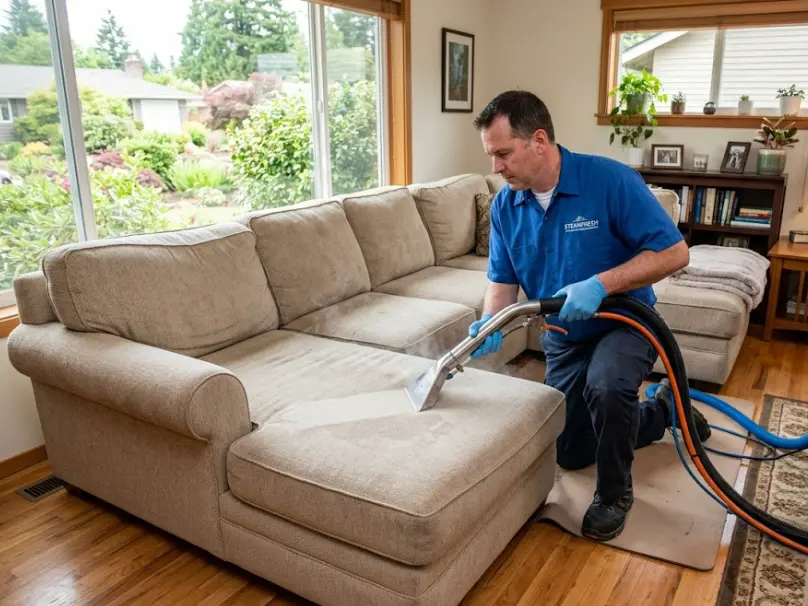
Federal Way Upholstery: Between Two Cities, with Its Own Set of Problems
Federal Way sits almost exactly between Seattle and Tacoma — 30 miles from downtown Seattle, 20 from Tacoma. That geography made it a commuter city, and that character shapes what we find in homes here. The rental turnover is higher than in more settled suburbs. People are in transition: renting while they figure out where to land, serving out JBLM assignments and looking at a move-out within 12–18 months, or newer arrivals to the area who haven't committed to a neighborhood yet. The result is a city with a lot of furniture that's been through multiple tenancies and a lot of households that need move-out cleaning more urgently than they need annual maintenance cleaning.
At the same time, Federal Way's western edge is a different story entirely. Dash Point, Twin Lakes, and Marine Hills sit close enough to Puget Sound that the air carries measurable salt content, morning fog lingers into mid-morning, and residents who use Dash Point State Park — 3,300 feet of saltwater beach — track fine silica sand back into their homes regularly. Sand in upholstery doesn't behave like household dust. Silica particles have sharp edges that cut fabric fibers from inside the weave as people sit and shift on the couch. It's a slow process, but over a few years it noticeably degrades the surface texture of fabric sofas in Dash Point-area homes.
Fresh Furnish Cleaners covers all of Federal Way — from the Twin Lakes golf community in the west to the denser apartment corridors along 320th Street, and from Steel Lake's 1960s ranches down to the Mirror Lake area. The city is well within our regular South King County route alongside Kent, Auburn, and Des Moines.
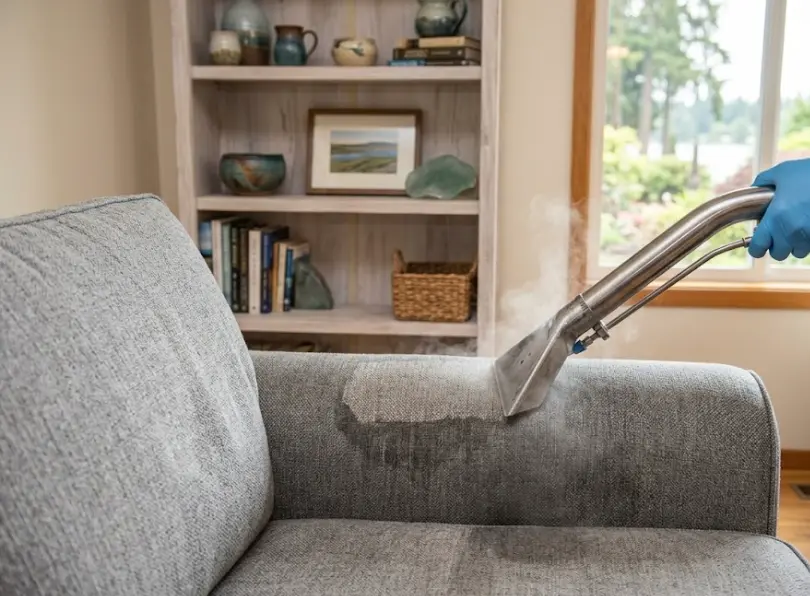
What Sofa Cleaning Costs in Federal Way, WA
| Furniture Type | Price Range | Typical On-Site Time |
|---|---|---|
| Sofa / Couch (2–3 seat) | $120–$185 | 45–75 min |
| Sectional (4–6 piece) | $195–$310 | 90–150 min |
| Loveseat | $80–$120 | 35–55 min |
| Armchair / Accent Chair | $60–$90 | 20–40 min |
| Pet odor enzyme treatment (add-on) | +$40–$65 | Included in visit |
| Stain guard protector (add-on) | +$30–$50 | Included in visit |
For multi-piece jobs in the same visit, we quote everything together — bundled rate applies. Give us the full list when you call. The price we quote is fixed before we start; if the inspection reveals something that would add cost (heavy mold pre-treatment, severe saturation requiring a second full pass), we tell you before doing it.
Federal Way Neighborhoods and What We Usually Find There
| Neighborhood | Common Upholstery Situation | Our Usual Approach |
|---|---|---|
| Twin Lakes / Golf Club Area | Upper-middle owner-occupied homes, quality furniture including leather and higher-end fabric, long-term residents; some vacation-home levels of care | Careful fabric identification, leather conditioning on genuine leather pieces, stain guard recommended on light-colored performance fabrics |
| Dash Point / Marine Hills | Coastal-adjacent homes with elevated salt air humidity; beach sand from Dash Point State Park tracked into homes regularly; furniture experiences faster fiber wear than inland areas | Extended HEPA vacuum pass to remove embedded sand before extraction; dehumidification awareness during drying; recommend annual cadence for beach-adjacent households |
| Steel Lake / Mirror Lake | Older homes from the 1960s–1970s, longer-term residents, furniture that may have been in place for 10–15 years; natural fibers more common than in newer neighborhoods | Fabric code inspection first; older foam cushions checked for moisture before wet methods; honest conversation if a very worn piece is past the point where cleaning makes financial sense |
| West Campus / The Commons Area | Apartment complexes and newer residential developments, high rental turnover, move-out cleaning needs, younger tenants with modern polyester sofas | Efficient extraction on standard synthetic fabrics; move-out documentation on request; same-day availability often requested and accommodated |
| 320th Street Corridor / Citywide | Mixed residential density, JBLM-connected households on rotation, diverse families with varied furniture types | Standard assessment first; move-out documentation available; mindful of schedule constraints that military rotation timelines often impose |
| Adjacent Auburn / Des Moines / SeaTac | Same service zone, similar suburban character to Federal Way | Covered without travel surcharge within our standard South King County area |
The Dash Point Factor: What Beach Proximity Does to Upholstery
Dash Point State Park has 3,300 feet of saltwater beach and is one of the most-visited shoreline parks on the central Puget Sound. For homes within a mile or two — the Dash Point neighborhood, parts of Marine Hills, and some Twin Lakes streets — that proximity creates a specific upholstery problem that doesn't affect most of our service area.
Fine silica sand from saltwater beaches is physically different from the dust and particulate that accumulates in inland homes. Sand grains are heavier, they settle deeper into pile fabrics, and — critically — they have irregular sharp edges at the microscopic level. As people sit and shift on a sand-contaminated sofa, those edges work against the fabric fibers from within the weave. It's not visible in the short term, but after two or three years of regular contact, sofas in Dash Point households often show surface texture degradation — a slight roughness or pilling — that wasn't there when the furniture was new. A standard household vacuum picks up surface sand but doesn't reach what's embedded in the pile.
Our HEPA vacuum pass before extraction is designed for exactly this kind of embedded particulate. We run a slower, more deliberate pre-vacuum on sofas in coastal-adjacent homes, working systematically across seams and tufts where sand concentrates. The extraction pass then removes whatever loosened material remains. For households within easy walking or biking distance of Dash Point, we recommend an annual professional clean on this basis alone — the mechanical abrasion from sand is silent but cumulative.
The salt air component is secondary but real. Marine-influenced humidity keeps fabric slightly damp over the winter months, and salt-laden air very gradually affects natural fiber upholstery more than synthetic. Leather in Dash Point-area homes also benefits from conditioning treatment during cleaning — salt air dries out the proteins in genuine leather faster than standard PNW inland conditions.
Rentals, Military Families, and Move-Out Cleaning in Federal Way
Federal Way has one of the higher rental occupancy rates in South King County, and a meaningful share of that rental population is connected to Joint Base Lewis-McChord, 15 miles south. Military families on 2–3 year assignment cycles in the Puget Sound area often settle in Federal Way because it splits the commute distance between JBLM and other employment centers in Seattle. When the rotation ends, they need a clean that passes property management inspection.
We do move-out cleaning in Federal Way regularly. The typical scenario: a 2–3 year tenancy with pets, kids, or both, and a landlord who'll assess furniture cleaning as part of the checkout. We provide written documentation of the service — date, items cleaned, cleaning method used — which tenants can submit alongside deposit recovery claims. Property managers in Federal Way generally recognize professional cleaning documentation and distinguish it from a standard cleaning charge.
One practical note on timing: military move-out schedules are often compressed. If you know your PCS orders and the date you need the apartment clean, book as soon as you have that date — don't wait until the week before. We accommodate tight timelines when we can, but last-minute bookings in peak months (June–August when most rotations happen) can be harder to fit in.
For renters cleaning ahead of a move-out who are asking whether it's worth having the sofa professionally cleaned vs leaving it: almost always worth it. A professional clean that costs $145–$185 typically prevents a deposit deduction of $200–$400 that a property manager would assess for a dirty couch. The math is straightforward.
What the Cleaning Visit Actually Involves
- Fabric identification and pre-inspection. We find the care tag — W (water-safe), S (solvent only), W/S (either), or X (vacuum only). No tag means a test spot on a hidden area before we commit to any method. We map stains, mark pet-affected zones, and check foam cushion moisture. In Dash Point homes in particular, we note whether the piece has been getting regular salt air exposure, which affects how we handle the leather or natural fiber components.
- HEPA dry vacuum pass. Every surface gets a thorough pre-vacuum — body panels, cushion faces and backs, arms, and underneath removable cushions. For homes near Dash Point, this step takes longer than in purely inland homes and is more important: embedded sand needs to be loosened mechanically before wet extraction, otherwise the extraction process can drive it deeper into the pile rather than removing it.
- Enzyme pre-treatment on problem areas. Pet urine zones, food staining, grease, and concentrated odor areas get a targeted pre-spray with 5–10 minutes dwell time. Enzyme solution breaks down uric acid at the molecular level — not a fragrance cover. We apply enzyme treatment on all pet household jobs as a baseline precaution, regardless of visible odor level.
- Hot-water extraction (or dry solvent for S-code). For W and W/S fabrics, heated extraction removes dissolved soil, allergens, pre-treatment residue, and loosened particulate in a single pass. For S-code fabrics — common on certain microfiber sofas — we use dry solvent. Using water on S-code microfiber causes permanent ring marks that no further treatment reverses; we've seen the results of DIY cleaning mistakes on S-code pieces and they're not fixable.
- Air mover drying. We run an air mover during the final extraction stage and for 20–30 minutes after finishing. Inland Federal Way homes dry in 3–4 hours in warm months. Dash Point and Marine Hills homes, and any Federal Way home during the November–March wet season, typically run 4–5 hours. We give you the honest number based on what we observe, not a default marketing figure.
- Final inspection. We look at everything before packing up. Areas that need a second pass get one at no additional charge. The job isn't done until it looks right.
Fabric Types We Handle in Federal Way Homes
Synthetic and Performance Fabrics
- Microfiber — W-code (hot-water extraction) and S-code (dry solvent; water causes permanent ring marks on S-code)
- Polyester and polyester blends — standard in most West Campus and 320th corridor apartment sofas
- Performance fabrics: Crypton, Revolution, Sunbrella indoor
- Velvet and velour — extractable with controlled moisture and directional brushing during drying
- Chenille and textured weaves
- Olefin / polypropylene (common in budget sofas and indoor-outdoor pieces)
Natural Fibers and Leather
- Genuine leather — full clean plus conditioning; salt air in coastal-adjacent Federal Way homes dries leather faster than inland conditions, making conditioning especially important
- Bonded leather (common in 2008–2018 mid-price sofas) — careful handling; active delamination cannot be reversed by cleaning
- Cotton and linen upholstery — controlled moisture to prevent shrinkage and ring marks
- Wool and wool blends — lower-temperature extraction, careful directional drying
- Silk-blend decorative fabrics — spot treatment only, no full wet clean
Federal Way's Twin Lakes and Dash Point neighborhoods have more genuine leather and higher-end fabric upholstery than most of our South King County coverage area — quality furniture in quality homes. We handle those pieces with extra attention to fabric code, pre-testing, and post-clean conditioning. A $2,000 leather sectional in a Twin Lakes home deserves a different level of caution than a $400 big-box polyester couch, even if the basic cleaning chemistry is similar.
Pet Households in Federal Way: What to Expect
Pet households are common across all Federal Way neighborhoods, and pet-related upholstery cleaning is a large portion of what we do here. Realistic expectations depend on the type and degree of contamination.
Dog hair and body odor
Hair compacted into upholstery weave from daily contact doesn't vacuum out reliably — it needs to be mechanically dislodged by extraction. We precede the extraction with a dedicated HEPA vacuum pass that loosens compacted material. The body oil and dander that causes the baseline "dog smell" in a heavily-used couch comes out in the water during extraction. Most customers notice an immediate odor difference in the room while the sofa is still drying.
Cat or dog urine (moderate)
A few incidents over months, not saturated through to the frame. Enzyme pre-treatment with adequate dwell time followed by full extraction addresses this in a single visit for most cases. Some residual odor can return faintly if the foam retains moisture during the drying period — fast drying with good air movement reduces this risk. We advise leaving windows open after we leave.
Heavy or long-term saturation
Years of accumulated urine saturated into foam, fabric backing, and frame wood. Surface cleaning significantly reduces but cannot fully eliminate odor at this level — the source material is deeper than extraction reaches. We tell you this before starting, give you a realistic range of outcomes, and let you decide whether to proceed. In some cases, foam replacement after cleaning is the right next step.
Book Couch Cleaning in Federal Way
Call or text (206) 212-1234. We cover all of Federal Way, Twin Lakes, Dash Point, Steel Lake, and adjacent Auburn, Kent, Des Moines, and SeaTac. Weekday and Saturday appointments available.
Questions Federal Way Customers Ask
How much does sofa cleaning cost in Federal Way?
A standard 2–3 seat sofa is $120–$185 with Fresh Furnish Cleaners. A sectional is $195–$310. Pet enzyme treatment adds $40–$65; stain guard adds $30–$50. These are fixed prices you hear before we arrive — we don't quote one number and bill another. As of July 2026, these are our actual working rates for Federal Way and South King County.
Does sand from Dash Point actually end up inside sofas?
Yes, and it causes more damage than people expect. Fine beach sand is heavier than household dust — it works its way into the pile of upholstery fabric rather than sitting on the surface. Regular vacuuming picks up surface material but not what's embedded. The silica particles have irregular edges that gradually cut fabric fibers through normal use, degrading the surface texture over time. For Dash Point-area households, we spend more time on the pre-vacuum pass than in inland homes, and we recommend annual professional cleaning specifically to prevent the abrasion damage from accumulating.
Can I get documentation for a move-out cleaning?
Yes. We provide written confirmation of the service — date, address, items cleaned, method used. This is standard for our move-out jobs in Federal Way, and we do them regularly across the rental-heavy apartment complexes along the 320th corridor and West Campus area. Landlords and property managers in Federal Way are generally familiar with professional cleaning documentation and accept it as evidence that the tenant left the furniture in professionally cleaned condition.
How long until my sofa is dry?
Inland Federal Way (Steel Lake, West Campus, 320th corridor): 3–4 hours in summer with air mover running during and after the job. Coastal-side neighborhoods (Dash Point, Marine Hills, Twin Lakes): 4–5 hours due to higher ambient humidity from the Sound. During the November–March wet season, add another hour regardless of location. We give you the honest number based on the room we find, not a blanket marketing estimate.
My microfiber sofa has no care tag. Can you still clean it?
Yes, but the care tag matters enough that we don't skip it. Microfiber comes in two types: W-code (water-extractable) and S-code (solvent only). Water on S-code microfiber causes permanent ring marks that no subsequent treatment removes. When the tag is missing, we identify the fabric visually and by feel, then run a test spot on a hidden area before committing to any method. This takes a few extra minutes and is non-negotiable — the test result tells us everything we need to know.
Do you serve Auburn, Des Moines, and SeaTac from Federal Way?
Yes. All three are within our standard South King County service area with no travel surcharge. Federal Way is effectively the center of our southern King County coverage — we work in all directions from here regularly. Kent is to the northeast, Auburn to the east, Des Moines and SeaTac to the north, and Tacoma/Fife to the south.
We're a military family and need the apartment clean before PCS. Can you accommodate short-notice bookings?
We try. If you have confirmed PCS orders and a specific date, book as soon as you know — June through August is the heaviest JBLM rotation season and availability gets tight. For confirmed military move-outs, we make every effort to fit the appointment into the needed window. Call or text (206) 212-1234 directly and explain the situation; we'll tell you honestly whether we can make it work.
Dust Mites, Salt Air, and Why Federal Way Sofas Need Annual Cleaning
Dust mites establish in virtually every upholstered piece of furniture in King County homes. They're not a cleanliness issue — they're a consequence of fabric, warmth, and human skin cells. Their fecal matter is the actual allergen, and it compacts into the fabric layer at a depth regular vacuuming can't reach. Hot-water extraction removes it mechanically.
What makes Federal Way's coastal-adjacent neighborhoods a specific case is the humidity. Mite populations grow and reproduce faster in humid conditions — and homes near Puget Sound are consistently more humid than comparable inland homes, especially through the October–April season. A Dash Point or Marine Hills sofa that hasn't been professionally cleaned in two or three years has a higher allergen load than an equivalent sofa in a drier inland climate. For households with asthma, rhinitis, or young children who spend time sitting directly on cushions, the impact of professional extraction is measurable.
The combination of salt air humidity, beach sand abrasion, and allergen accumulation means that Federal Way's coastal neighborhoods genuinely benefit from annual professional cleaning in a way that drier, more inland cities don't. It's not a sales pitch — it's what the physical environment of those neighborhoods produces in furniture over time.
