How to Remove Pet Hair from Couch: What Actually Works
Why Pet Hair Grips Couch Fabric So Hard (and What That Tells You About How to Remove It)
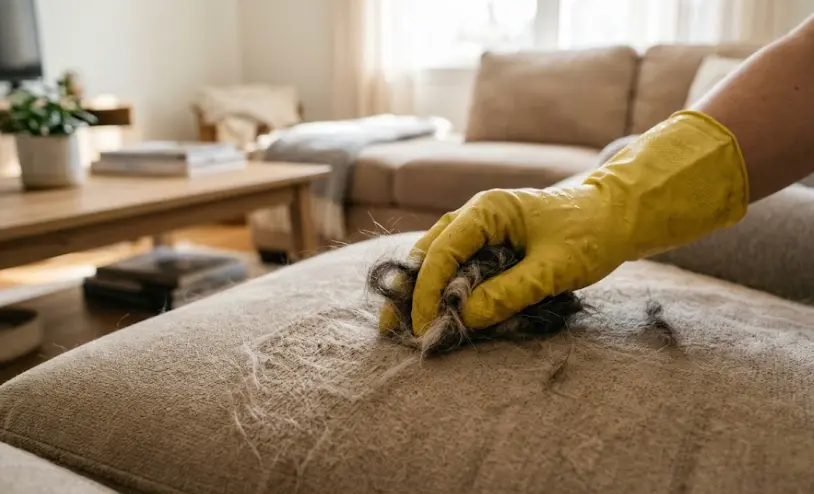
Pet hair doesn't just sit on the surface of upholstery — it gets locked into the fabric by two separate forces, and most cleaning tools only address one of them. Getting this wrong is why people vacuum a couch twice and still pull out handfuls of hair with their hand afterward.
The first force is static electricity. When a dog or cat rubs against a cushion, friction between animal hair and synthetic fabric generates a triboelectric charge. On polyester and microfiber upholstery — the two most common modern sofa fabrics — this electrostatic buildup can reach 8,000 to 35,000 volts, pinning individual hairs against fiber surfaces with force that a dry brush or standard vacuum nozzle cannot overcome. This is why dry methods often move hair around on the surface without actually removing it from a heavily-staticked couch.
The second force is mechanical entanglement. Microfiber has fibers as thin as 1.2 denier — roughly 1/100th the diameter of a human hair. Pet hair doesn't rest on top of this surface; it slips between micro-fibers and gets gripped from multiple angles simultaneously. That's why vacuuming alone, without first breaking that mechanical grip, is so ineffective: suction can't pull a mechanically trapped hair fiber out of a dense microfiber weave.
Every method in this guide works by attacking one or both of these forces. Methods that address both at once — damp rubber gloves, silicone squeegees with anti-static pre-treatment, combined spray-and-brush — consistently outperform single-action tools on any couch with more than light hair coverage.
Pet Hair Removal Methods — Compared Honestly
| Method | Best Use Case | Microfiber | Velvet | Linen / Cotton | Leather |
|---|---|---|---|---|---|
| Damp Rubber Glove | Heavy buildup, fast cleanup | Excellent | Dry only, light pressure | Good | Not needed |
| Silicone Squeegee | Large flat cushion surfaces | Excellent | Not recommended | Good | Not needed |
| Vacuum + Turbo Brush | Regular maintenance, fine hair | Good (after loosening) | Good (low setting) | Excellent | Crevice tool for seams |
| Adhesive Lint Roller | Light surface hair, quick touch-up | Surface only | Test hidden area first | Good | Works fine |
| Silicone Lint Roller | Regular upkeep, eco-friendly | Good | Caution on pile | Good | Works fine |
| Anti-Static Spray + Brush | Synthetic fabrics with static buildup | Excellent | Good | Rarely needed | Not applicable |
| Professional Hot Water Extraction | Deep-embedded hair, allergen removal, annual reset | Excellent | Excellent | Excellent | Excellent |
The Rubber Glove Method — Why It Beats Everything Else on Heavy Hair
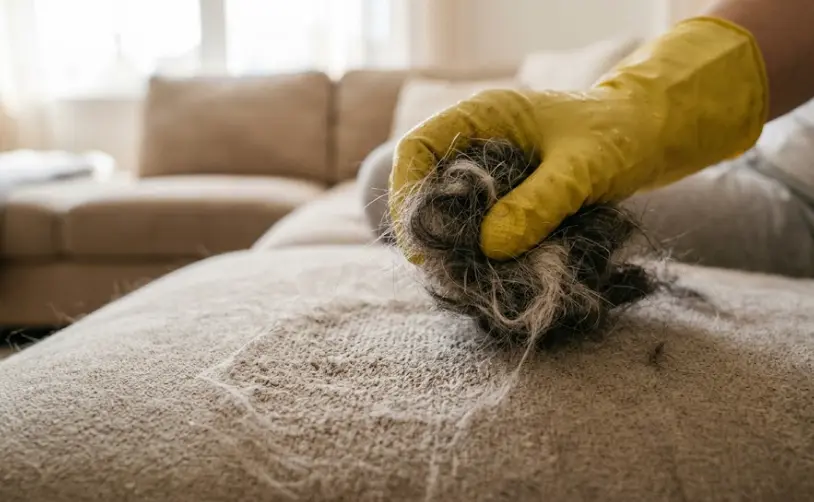
The fastest way to remove heavy pet hair from a couch is to put on a rubber dishwashing glove, run it under water until it's barely damp — not dripping — and make short firm strokes across the cushion surface. In 30 to 60 seconds per cushion, the hair rolls into dense clumps that you peel off and discard. No consumables, nothing to replace, total cost: the rubber gloves under your kitchen sink.
The reason this works so well comes down to two things happening at once. Rubber has a high friction coefficient against fabric — around 0.8 to 1.2 — which gives it genuine mechanical pulling force. Unlike a flat lint roller that presses down, the glove's angle of friction drags hairs sideways and upward, breaking the mechanical entanglement. The slight moisture adds surface tension that clumps individual hairs before they can re-scatter across the cushion.
One thing to calibrate: the glove needs to be damp, not wet. On microfiber especially, too much water leaves ring marks as the fabric dries. The right amount of moisture clumps the hair without visibly wetting the fabric beneath your hand.
After two or three passes, the glove gets coated and loses its grip. Rinse it under the tap, shake off the excess, and continue. On a full sectional, you'll rinse 4–6 times, but the total job still takes under 10 minutes — faster than any lint roller on the same amount of hair, without spending a dollar on replacement sheets.
Silicone Squeegee — Best for Covering Large Flat Surfaces Quickly
A silicone or rubber-edged squeegee (a standard window squeegee works; dedicated upholstery squeegees are sold as pet hair tools for a few dollars more) covers more surface per stroke than a gloved hand and maintains consistent edge pressure across the full width of a seat cushion. For large, flat couch cushions on sectionals, it's faster than the glove method for the same result.
Hold the squeegee at a 30–45 degree angle to the fabric and push in firm strokes toward one edge. The hair bunches ahead of the blade into a windrow that you collect and discard. The silicone edge both loosens mechanically embedded hair and pushes it together in a single motion — you do two steps at once.
Two situations where squeegees don't work well: tufted surfaces and velvet, where the edge catches in buttons or pile; and completely dry synthetic fabric on a low-humidity day, where the blade can generate additional static that scatters the hair rather than clumping it. A light mist of water or anti-static spray before squeegeeing solves the second issue entirely.
Vacuuming — The One Change That Makes It Actually Work
What Most People Do (and Why It Doesn't Clear Embedded Hair)
Standard flat upholstery nozzle, one direction, one pass. This approach skims surface hair but leaves embedded hair completely untouched. Vacuum suction alone does not have the mechanical force to pull a hair that's gripped inside a microfiber weave — it passes directly over it. The couch looks marginally cleaner, but running a rubber glove over it immediately afterward still produces dense clumps from the fabric.
What Works — Turbo Brush, Crosshatch Pattern
Switch to a turbo brush attachment (motorized rotating brush, also called a pet hair attachment). The spinning bristles agitate the fabric surface and break the mechanical grip on embedded hair before suction removes it. Vacuum in overlapping horizontal passes first, then vertical — the crosshatch pattern catches hairs oriented in different directions. Finish with the crevice tool along all seams, cushion gaps, and under armrests, where hair compacts most densely.
Anti-Static Spray — The Pre-Treatment Step That Makes Everything Easier
On polyester, microfiber, and nylon-blend upholstery, static electricity keeps individual hairs pinned to fibers with real force. A 30-second pre-treatment that neutralizes that charge before you start mechanical removal cuts your working time roughly in half on staticky fabrics.
You don't need a commercial product. Mix one part fabric softener with two parts water in a spray bottle. Fabric softener contains quaternary ammonium compounds — cationic surfactants — that deposit on fiber surfaces and neutralize the accumulated negative charge on synthetic fabrics. Mist the couch lightly (not soaking, just damp to the touch), wait 30 seconds, and then use the glove, squeegee, or brush. The hair comes up in larger, more cohesive clumps with noticeably less effort.
Dryer sheets work on the same principle at lower concentration. Rubbing a dryer sheet across upholstery before cleaning deposits the same surfactants and reduces static — good for light maintenance or as a follow-up step, but less effective than the spray for heavy buildup where you need the anti-static treatment to penetrate between fibers rather than just coat the very surface.
Applied preventively once a week to a clean couch, the spray keeps the static charge low enough that each new hair deposits with less grip — you're not fighting the same level of electrostatic adhesion the next time you clean.
Lint Rollers — Where They Fit (and Where They Don't)
Lint rollers are the tool most people buy first and the one that most consistently disappoints on a couch with actual pet hair. They're designed for clothes with light, sparse hair — and on that use case, they're excellent. On a couch where a dog or cat has been sleeping, the math doesn't work in the lint roller's favor.
Standard adhesive sheets need replacing every 30–40 full passes, and on a pet-hair-heavy cushion, a single side of a seat cushion can exhaust a sheet before you've finished it. More critically: once the adhesive is 60% covered in hair, it begins redepositing collected hair onto the fabric rather than removing it. The sheet still looks sticky, but it's past its effective threshold.
Reusable silicone lint rollers are a meaningful upgrade for couch use. They rinse clean under water, don't degrade with use, and perform better on microfiber per pass than standard adhesive. The trade-off is they don't pull as well on velvet where the soft silicone can flatten pile rather than grip hair. For linen and cotton upholstery, either style of lint roller works well — the lower static of natural fiber fabric means a roller can finish the job without first needing a glove or spray step.
Fabric-Specific Guide — What Your Couch Type Actually Needs
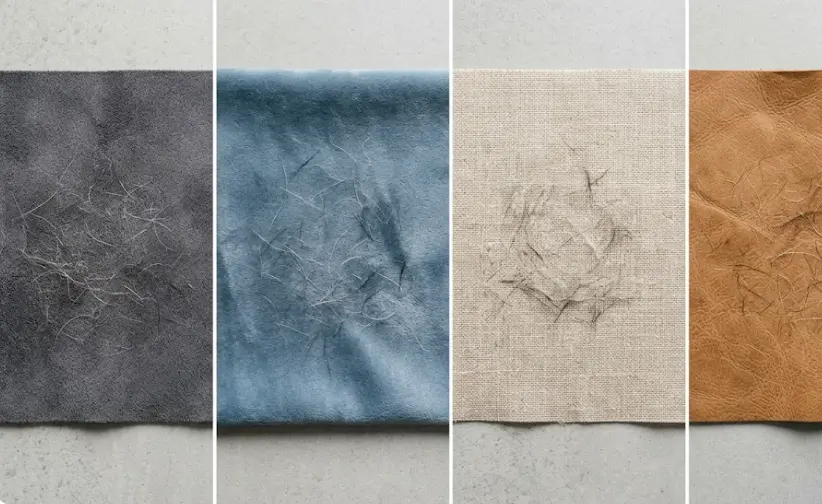
Microfiber generates both high static charge and deep mechanical entanglement simultaneously — which is why it's the most difficult upholstery to keep pet-hair-free and why a single method almost never completes the job. The effective sequence handles both problems in order.
Recommended sequence:
- Mist lightly with anti-static spray (1 part fabric softener, 2 parts water). Wait 30 seconds.
- Damp rubber glove, short firm strokes, working section by section. Rinse glove when it loads up.
- Vacuum with turbo brush in crosshatch pattern to catch fine residual hair and dander.
- Dry microfiber cloth wipe in the nap direction to restore texture and pick up any remaining loose hairs.
Avoid: over-wetting (water rings form as it dries), scrubbing against the nap (permanently crushes micro-fibers), oil-based fabric softeners (leave residue that accelerates dirt adhesion).
Velvet traps hair in the pile and shows every mark from tools applied against the grain. Any technique that works beautifully on microfiber — firm scrubbing, squeegee strokes across the nap — can leave permanent pile distortion on velvet. The principle here is always: light touch, one direction, with the pile.
Recommended sequence:
- Vacuum first with soft upholstery brush attachment at low suction. Remove surface hair before any manual tools.
- Dry rubber glove at light pressure, moving only in the pile direction. Stop and check after each pass — if you see any pile compression, reduce pressure.
- Soft-bristle velvet brush (garment velvet brushes work well on cushions) to lift embedded hair.
- For stubborn hair that won't budge: a gentle pass with a lint roller, tested first on a hidden area.
Avoid: silicone squeegees, rubber squeegees, any cross-pile motion, wet methods unless the care tag shows "W," hard-bristle brushes. When in doubt on a velvet sofa with heavy embedded hair, professional dry-extraction cleaning is a better call than risking the pile.
Natural fiber upholstery generates significantly less static than polyester and microfiber, so pet hair doesn't bond as aggressively. It still catches mechanically in the weave, but responds well to most removal techniques and rarely needs the full anti-static pre-treatment that synthetic fabrics require.
Recommended sequence:
- Vacuum with turbo brush in crosshatch pattern — handles the majority of hair effectively on natural fibers without additional steps.
- Rubber glove or fabric brush for any stubborn embedded patches.
- Lint roller for surface cleanup.
Removable linen or cotton cushion covers are worth machine-washing on a hot cycle when hair buildup is significant. A dryer sheet in the wash cycle helps prevent static cling between fibres during drying. Check care tags — many woven blend cushion covers are machine-washable, which makes them the lowest-maintenance pet-hair couch fabric option overall.
Leather's smooth non-porous surface doesn't trap hair at all — a wipe with a barely damp cloth clears flat surfaces completely in one pass. The challenge is exclusively in seams, tufting buttons, cushion gaps, and the base skirt where hair compacts into dense mats that a surface wipe can't reach.
Recommended sequence:
- Wipe all flat surfaces with a slightly damp cloth — done in one pass.
- Vacuum crevice tool along every seam, under armrests, between cushions, and along the base edge.
- Soft brush to loosen compacted hair from deep tufting before vacuuming.
- Leather conditioner after cleaning — pet oils and claws degrade leather finish over time, and conditioning after each full cleaning extends the life of the upholstery significantly.
Faux leather (PU, bonded leather) gets slippery and can delaminate if over-wetted. Stick to a barely damp cloth rather than a wet one, and skip the leather conditioner — faux leather doesn't absorb it and the oil can leave a slick surface residue.
Keeping Pet Hair Under Control — Three Things That Actually Cut Maintenance Time
Deshedding at the Source
The only hair that can't get on your couch is hair that's already off your pet. Weekly brushing with a deshedding tool — undercoat rakes like the Furminator remove 40–60% of loose coat before it falls naturally — is the highest-return maintenance habit for shedding breeds. Brush outdoors when possible: hair released in the yard is hair that never reaches the cushions.
Seasonal shedding periods (spring and fall for most dogs and cats) warrant brushing 2–3 times per week rather than weekly — this is when the rubber glove method goes from being a weekly job to a daily one without an intervention upstream.
Washable Couch Covers
A snug machine-washable couch cover keeps all hair off the upholstery underneath and converts a 15-minute cleaning task into a 5-minute cover removal and a laundry cycle. Tightly-woven polyester and canvas covers shed pet hair most easily in the wash; avoid fleece, which holds hair through the entire wash cycle and transfers it to other laundry.
Washing every 1–2 weeks during heavy shedding periods is realistic when covers are machine-washable. A dryer sheet in the dry cycle reduces static cling and makes hair easier to shake out of the cover before loading the machine.
Weekly Anti-Static Spray Routine
Applying anti-static spray to a clean couch once a week (before hair builds up, not after) reduces how firmly each new hair bonds to the fabric. Quaternary ammonium compounds in fabric softener stay on synthetic fibers for 3–5 days, keeping the surface charge low enough that hair slides off more readily rather than embedding. This is a preventive maintenance step — it doesn't replace cleaning, but it makes the next cleaning session measurably shorter.
Combined with weekly deshedding brushing upstream, a consistent spray routine can cut couch hair maintenance time by roughly half for most pet owners.
What Seattle-Area Pet Owners Have Found
"Two huskies, a microfiber sectional, and three years of buying every pet hair gadget I could find. Then someone in our neighborhood group mentioned the rubber glove trick. First time I used it, I pulled off what looked like a third husky's worth of hair. I do it twice a week now — 8 minutes, and the couch actually looks clean."
"I was vacuuming with the flat nozzle and wondering why it never made a real difference. Switched to the turbo brush and did it in a crosshatch pattern — the difference in one pass was dramatic. Should have been obvious, but I'd never thought to vacuum in two directions. The crevice tool in the seams also found a truly alarming amount of hair I'd never touched."
"I have a velvet sofa and two cats. Everything I tried either did nothing or left marks on the pile. What finally worked: dry rubber glove, very light touch, moving only with the pile direction. Any cross-pile motion shows in the velvet immediately. Takes longer than the glove method on microfiber, but it actually works without damaging anything."
"I book a professional cleaning once a year for the deep reset and keep up with the glove and spray routine in between. The professional extraction gets all the hair and dander that's worked down into the cushion padding — you can feel the difference in the air quality in the room afterward. My husband's allergies were part of what pushed us toward the annual cleaning."
When the Couch Needs More Than a Rubber Glove
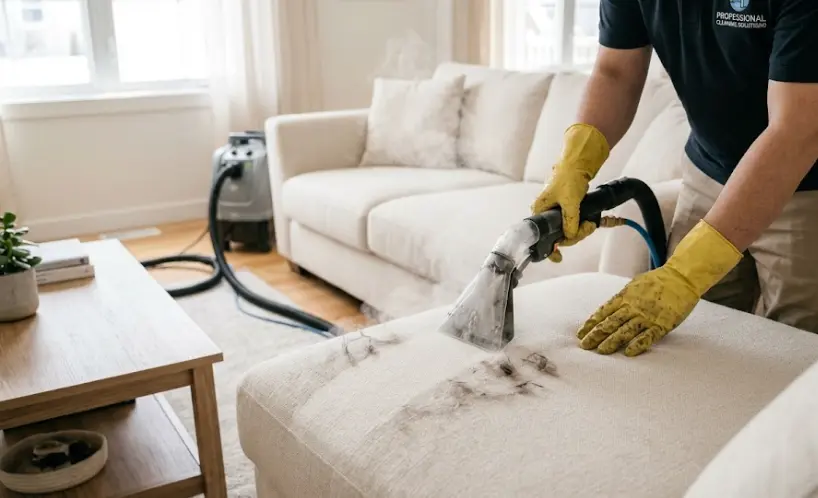
Professional upholstery cleaning in the Seattle area starts at $120–$175 for a standard sofa and $175–$260 for a sectional, depending on fabric type and condition. For pet owners with shedding breeds or multiple animals, one annual cleaning removes something home methods can't: hair, dander, and pet oils that have worked into cushion foam layers over months of accumulation.
The rubber glove, squeegee, and vacuum methods described above clean the fabric surface thoroughly. But hair that gets compressed repeatedly — from people and pets sitting on the same spots daily — works progressively deeper into the padding. Over a season, this compacted material breaks down into fine particulate that becomes part of the air in the room, which is why allergy symptoms often worsen in rooms with pet-heavy furniture even when the surface of the couch looks clean. Hot water extraction physically flushes and removes this sub-surface layer.
Fresh Furnish Cleaners serves Bothell, WA and the greater Seattle area with in-home upholstery cleaning for all couch fabric types — microfiber, velvet, linen, leather, and performance fabrics. Our technicians assess the fabric before choosing the extraction method and tool combination. If your household includes allergy sufferers or you have two or more pets with year-round shedding, an annual professional cleaning combined with regular at-home rubber glove maintenance is the most complete approach available.
Frequently Asked Questions
A damp rubber dishwashing glove is the fastest method for couches with heavy pet hair — most cushions are done in 30 to 60 seconds per surface. For large flat cushions on sectionals, a silicone squeegee covers more area per stroke and is comparably fast. Both significantly outperform lint rollers and standard vacuum nozzles on heavy buildup, and neither requires any consumables to replace.
Two forces are at work. Static electricity — generated by friction when pets rub against synthetic fabric — can reach 35,000 volts on microfiber and polyester, pinning individual hairs to fiber surfaces. Simultaneously, pet hair physically entangles in the tight weave of microfiber (which has fibers roughly 1/100th the diameter of a human hair), gripping from multiple directions. Methods that address both forces at once — anti-static spray followed by a rubber glove — consistently outperform single-action tools.
Start with a light mist of anti-static spray (1 part fabric softener, 2 parts water) and wait 30 seconds. Then use a damp rubber glove in short strokes, section by section. Follow with a vacuum using a turbo brush attachment in a crosshatch pattern to catch residual fine hairs and dander. Finish with a dry microfiber cloth in the nap direction to restore texture. Never scrub hard — it permanently crushes microfiber nap.
For light surface hair, yes. For heavy buildup, lint rollers fall short — the adhesive sheet saturates quickly and once it's 60% covered, it begins redepositing hair rather than collecting it. You'd need multiple sheets per cushion, making it slow and costly on a pet-heavy couch. Reusable silicone rollers are a better couch option: they rinse clean, don't degrade, and perform better per pass on microfiber. For embedded hair, a rubber glove or squeegee outperforms any roller.
Use a dry rubber glove with light pressure, moving only in the pile direction. Follow with a soft-bristle velvet brush. Never use a squeegee on velvet (it crushes the pile) and never move tools against the nap. On heavily embedded hair in velvet where DIY is making marks, professional dry-extraction cleaning is the safer option — the right equipment removes hair without distorting the pile.
Home methods clean the fabric surface well but don't reach hair and dander that has worked into cushion padding layers over time. If someone in your household has pet allergies, if the couch has a persistent odor even after surface cleaning, or if it's been more than a year since a deep clean, professional hot water extraction is worth scheduling. Fresh Furnish Cleaners provides in-home upholstery cleaning throughout the Seattle area — most sofas dry within 2 to 4 hours after treatment.
Our Service Area — Upholstery Cleaning for Pet Owners in Washington State
We Come to You — No Need to Move Your Furniture
Fresh Furnish Cleaners provides in-home professional upholstery cleaning throughout Washington State. All equipment and supplies come to your home — you don't move anything.
- Bothell and Mill Creek
- Seattle and all neighborhoods
- Bellevue and the Eastside
- Kirkland and Redmond
- Everett and Lynnwood
- Edmonds and Shoreline
- Sammamish and Issaquah
- Woodinville and Snohomish
Related Cleaning Guides
Cat Urine on Sofa — Professional Solutions
Why DIY odor removal fails and how professional enzyme treatment eliminates cat smell from couches permanently.
Cat Urine Sofa CleaningUpholstery Cleaning Seattle
Professional upholstery cleaning for all furniture types throughout Seattle and the greater Puget Sound region.
Upholstery Cleaning SeattleVelvet Sofa Cleaning — DIY Risks
What happens when you use the wrong method on velvet upholstery — and what professionals do differently.
Velvet Sofa Cleaning GuideNeed a Professional Deep Clean After All That Pet Hair?
Surface methods clean the fabric — professional extraction cleans what's underneath it. If pet hair, dander, or odor has built up in your cushions, we'll remove it completely.
Serving Bothell, Seattle, Bellevue, Kirkland, Redmond, Everett & surrounding Washington communities
