Mobile Upholstery Cleaning Service Near Me – What to Expect
How Mobile Upholstery Cleaning Actually Works
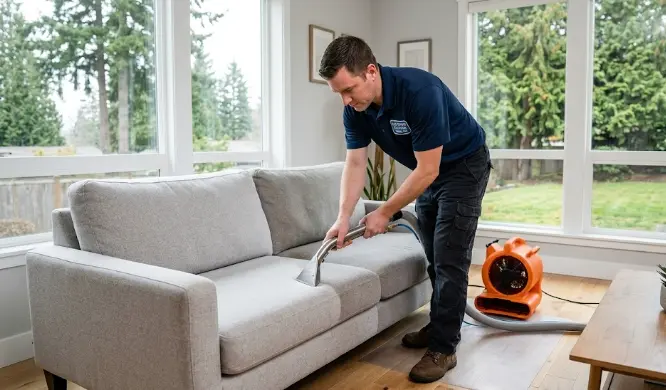
When most people think of getting furniture cleaned, they picture transporting pieces to a shop or waiting weeks for availability. Mobile upholstery cleaning works the opposite way — a fully equipped professional technician comes to you, cleans your furniture in the room where it lives, and leaves with everything packed back into the vehicle. Nothing moves. Nothing goes anywhere.
This is the standard model for professional upholstery cleaning in the US. Unlike carpet cleaning — where some consumers rent equipment and do it themselves — upholstery cleaning requires specialized attachments, fabric-specific chemistry, and technique that varies by fiber type. The mobile service model exists specifically because the equipment and expertise need to come to the furniture, not the other way around.
If you have been searching for an in-home couch cleaning service near me and are not sure what to expect when the technician arrives, this guide covers the full process from booking to the moment you sit back down on a clean sofa.
What Happens During an In-Home Couch Cleaning Appointment
A professional mobile upholstery cleaning visit follows a consistent sequence. Here is exactly what happens from the moment the technician arrives:
Step 1 — Fabric Inspection and Code Check
Before any equipment is unpacked, the technician inspects the sofa. This means locating and reading the care tag — the cleaning code (W, S, W/S, or X) and fiber content — and conducting a visual assessment of the fabric condition, soiling type, and any existing damage.
This step determines everything that follows: which cleaning method is used, which pre-treatment products are selected, and what results are achievable. If you are unsure about your fabric type, see our guide to identifying upholstery fabric before cleaning.
A spot test is applied in an inconspicuous area before full treatment begins. This confirms dye stability and fabric response.
Step 2 — Pre-Vacuuming
The entire sofa surface is vacuumed with an upholstery-specific attachment before any liquid treatment. This removes dry surface soiling — pet hair, crumbs, dust, loose debris — that would otherwise be pushed deeper into the fabric during wet cleaning.
Skipping this step is one of the most common errors in DIY upholstery cleaning. Wet cleaning over dry debris does not remove it — it embeds it. Professional technique always separates the dry extraction stage from the wet cleaning stage.
Step 3 — Pre-Treatment
Targeted pre-treatment solutions are applied based on the soiling type identified in Step 1. Protein-based soiling (pet accidents, food, body oils) receives enzyme pre-treatment with adequate dwell time — typically 5 to 10 minutes — to break down organic compounds before extraction. Grease-based soiling receives solvent pre-treatment. Tannin stains (coffee, wine, tea) receive oxidizing pre-treatment.
For in-home couch cleaning service, general soiling across the whole sofa surface typically receives a light overall pre-treatment to loosen body oils and dust from deep within the fiber before the extraction pass.
Step 4 — Hot Water Extraction
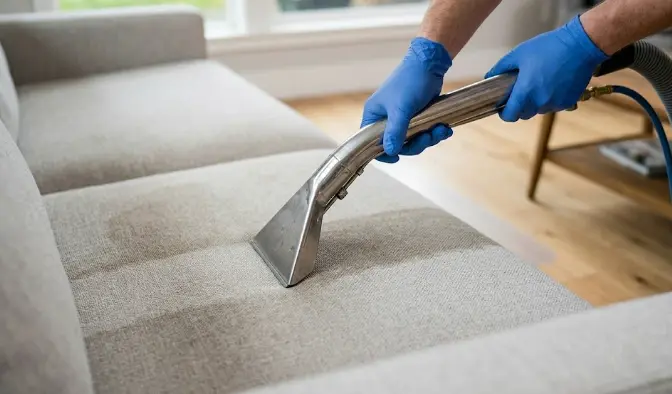
The primary cleaning pass uses hot water extraction — the most effective method for W-coded and W/S-coded upholstery. Heated water and cleaning solution is injected into the fabric at pressure, then immediately extracted along with dissolved soiling via a high-powered vacuum.
The extraction wand used for upholstery is smaller and lower-pressure than carpet cleaning tools — precision matters on furniture fabric to avoid over-saturation. Multiple passes are made over high-soil areas. The technician works systematically across the entire surface, ensuring even cleaning.
S-coded fabrics (dry-clean only) instead receive solvent-based cleaning without any water. The principle is the same — a solvent is applied and extracted — but the chemistry is entirely different.
Step 5 — Spot Treatment Pass
After the general extraction pass, the technician reviews all previously identified stains. Stains that responded well in the general pass are complete. Resistant stains receive additional targeted treatment — a second pre-treatment application with extended dwell time followed by a focused extraction pass.
At this stage, a UV light scan is also performed if pet accidents were mentioned or suspected — identifying any contaminated areas that are not visible in normal light. Pet urine fluoresces under UV and can be detected in areas the owner was not aware of.
Step 6 — Rinse and Final Extraction
A pH-balanced rinse solution is applied and extracted to neutralize any residual cleaning chemistry and prevent resoiling. Leaving detergent residue in the fabric is one of the main causes of sofas re-soiling quickly after cleaning — residue acts as a magnet for new dirt. The rinse pass ensures the fabric is left with no chemical residue.
Final extraction removes the maximum amount of moisture from the fabric, shortening drying time and preventing any possibility of mildew developing in the cushion foam during the drying period.
Step 7 — Air Mover Setup
Air movers — high-velocity fans purpose-built for drying — are positioned around the sofa after cleaning. These dramatically accelerate the drying process, typically reducing drying time by 30 to 50% compared to natural air drying. The air movers stay in place for the remainder of the drying period.
For mobile upholstery cleaning appointments where the technician needs to leave for the next job, air movers are typically left with the customer and collected the following day. We include air mover setup in every appointment — it is not an add-on service.
Step 8 — Post-Clean Walkthrough
Before leaving, the technician walks through the results with you — pointing out stain treatment outcomes, noting any areas where a second appointment might improve results on deeply set old stains, and confirming the drying timeline. Any questions about post-cleaning care or future maintenance are answered at this stage.
If fabric protector was booked (recommended after every cleaning), it is applied at this stage to the dry or near-dry fabric surface before the technician leaves.
The Equipment a Mobile Cleaning Unit Carries
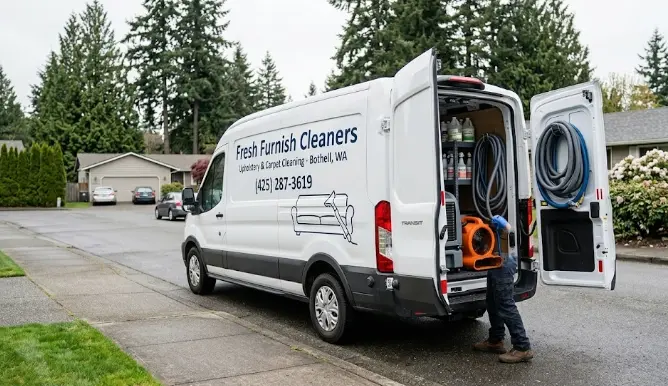
One of the most common questions about in-home couch cleaning service is what the technician actually brings. The service vehicle for a professional mobile upholstery cleaning unit is purpose-equipped:
Extraction Machine
Either truck-mounted (connected to the vehicle) or portable (a self-contained unit brought inside). Truck-mounted systems have stronger suction and heating capacity. Portable units are used in situations where the vehicle cannot park close enough, or in multi-story buildings.
Both types provide the same cleaning capability for upholstery — the choice is determined by access, not quality of result.
Upholstery Wands and Tools
Upholstery cleaning wands are narrower and lower-pressure than carpet wands. Different tool heads handle different surfaces: a detail wand for cushion edges and crevices, a wider glide tool for flat seat surfaces, and a stair tool for tight corners and tufted sections.
Tool selection matters significantly for fabric outcome — the wrong tool head on velvet or microfiber causes distortion that the right tool prevents entirely.
Chemistry Set
A complete chemistry kit includes: enzyme pre-treatment (protein stains), oxidizing pre-treatment (tannin stains), dry solvent (S-coded fabrics), pH-balanced extraction detergent, rinse solution, leather cleaner and conditioner, antimicrobial treatment, pet urine enzyme neutralizer, and fabric protector.
Each product is matched to a specific fabric code and soiling type — the technician selects and applies based on the assessment, not a one-size approach.
UV Light
A UV (ultraviolet) lamp identifies pet urine contamination that is invisible under normal lighting. Urine fluoresces yellow-green under UV. This is how technicians locate all affected areas before treatment — including areas the owner was unaware of — ensuring complete enzyme treatment coverage.
UV scanning is included in every appointment where pets are present or urine odor is reported.
Air Movers
Compact, high-velocity drying fans designed for post-cleaning acceleration. These are not household fans — they move air at much higher velocity across the fabric surface to evaporate residual moisture quickly. Running air movers after extraction is the single most effective step for preventing mildew development in foam cushions.
We leave air movers in place for the full drying period — typically 2 to 4 hours for synthetic fabrics, up to 6 hours for natural fibers.
Drop Cloths and Floor Protection
Professional mobile upholstery cleaning services protect your floors during the appointment. Drop cloths are placed under and around the furniture before any wet cleaning begins. Hoses running from the vehicle into the home are laid over door protectors to prevent floor damage or tripping hazards.
The home is left in the same condition it was found, minus the soiling in your sofa.
How to Prepare for Your In-Home Couch Cleaning Service
Preparation for a mobile upholstery cleaning appointment is minimal. There are five practical steps that make the appointment go smoothly:
| Preparation Step | Why It Matters | Required? |
|---|---|---|
| Clear the sofa surface — remove throws, pillows, remotes, books | Items left on the sofa slow the technician down and may get damp during cleaning | Helpful |
| Clear a path from the front door to the furniture | The technician carries equipment through the home — a clear path avoids damage and delays | Helpful |
| Note known stains and problem areas before the appointment | Stains you can identify and describe help the technician bring the right pre-treatment | Recommended |
| Secure pets during the appointment | Equipment noise unsettles most pets; pets moving through wet fabric picks up new soiling immediately | Recommended |
| Plan for drying time — 2 to 4 hours off the sofa after cleaning | Sitting on a damp sofa immediately after cleaning re-soils the fabric and slows drying | Recommended |
| Move the sofa away from walls | Access to the back of the sofa allows complete cleaning of all surfaces including the rear panels | Optional |
| Open windows in the room being cleaned | Ventilation significantly speeds drying time and dissipates any cleaning product smell | Optional |
Which Furniture Can Be Cleaned On-Site
Every upholstered item in your home can be cleaned by a mobile upholstery cleaning service. The on-site model is not a limitation — it is specifically designed for furniture that cannot practically be moved. Here is what is routinely cleaned in home appointments:
Sofas and Sectionals
- Two-seat sofas and loveseats
- Three-seat sofas — all fabric types and care codes
- L-shaped and U-shaped sectionals — any number of sections
- Sleeper sofas — sofa surface cleaned, mattress available separately
- Modular sofas with removable sections
Chairs and Seating
- Accent chairs and armchairs
- Recliner chairs — fully upholstered, all mechanisms
- Dining chairs — padded seats and upholstered backs
- Office chairs — fabric-upholstered seat pads and backs
- Ottomans and poufs
Bedroom Furniture
- Upholstered headboards — fabric, leather, velvet
- Upholstered bed frames and footboards
- Mattresses — all sizes, cleaned in place on the bed frame
- Bedroom accent chairs and chaise lounges
- Upholstered storage benches at foot of bed
Specialty Pieces
- Chaise longues and fainting couches
- Window seats and built-in bench cushions
- Banquette seating and booth upholstery
- Antique and heirloom upholstered furniture
- Leather sofas, chairs, and sectionals
Mobile Service vs. Drop-Off: Why On-Site Is Better for Upholstery
A small number of markets have shop-based upholstery cleaning where you bring the piece to a facility. For almost every situation, mobile upholstery cleaning is the better option for furniture:
Reasons Mobile Wins for Furniture
- No transport damage. Sofas are not designed to be moved repeatedly. Transport causes frame stress, fabric abrasion, and cushion displacement that do not occur with in-home cleaning.
- No logistics. Arranging a vehicle large enough to transport a sectional, coordinating drop-off and pickup times, and managing a sofa-free living room for days adds significant effort and cost.
- Cleaning happens in context. The technician sees the actual room environment — ambient light, soiling pattern, usage context — which informs better treatment decisions than a shop would have.
- Full system cleaning. An in-home technician can clean the sofa, the area rug beneath it, dining chairs, and bedroom furniture in a single visit — eliminating multiple appointments.
- Same-day results. The furniture is clean and drying in place the same day. No waiting for delivery back.
When Shop-Based Cleaning Makes Sense
There are genuinely rare situations where a shop environment is the better choice:
- Extremely delicate antique pieces where immersive handling in a controlled environment is warranted — though even most antiques can be safely cleaned on-site by an experienced technician.
- Re-upholstery work — if the fabric itself needs replacement rather than cleaning, that is a shop task regardless.
- Deep foam replacement — if internal foam is deteriorated and needs replacement alongside cleaning, a shop setting is more practical.
- For the large majority of household furniture cleaning, mobile on-site service is the better experience and equivalent or superior result.
Service Area and What to Expect When You Book
Our mobile upholstery cleaning service covers the entire Seattle metro area and greater Puget Sound region. Here is what the booking process looks like:
1. Contact and Quote
Call or message us with the number and type of pieces you want cleaned and your location. We provide a quote based on fabric type and piece size — no in-person assessment required for standard furniture. For unusual or very large pieces, a photo helps us give an accurate quote.
Quotes are firm — the price you are given before the appointment is the price you pay. No on-site upsells or surprise charges.
2. Scheduling
Appointments are available Monday through Saturday with morning and afternoon windows. Standard scheduling is 2 to 5 days out. Same-day service is available on request depending on schedule — call before 11 AM for the best availability.
We give a 2-hour arrival window at booking and call 30 minutes before the technician arrives. No waiting for an unconfirmed time.
3. The Appointment
The technician arrives with all equipment and conducts the full 8-step process described above. You do not need to be present throughout — most customers go about their day once the technician has been shown the furniture and the pre-clean walkthrough is done.
Payment is collected after the appointment when you have seen the results. We accept all major cards and cash.
Frequently Asked Questions: Mobile Upholstery Cleaning
A mobile upholstery cleaning service sends a fully equipped professional technician to your home or office. The technician brings all equipment and cleaning supplies — there is nothing to transport or arrange. Your furniture is cleaned in place, in the room where it lives, and is ready to use again within a few hours.
In most cases, no. Our technicians work around the furniture in its normal position. It helps to remove loose items from the surface — cushions, throws, remotes — but the sofa or chair itself stays in place. If better access is needed to clean all surfaces, the technician repositions the piece during the appointment.
A standard two-seat sofa takes 45 to 60 minutes. A large three-seat sofa takes 60 to 75 minutes. A full sectional takes 90 to 120 minutes. Adding a second piece in the same visit is more efficient than a separate appointment — a sofa plus a set of dining chairs, for example, typically adds 30 to 45 minutes rather than a full additional appointment time.
A professional mobile unit carries: a hot-water extraction machine (truck-mounted or portable), upholstery wands and tool attachments, a full chemistry set (enzyme, oxidizing, solvent, pH-balanced cleaners), UV light for pet urine detection, air movers for drying acceleration, drop cloths for floor protection, and fabric protector. Everything is self-contained — you provide nothing except room access.
Yes — our portable extraction equipment operates from the vehicle's own water tank and requires no access to external water or building drainage. We clean in high-rise apartments, condos, and buildings with restricted utility access. For portable unit use, a standard power outlet is the only building connection needed. Truck-mounted systems operate entirely from the vehicle.
With our low-moisture technique and air mover setup, most fabric sofas are dry and ready to use within 2 to 4 hours. Microfiber and synthetic fabrics dry fastest. Natural fiber sofas (linen, cotton) may take 4 to 6 hours. Leather sofas are ready within 1 to 2 hours. We advise not sitting on the sofa until it is fully dry — damp fabric resoils faster than dry fabric.
Mobile Upholstery Cleaning Pricing
| Furniture Type | Price Range | Notes |
|---|---|---|
| Loveseat (2-seat) | $85 – $120 | Standard fabric |
| Sofa (3-seat) | $115 – $175 | Most common request |
| Sectional sofa | $195 – $350 | Depends on configuration |
| Leather sofa | $120 – $190 | Includes conditioning |
| Upholstered chair | $55 – $95 | Armchair or accent chair |
| Pet odor enzyme treatment | +$35 – $65 | Add-on to any piece |
Prices as of September 2026. We serve Bothell, Kirkland, Bellevue, Redmond, Shoreline, Everett, and surrounding King/Snohomish County communities. Call (425) 287-3619 for a free quote.
Book Your Mobile Upholstery Cleaning
We come to you — fully equipped, on time, with results you can see the same day. Serving Seattle, Bellevue, Kirkland, Redmond, Bothell, Everett, Lynnwood, Edmonds, Sammamish, Issaquah, and the greater Puget Sound area.
Free quote before we start • Firm pricing, no surprises • Satisfaction guaranteed
Related Guides
How to Identify Your Upholstery Fabric
Know your cleaning code before any technician arrives — W, S, W/S, or X, and what each one means for your sofa.
Read Fabric ID GuideBefore & After: Real Upholstery Cleaning Results
What professional upholstery cleaning actually achieves on microfiber, velvet, leather, and fabric sofas — with honest outcome expectations.
See Real ResultsSame-Day Couch Cleaning in Seattle
Need it cleaned today? How same-day mobile upholstery cleaning works, cutoff times, and how to book the fastest available slot.
Read Same-Day Guide