How to Clean a Linen Sofa: The Complete Guide to Keeping It Fresh Without Watermarks
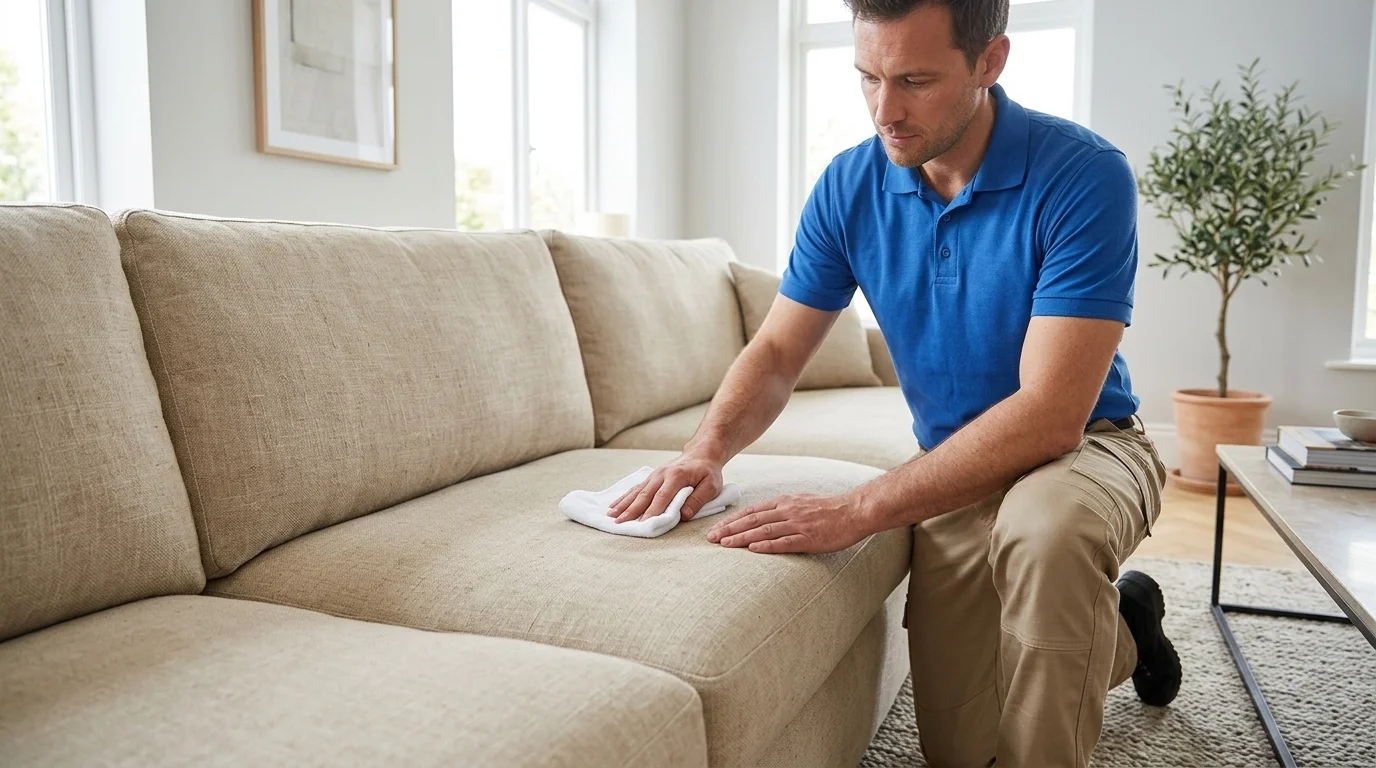
Linen sofas are everywhere right now. The natural texture, the warm neutral tones, the way the fabric softens and develops character over time — it's easy to see why linen has become one of the most searched upholstery materials in the US. Interior designers have been specifying it heavily since 2023, and close to half of all neutral-toned sofa sales in 2025 fell into the linen and linen-blend category. The problem is that the same open-weave fiber structure that gives linen its distinctive look is also what makes it the most watermark-prone upholstery fabric you can own.
One wrong move with a wet cloth — too much water, uneven coverage, letting it dry in direct sun — and you have a visible ring that's often harder to remove than the original stain. We've cleaned hundreds of linen sofas across the Seattle metro area, including a lot of them where a homeowner attempted DIY cleaning first and created a secondary problem. This guide covers everything you actually need to know: how to check what cleaning method is safe for your specific sofa, how to handle stains without leaving rings, and the point at which professional extraction is the right answer.
Before You Touch It: The Cleaning Code That Changes Everything
Every upholstered sofa sold in the US is legally required to carry a cleaning code tag. It's usually attached under a seat cushion, stitched to the dust cover on the frame's underside, or tucked into a zipper pocket on the cushion. On linen sofas specifically, this tag matters more than on most fabrics — because applying water to an S-coded linen piece causes the same kind of permanent damage as applying water to velvet: watermarks that don't come out.
| Code | What It Means | Safe for Linen | What to Avoid |
|---|---|---|---|
| W | Water-based cleaners only | Yes — use distilled water, low moisture | Solvent-based products, excessive water |
| S | Solvent-based cleaners only | No water of any kind | Any liquid, steam — permanent rings will form |
| WS | Water or solvent, either works | Yes — most flexible option | Bleach, aggressive scrubbing, over-wetting |
| X | Vacuum only, no liquid | Vacuum and dry brushing only | Any liquid, foam, or spray cleaner |
Most modern linen sofas from mainstream retailers — IKEA, Article, West Elm, Pottery Barn, Crate & Barrel — are coded W or WS. European and artisan-made pieces in pure or high-percentage linen (80% linen and above) are more often coded S, because undyed or minimally processed linen reacts badly to water. If your sofa's tag is missing and you don't have the original paperwork, test a cotton swab dampened with distilled water on the underside of a back cushion. If the fabric darkens and then dries leaving a faint ring, you have an S-code piece. If it dries evenly with no line, water cleaning is likely safe.
Why Linen Forms Watermarks — and the One Rule That Prevents Them
Watermarks on linen form for a specific and entirely preventable reason: water migrates outward as it evaporates, and it carries dissolved minerals, loosened soil, and fabric finish compounds with it. When that water evaporates fastest at the outer edge of the wet area — which it always does, because the edges dry first — it deposits everything it was carrying right at that boundary. That line is the watermark. On synthetic fabrics, this happens too, but the effect is subtle. On natural linen, which has a looser weave and higher mineral affinity, the ring is pronounced and immediately visible.
The rule that prevents watermarks: if you wet any part of a linen cushion, wet the entire panel. Not just the stain. The whole face of the cushion, or the whole armrest, or the whole seat — whatever surface the stained section is part of. When the entire fabric surface is uniformly damp and dries at the same rate, there's no dry-wet boundary for minerals to deposit at. This is why professional low-moisture extraction eliminates watermarks that home cleaning creates — the technician controls moisture across the full surface evenly, and extraction equipment removes the water before it has time to migrate.
How to Clean a Linen Sofa: Step-by-Step
This method works for W and WS coded linen sofas with general soiling, light stains, and odors. It's the approach we recommend to homeowners between professional cleanings — not as a substitute for periodic professional extraction, but as genuine maintenance that keeps linen looking good for years.
Before any moisture goes near linen, vacuum the entire sofa with an upholstery attachment. Linen's open weave traps dry soil, pet hair, and dust between fibers. If you apply liquid before vacuuming, that dry soil absorbs the moisture and turns into a harder, bonded stain. Remove seat cushions and vacuum beneath them, along the crevices, and along the back and arm panels. A 5-minute thorough vacuum session makes everything that follows easier.
One teaspoon of mild dish soap (fragrance-free, no bleach or brighteners) mixed into one cup of distilled water. For odors, skip the soap and use a 50/50 mix of distilled white vinegar and distilled water. Do not use undiluted vinegar on linen — the acidity can affect dye on some natural-fiber fabrics. Do not use baking soda as a paste for general cleaning — it works for odors as a dry application, but wet baking soda on linen leaves a powdery residue that's difficult to fully remove.
Dampen a clean white microfiber cloth with your solution — it should be damp, not dripping. Work section by section across the full panel you're cleaning, using light blotting pressure. On a seat cushion, cover the entire seat face. On an armrest, cover the entire top and front face. The goal is even coverage so the whole surface dries at the same rate. Never scrub. Linen's weave opens up under friction and the fibers abrade, leaving a fuzzy, damaged texture that's permanent.
After cleaning, go over the same area with a cloth dampened in plain distilled water to remove soap residue. Then blot with a dry towel to absorb as much moisture as possible. Direct a fan at the sofa on a low setting — not a heat gun, not a hair dryer, not direct sun through the window. The goal is slow, even evaporation. Full drying typically takes 2 to 4 hours on a standard linen sofa with good airflow. Sit on the sofa before it's fully dry and you'll compress the fibers in a way that leaves impressions as it dries.
Stain-by-Stain: What Actually Works on Linen
Linen behaves differently from synthetic upholstery for almost every stain type. The open weave means stains penetrate faster, but also means the right treatment reaches them more directly than on tightly woven polyester. Time is the biggest factor — a stain treated within the first two minutes has a very different prognosis than the same stain found an hour later.
Coffee and Tea
Blot immediately — don't add liquid yet. Get up as much of the liquid as possible with a dry white cloth before treating. Then apply the dish soap and distilled water solution to the full panel (not just the stain), blotting from the outside of the stain inward. Tannins in coffee and tea bond to linen fibers faster than to synthetic fabrics — a stain treated within 2 minutes is almost always fully removable. After 30 minutes, you're dealing with a set stain that may need professional pre-treatment chemistry.
Red Wine
Blot up as much liquid as possible first — don't dilute with water until you've absorbed the bulk of it, or you just spread the stain footprint. Once blotted, apply club soda or sparkling water and blot again — carbonation mechanically lifts pigment from linen fibers in a way that still water doesn't. Follow with the soap-and-distilled-water method across the full panel. A red wine stain on beige or natural linen that's been sitting for more than a few hours typically requires professional pre-treatment to remove fully without leaving a ghost stain.
Pet Urine
This is the stain type where DIY cleaning on linen most reliably creates a worse problem. Standard soap-and-water removes the visible stain and temporarily reduces odor, but uric acid crystals remain in the fiber and reactivate with humidity. Use an enzyme cleaner designed for upholstery — apply generously across the full affected area, let it dwell for 10 to 15 minutes, then blot and dry with a fan. If the urine soaked through to the cushion fill, the fill itself is contaminated and needs extraction equipment to reach — surface cleaning won't resolve the smell.
Body Oils and Armrest Grime
The gradual grey shadow on linen armrests and headrests is body oil accumulation — one of the most common linen sofa problems and one that water-based spot cleaning doesn't address well. Apply dry baking soda to the affected area, let it sit for 30 to 45 minutes, vacuum it off. The baking soda draws the surface oil before it bonds deeper. For set-in oil, a small amount of cornstarch works similarly. Avoid the water-based solution as a first step on oil — water and oil don't mix, and you push the oil deeper into the open weave before lifting any of it.
Grease and Food Stains
Start dry — baking soda or cornstarch applied generously, let sit for 20 minutes, then vacuum. This absorbs as much of the grease as possible before any liquid is introduced. Follow with the dish soap solution (dish soap is formulated to cut grease and it does the same job on upholstery fabric). Apply to the full panel, blot, rinse with distilled water, and dry with a fan. Skipping the dry absorption step and going straight to soap on greasy linen stains just spreads the oil into a larger area.
Ink and Marker
Rubbing alcohol on a white cotton ball, applied with a dabbing motion — not rubbing. Work from the outside edge of the stain inward, and move to a fresh section of the cotton ball frequently so you're not redepositing ink you've already lifted. Alcohol spreads on linen if you rub, so dab and lift only. For water-based markers on W-coded linen, the soap and water method works. Permanent marker on natural linen is borderline — the right move is to stop after a few attempts if it's not lifting, and call a professional before you set the stain further with more aggressive DIY attempts.
The Mistake That Ruins More Linen Sofas Than Any Stain Does
It's not the stain itself. It's the scrubbing that follows it. We see this consistently in linen cleaning calls — a homeowner had a spill, grabbed a cloth, and rubbed. The original stain might have been fully removable. The damaged fabric around it is not.
Linen's open weave is what makes it look the way it does. That same structure means the individual fibers are unsupported across small gaps, and friction breaks down those exposed fibers. On linen that's been rubbed, the surface becomes fuzzy — a "pilling" effect where broken fiber ends knot together. The fiber structure itself is degraded. You can see it in direct light as a textural change, a slightly different sheen in the rubbed area. No cleaning reverses this. The fabric has been physically damaged, not stained.
Blotting works because you're absorbing liquid out of the fiber without applying lateral force. The rule on linen is blot, lift, move to a clean section, blot again. If a stain isn't lifting after four or five blotting passes, more pressure won't fix it — you need a different approach or professional help. The pressure to "scrub harder" is the instinct to resist.
When Professional Cleaning Is the Right Answer for a Linen Sofa
Professional linen sofa cleaning in the Bothell and Seattle area typically costs between $120 and $200 for a standard two or three-seat sofa — less than a tenth of the replacement cost of most quality linen sofas, and a fraction of reupholstering. Knowing when that call is worth making early prevents situations where amateur cleaning makes the damage permanent.
Call Fresh Furnish Cleaners — or another qualified upholstery professional — when:
- You have a watermark that's been sitting for more than 48 hours. The mineral deposit hardens over time and hand cleaning typically spreads it rather than eliminating it. Professional low-moisture extraction with controlled even drying is the most reliable fix.
- The sofa is S-coded and has a stain that needs liquid treatment. You do not have the right tools for this at home — solvent-based upholstery cleaning requires specific products and proper ventilation that consumer products can't match.
- Pet urine has soaked through the cushion cover into the fill. Surface enzyme cleaning won't reach it.
- The fabric has a general dull, flat appearance despite regular vacuuming. This is accumulated body oils and embedded soil in the weave — the kind of cleaning that requires extraction, not surface treatment.
- You've already tried cleaning and the stain looks worse, or a new ring has appeared around the original stain. Stop. Let it dry. Call for an assessment before attempting another round that may set the stain further.
- The sofa is a high-value piece — artisan-made, antique, or natural undyed linen — where getting the chemistry wrong has significant cost implications.
Fresh Furnish Cleaners serves Bothell, Kirkland, Everett, Woodinville, and the greater Seattle area. Linen sofa cleaning appointments are typically available within the same week, and most standard W and WS coded pieces dry within 2 to 3 hours after professional extraction — meaning usable the same afternoon.
Maintaining a Linen Sofa Between Professional Cleanings
Linen ages better than most upholstery fabrics if it's maintained — the natural fiber softens and develops a worn-in quality that polyester never achieves. The maintenance that makes that happen is straightforward and mostly dry.
Vacuum weekly with an upholstery attachment, including the crevice between cushions and the back of the seat area. Dry soil ground into linen before it's vacuumed becomes a bonded stain when it eventually contacts moisture. A consistent vacuum schedule is the highest-return maintenance habit for linen upholstery.
Rotate cushions every month if they're reversible. Linen compresses and slightly discolors from concentrated use on one surface. Rotating spreads the wear evenly and extends the time between necessary professional cleanings.
Treat spills in the first two minutes. Keep a clean white cloth within reach. The difference between a spill blotted immediately and the same spill found an hour later is substantial on linen's open weave — immediate action and a dry blot is usually all that's needed for most liquid spills.
Apply a fabric protector after each professional cleaning while the fabric is still clean. Scotchgard or upholstery-specific protectors create a barrier that slows absorption and gives you more time to blot a spill before it penetrates the fiber. Applied to a clean surface right after professional extraction, the protector bonds more effectively than retail spray-on application to a sofa that hasn't been deep cleaned first.
Schedule professional cleaning every 12 to 18 months for a linen sofa in regular use. At that interval, the cleaning is routine maintenance and the results are dramatic — fresh, bright fabric that looks close to its original state. Beyond 18 months of daily use, the embedded soil and oil accumulation is significant enough that cleaning becomes more difficult and results less complete.
Professional Linen Sofa Cleaning — Bothell & Seattle Area
Watermark removal, stain treatment, odor elimination — done with low-moisture technique that protects natural linen fiber. Standard linen sofa cleaning from $120. Same-week appointments available across Bothell, Kirkland, Woodinville, Everett, and greater Seattle.
